
Septoplasty: deviated septum surgery
Medically reviewed by Dr. Iván Méndez-Benegassi Silva · Otorhinolaryngology (ENT) Specialist with over 25 years of experience in sleep surgery and advanced rhinology · European Board Certificate (ORL-HNS) · HM Hospitales, Madrid · License No. 282855946
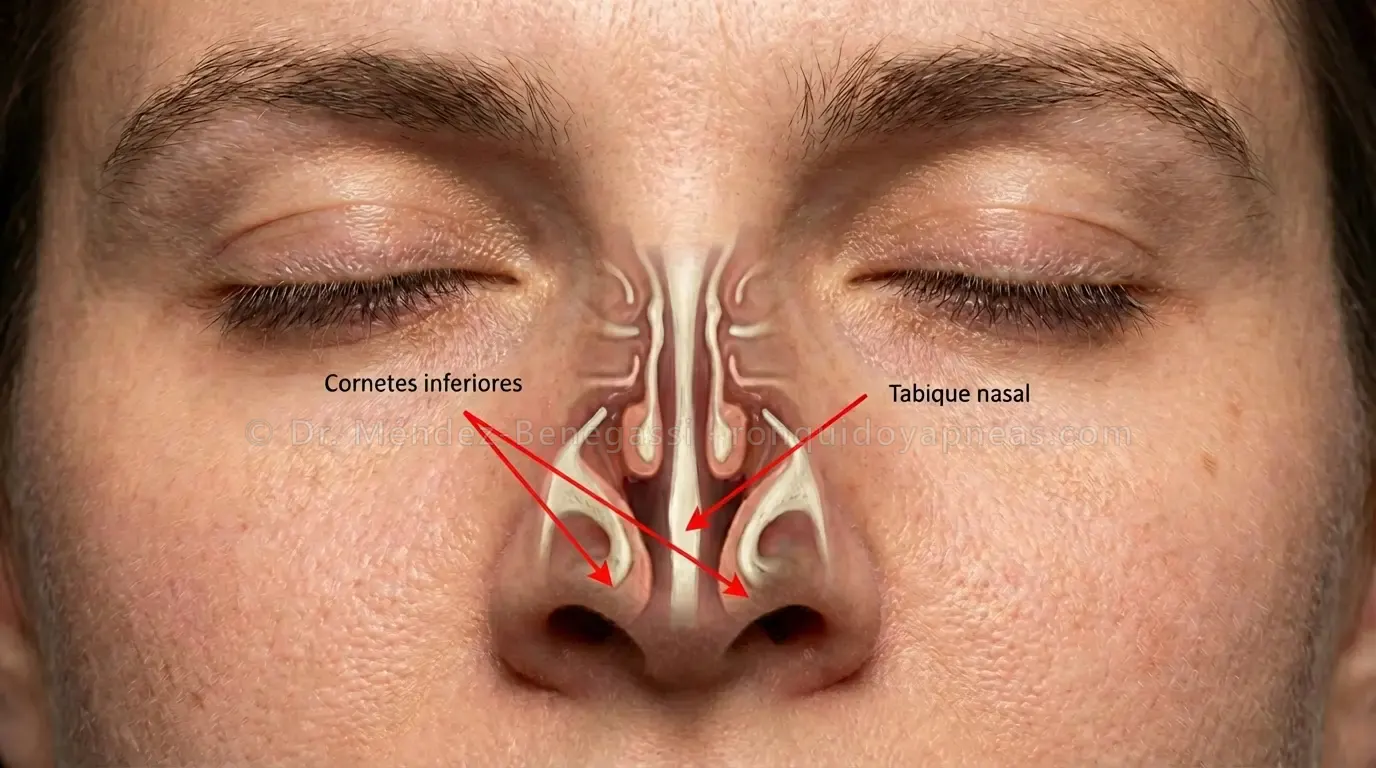
What is a septoplasty?
Septoplasty is the surgical procedure performed to straighten a deviated nasal septum (the internal wall of bone and cartilage dividing the nostrils). Its primary objective is functional: to restore unobstructed nasal airflow and improve breathing, without altering the external aesthetic shape of the nose and without external skin incisions.
Just the septum, or the outside of the nose too?
If your nose looks crooked, closes when you breathe in, has a hump or a dip on the bridge, or looks asymmetric, a septoplasty alone is not enough: what you need is a septorhinoplasty, which corrects the septum and the outside of the nose in the same operation [4][5].
Septoplasty at a glance
- Duration
- About 1 to 1½ hours [1]
- Anaesthesia
- Usually general; sometimes local [1][3]
- Hospital stay
- Most people go home the same day, a few hours after the anaesthetic [1][3]
- Packing or splints
- If packing is used, it comes out after 24-36 hours [2]; soft silicone splints are removed within 1-2 weeks [2][3]. Routine packing does not prevent bleeding and causes more discomfort [6]
- Time off work
- Between 1 and 2 weeks, depending on the job [2][3]
- Sport
- No strenuous exercise or contact sports for 2 weeks [3]
- Flying
- ENT UK advises not flying for 14 days [3]
- Breathing
- The nose can take up to 3 months to settle [3]
This is what the guidelines describe as usual; your surgeon will give you the instructions for your case.
How we operate on the septum
With a surgical microscope
Dr. Méndez-Benegassi performs septoplasty with a surgical microscope. It gives a magnified, well-lit view of the inside of the nose, which is used to see the back part of the septum and to work through small incisions, taking care of the lining of the nose (the mucosa).
Video: septoplasty with a microscope
In under two minutes (in Spanish): what the septum is, why a bent septum blocks the nose, how it is straightened from inside with no external scars and what the microscope is for. Then, images of the operation.
It contains real surgical images.
What if the nose is also crooked on the outside?
If besides the internal deviation there is an external deformity or nasal valve collapse, the entire structure is corrected to restore breathing without neglecting aesthetic harmony. It has its own page: functional septorhinoplasty (functional rhinoplasty).
No classic packing, in most cases
In most of our cases we do not use the classic gauze packing: the septum is held in place with stitches on the inside (internal suture) and, sometimes, with soft silicone splints for a few days. Routine packing after septoplasty does not prevent bleeding and causes more discomfort [6].
| Aspect | Classic technique | With a microscope (Dr. Méndez-Benegassi) |
|---|---|---|
| How the inside of the nose is seen | Headlight and speculum, without magnification | Surgical microscope: a magnified view, used to see the back part of the septum (bony spurs, vomer) |
| Packing | Gauze or sponge packing, removed after 24-36 hours [2] | No gauze packing in most cases: internal suture or soft silicone splints |
| First days | While the packing is in, you breathe through your mouth; packing causes more pain and worse sleep [6] | Without gauze packing: less pain and better sleep [6] |
Septoplasty and turbinates in the same operation
It is common for the septum and the turbinates to block the nose at the same time. In that case both can be treated in the same operation: the septum is straightened and the turbinates are reduced (turbinoplasty).
The two largest randomised trials of septoplasty (203 patients in the Netherlands and 378 in the United Kingdom) included turbinate reduction when needed. In both, the operation improved the blocked nose more than treatment without surgery [7][8]; in the Dutch trial the benefit was maintained at 2 years [7]. In the British trial, the improvement depended on how blocked the nose was at the start, not on whether the turbinates were also treated [8].
Is fixing the septum enough? How to tell which operation you need
| Feature | Functional Septoplasty | Functional Septorhinoplasty | Cosmetic Rhinoplasty |
|---|---|---|---|
| Primary Goal | Restore internal airflow | Airflow + external nasal valve support | Refine appearance and facial harmony |
| Structures Treated | Nasal septum (cartilage & bone) | Septum, nasal valve, lateral cartilages | Dorsal hump, nasal tip, bridge |
| External Scars & Splints | None (from inside the nose, no external splint) | Internal or columellar cut; external splint 1–2 wk | Closed or open approach; external splint 1–2 wk |
| More information | Current page | See Septorhinoplasty | See Ultrasonic Rhinoplasty |
Wondering whether to choose an ENT or a plastic surgeon?
Key differences in training, airway preservation, and nasal valve expertise explained in our clinical guide.
The septum, your breathing and apnea
A deviated septum — or a collapsing nasal valve — raises the resistance to airflow and pushes you towards mouth breathing during sleep. That feeds snoring, dries the throat and is one of the most common reasons patients cannot tolerate CPAP: the more nasal resistance at the start, the more likely CPAP is rejected [12].
Honest framing: straightening the septum does not by itself cure sleep apnea. In a randomised trial against sham surgery only 4 of 27 operated patients responded [11], and in a meta-analysis nasal surgery improved sleepiness but not the AHI significantly [10]. What it does is restore nasal breathing: in another meta-analysis the CPAP pressure needed dropped by about 2.7 cm H₂O and use of the machine increased [9]. It is the step that makes the rest of the treatment viable; to compare those options, see CPAP, oral appliance or surgery: how to choose, and for the whole picture, blocked nose, snoring and sleep apnea.
When the snoring also comes from the soft palate, the septoplasty can be combined in the same operation with a septal graft pharyngoplasty, which uses the cartilage removed from the septum to stiffen the palate. If the collapse is in the throat, a pharyngoplasty is considered.
References: Camacho et al., meta-analysis (Sleep, 2015) [9]; Ishii et al., meta-analysis (Otolaryngol Head Neck Surg, 2015) [10]; Koutsourelakis et al., randomised trial (Eur Respir J, 2008) [11]; Sugiura et al. (Respiration, 2007) [12].
When we recommend it
- A symptomatic deviated septum: persistent blocked nose, especially one-sided.
- Nasal valve collapse, where the side wall of the nose draws in on inspiration.
- Mouth breathing and nasal-origin snoring that disturb rest.
- Poor CPAP tolerance due to nasal obstruction, before optimising the device pressure.
When the deviation also involves the nasal valve or an external deformity, functional septorhinoplasty corrects the whole structure so that breathing — not just appearance — improves [13].
And if what bothers you is a small defect in the profile, such as a dip or an irregularity on the bridge, the cartilage removed from the septum can be used in the same operation as diced cartilage: we explain it in permanent rhinomodelling with your own cartilage.
To put a number on how blocked your nose feels, fill in the NOSE nasal obstruction questionnaire (five questions, two minutes) and bring the result to the consultation.
Recovery, time off work and risks
Most people go home the same day [1][3]. The nose may drain and bleed a little for 2 to 5 days [2], and it is normal to feel it blocked for several weeks because of the internal swelling; it can take up to three months to settle [3]. Avoid blowing your nose hard in the first days [2][3]. Most people return to work within 1 to 2 weeks [2][3]. When traditional packing is avoided, the postoperative course is more comfortable [6].
It is a well-established surgery, but like any operation it has possible risks: bleeding, septal haematoma, infection, adhesions, temporary nasal congestion, a small residual deviation or, rarely, a septal perforation or changes in smell [1][3]. It is common to feel numbness in the tip of the nose, the upper teeth or the lip; it usually settles with time [3]. We assess each case individually beforehand to minimise them and explain them honestly during the consultation.
Surgical procedures are scheduled with full safety guarantees at Hospital Universitario Rey Juan Carlos and at HM Hospitales.
Frequently asked questions
How long does septoplasty take?
Around one to one and a half hours. Most people go home the same day, a few hours after the operation.
What anaesthesia is used?
Usually general anaesthesia: you will be asleep and pain-free. Some people have it under local anaesthesia. Your surgeon will tell you which one in your case.
Will I have nasal packing afterwards?
In most of our cases, no. With internal suture techniques, we usually avoid the uncomfortable traditional packing. Small soft silicone splints may sometimes be left for a few days to protect the septum, but they are better tolerated than classic gauze packing.
How many days of recovery or sick leave will I need?
Between one and two weeks, depending on your job. The nose feels blocked at first because of the internal swelling, and it can take up to three months to settle completely.
When can I exercise?
For the first two weeks it is best to avoid strenuous exercise and heavy lifting, and not to play contact sports. Your surgeon will tell you when to resume.
Can I fly after a septoplasty?
ENT UK advises not flying for 14 days after the operation. If you have a trip planned, mention it before setting the date.
Can I wear glasses?
Generally yes. A septoplasty is done from inside and does not touch the bones on the outside of the nose, where glasses rest. If outer bones or cartilage are also moved, an external splint is worn for 1-2 weeks: ask your surgeon when you can rest them on your nose again.
Is it covered by my health insurance?
It depends on your policy. Check with your insurer whether it covers the operation and whether prior authorisation is needed. If a change in the shape of the nose is also wanted, ask about that part separately.
Will it improve my snoring or help me tolerate CPAP?
Straightening the septum does not by itself cure sleep apnea, but it restores nasal breathing. That usually reduces nasal-origin snoring and often allows a lower CPAP pressure and a better tolerance of CPAP or the mandibular advancement device. It is the step that makes the rest of the treatment viable.
Will it change the shape of my nose?
A pure functional septoplasty works inside the nose and does not change its external appearance. If there is also an external deformity or nasal valve collapse, a functional septorhinoplasty corrects the whole structure: the priority remains breathing, and any change in shape is discussed beforehand and aimed at natural harmony, not a purely cosmetic result.
What are the risks?
It is a well-established surgery, but like any operation it has possible risks: bleeding, infection, temporary nasal congestion, a small residual deviation or, rarely, a septal perforation or changes in smell. We assess each case individually beforehand to minimise them and explain them honestly during the consultation.
Where does Dr. Méndez-Benegassi consult and operate for septoplasty in Madrid?
Dr. Méndez-Benegassi provides in-person septoplasty consultations in Madrid across three HM Hospitales centers: HM Madrid University Hospital (Chamberí), HM Valdebebas Polyclinic (Hortaleza), and HM Tres Cantos University Hospital, as well as via video consultation. Surgical procedures are scheduled in fully equipped hospital operating theaters with high-resolution optical microscopy and complete general anaesthesia safety guarantees.
Take the next step in your evaluation
Dr. Méndez-Benegassi uses your data to answer your message. Email is not end-to-end encrypted: it can be read on the servers it passes through. Do not send medical reports or health data that way.
Data controller: Dr. Iván Méndez-Benegassi Silva, ENT physician.
Purpose: To read and answer your message. Tell us only what is essential; the rest is covered in the consultation.
Legal basis: The healthcare you are requesting (Art. 9.2.h GDPR).
Recipients: Your data is not shared with third parties; only the technical providers needed are involved, as data processors.
Your rights: Access, rectify or erase your data, object, restrict its processing and request its portability by writing to contacto@ronquidoyapneas.com. You may also lodge a complaint with the Spanish Data Protection Agency.
Full details in the Privacy policy.
References
- MedlinePlus. Septoplasty (2025). medlineplus.gov/ency/article/003012.htm
- MedlinePlus. Septoplasty - discharge (2025). medlineplus.gov/ency/patientinstructions/000246.htm
- ENT UK. Septal surgery (2022). www.entuk.org/patients/conditions/62/septoplasty_new
- ENT UK. Septorhinoplasty (2022). www.entuk.org/patients/conditions/61/septorhinoplasty/
- MedlinePlus. Rhinoplasty (2025). medlineplus.gov/ency/article/002983.htm
- Titirungruang y cols., revisión sistemática y metaanálisis (47 estudios). Rhinology, 2021. PMID 34350430. doi.org/10.4193/Rhin21.057
- van Egmond y cols., ensayo aleatorizado (203 pacientes). Lancet, 2019. PMID 31227374. doi.org/10.1016/S0140-6736(19)30354-X
- Carrie y cols., ensayo aleatorizado NAIROS (378 pacientes). Health Technol Assess, 2024. PMID 38477237. doi.org/10.3310/MVFR4028
- Camacho y cols., revisión sistemática y metaanálisis. Sleep, 2015. PMID 25325439. doi.org/10.5665/sleep.4414
- Ishii y cols., metaanálisis. Otolaryngol Head Neck Surg, 2015. PMID 26183522. doi.org/10.1177/0194599815594374
- Koutsourelakis y cols., ensayo aleatorizado. Eur Respir J, 2008. PMID 17898015. doi.org/10.1183/09031936.00087607
- Sugiura y cols. (77 pacientes). Respiration, 2007. PMID 16299414. doi.org/10.1159/000089836
- Rhee y cols., consenso de expertos sobre la válvula nasal. Otolaryngol Head Neck Surg, 2010. PMID 20620619. doi.org/10.1016/j.otohns.2010.04.019
Where I see patients in Madrid
I see patients in person at my HM Hospitales clinics (HM Madrid, HM Valdebebas and HM Tres Cantos), or by personalized video consultation if you prefer.
Private consultation, no waiting lists
Call the appointments line: you get your appointment during the same call, at any of my three clinics.
Call · 910 786 601- HM Madrid
Wednesdays 3:00 PM - 4:00 PM - HM Valdebebas
Tuesdays 3:00 PM - 4:00 PM - HM Tres Cantos
Tuesdays 1:30 PM - 2:30 PM
€150, paid at the reception desk of the clinic. It is not processed through insurance, except for reimbursement insurance.
Coming with your health insurance? Book with HM: 919 370 000.
HM Madrid
HM Madrid University Hospital
Pl. del Conde del Valle de Súchil, 16
28015 MadridWith insurance (book with HM): Wednesdays 4:00 PM - 7:00 PM
How to get thereHM Valdebebas
HM Valdebebas Polyclinic
Av. de Juan Antonio Samaranch, 51
28055 MadridWith insurance (book with HM): Tuesdays 4:00 PM - 7:00 PM
How to get thereHM Tres Cantos
HM Tres Cantos University Hospital
C. Santiago Ramón y Cajal, 23
28760 Tres CantosWith insurance (book with HM): Tuesdays and Wednesdays 9:30 AM - 1:30 PM
How to get there