
Turbinoplasty: turbinate reduction surgery with coblation and radiofrequency
Medically reviewed by Dr. Iván Méndez-Benegassi Silva · Otorhinolaryngology (ENT) Specialist with over 25 years of experience in sleep surgery and advanced rhinology · European Board Certificate (ORL-HNS) · HM Hospitales, Madrid · License No. 282855946
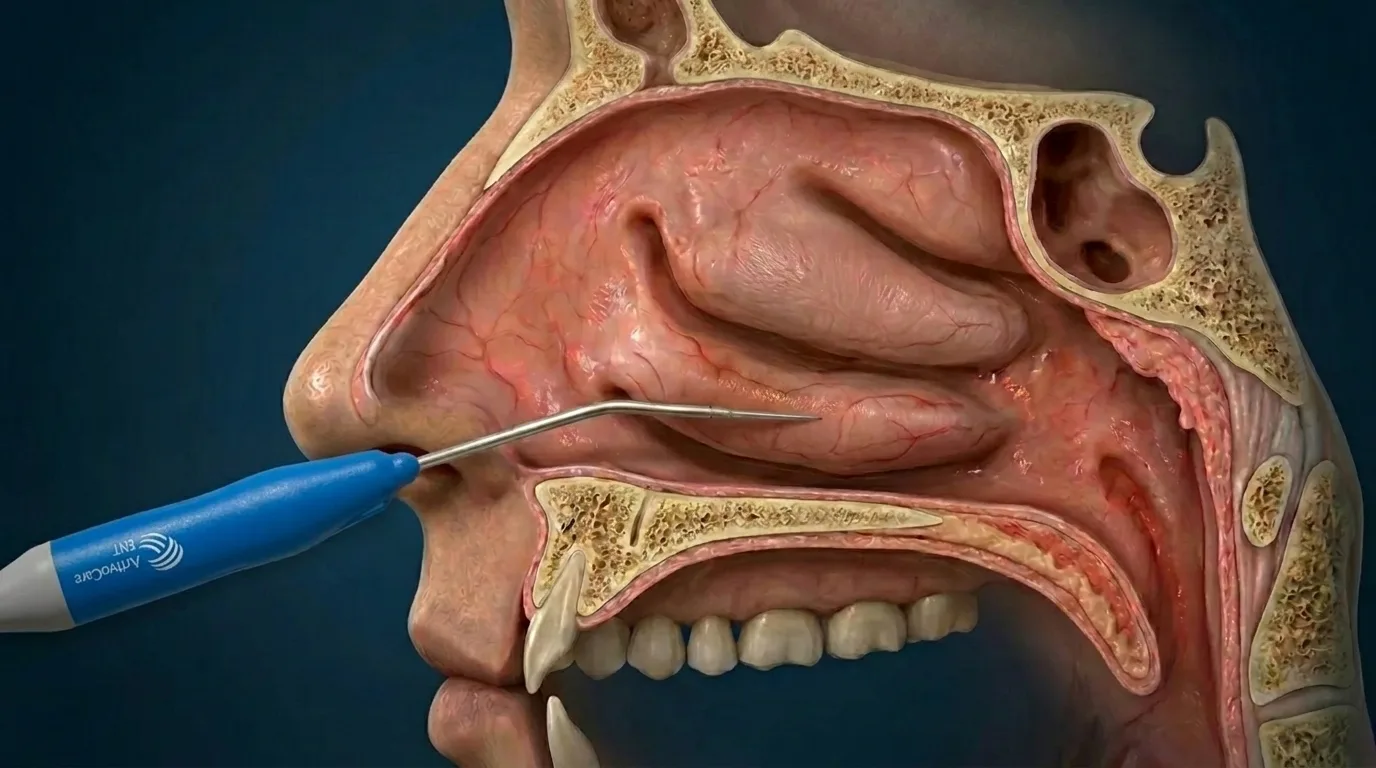
Turbinoplasty is the operation to breathe better through the nose when enlarged turbinates block it. It is done from inside the nose, with no external cuts, and it does not remove them: it reduces their volume and aims to preserve the lining, the layer that warms and humidifies the air. It is also called "turbinate reduction"; the problem itself is called turbinate hypertrophy. It is not the same as a turbinectomy, which does remove part of the tissue.
Symptoms of enlarged turbinates
- A blocked nose almost every day, sometimes switching sides, and worse when lying down.
- Breathing through the mouth at night and waking up with a dry mouth.
- Snoring: people with nasal symptoms on 5 or more nights a month snore habitually more often [3].
- Depending on a decongestant spray, which, used for many days in a row, causes a rebound effect.
A deviated septum or polyps cause similar symptoms. That is why the nose has to be examined with an endoscope before deciding. To put a number on how blocked it feels, fill in the NOSE questionnaire; how the nose relates to snoring and apnea is explained in the guide blocked nose, snoring and sleep apnea.
Our Technologies
Coblation (Plasma Ablation)
This technology uses radiofrequency energy to reduce the tissue inside the turbinate at low temperature. Unlike laser or cautery, it does not burn the surface, which results in gentle healing and a postoperative period with few discomforts [7][8].
Radiofrequency
Controlled energy is applied to make the inner tissue of the turbinate retract as it heals, gradually and durably increasing the space available for air [10][13].
Advantages
Day-case procedure, under local or general anaesthesia depending on the case [1], with a quick recovery that allows resuming daily activities within a few days.
Turbinoplasty, turbinectomy, radiofrequency and coblation: differences
"Turbinoplasty" is the general name for the techniques that reduce the turbinate while preserving its surface. Radiofrequency and coblation are two ways of doing it.
Microdebrider turbinoplasty
- What is done:
- Removes tissue from the inside, respecting the surface
- Is tissue removed?
- Yes, only from the inside
- Recovery:
- A few days of discomfort [2][7]
- Crusting:
- Somewhat more than with radiofrequency or coblation [4][9]
Turbinectomy
- What is done:
- Cuts away part of the turbinate with its lining
- Is tissue removed?
- Yes, including the surface
- Recovery:
- Longer, with more bleeding [5][6]
- Crusting:
- More frequent [4][5]
Radiofrequency
- What is done:
- A probe heats the inside; as it heals, the turbinate shrinks
- Is tissue removed?
- No
- Recovery:
- Short; local anaesthetic, no packing [10]
- Crusting:
- Few [10][11]
Coblation
- What is done:
- Low-temperature radiofrequency that reduces the inner tissue
- Is tissue removed?
- No
- Recovery:
- Short; less pain than with microdebrider or cautery [7][8]
- Crusting:
- Few [8][9]
No technique is best for everyone. Those that remove more tissue open the nose more [12], but with a higher risk of bleeding [6]. The gentler ones recover sooner, but may last less if the allergy remains uncontrolled [13].
Why enlarged turbinates affect your sleep
When the turbinates swell (typically from allergy or chronic rhinitis), they raise the resistance to airflow and force you to breathe through the mouth at night. Mouth breathing worsens snoring, dries the throat and, crucially, undermines CPAP: it causes mask leaks, demands higher pressure and makes the therapy uncomfortable.
Honest framing: reducing the turbinates does not by itself cure sleep apnea. It clears the nasal airway, which usually lets us lower the CPAP pressure and improves tolerance of CPAP or the mandibular advancement device [19] — an enabling step, not a stand-alone cure.
If you have given up on CPAP, the guide CPAP intolerance: what real alternatives do I have? reviews the options; to compare the three main paths, see CPAP, oral appliance or surgery: how to choose.
If you use CPAP or an oral appliance and your nose is blocked
- CPAP: the higher the nasal resistance at the start, the more likely people were to reject it [14]. In addition, with a blocked nose it is common to switch to a nose-and-mouth mask, which is associated with higher pressure and fewer hours of use than a nasal mask [15].
- Mandibular advancement device: it works by breathing through the nose with the mouth closed. Higher nasal resistance was associated with a poorer response [16].
- What to do: tell your sleep doctor. First, medical treatment. If that is not enough, consider reducing the turbinates. Afterwards, review the CPAP pressure or the fit of the appliance with your sleep unit; your doctor will tell you when.
Who benefits most
- Persistent nasal congestion from allergic or chronic rhinitis that does not respond to medication.
- Nighttime mouth breathing and nasal-origin snoring.
- Poor CPAP tolerance because of a blocked nose (leaks, high pressure, dryness).
- As a first step before, or alongside, septoplasty when both the septum and turbinates obstruct.
Because coblation works at low temperature it preserves the turbinate’s job of warming and humidifying air, with less crusting than more aggressive heat techniques [8].
When a septoplasty is also needed and the snoring comes from the soft palate, the cartilage removed from the septum can stiffen the palate in the same operation: that is the septal graft pharyngoplasty. If the septum is also deviated, see septoplasty and turbinates in the same operation.
When it is not indicated
- If the obstruction comes mainly from another cause: the septum, polyps or a nasal valve that closes when you breathe in (functional septorhinoplasty).
- If a proper course of medical treatment has not been tried first (see chronic rhinitis and snoring).
- If the nose is blocked by overuse of decongestant sprays: those must be stopped first.
- If the turbinates have already been operated on and there is dryness or crusting: removing more tissue can make it worse [1].
Scientific Evidence & Clinical Results
CPAP Compliance & Pressure Reduction
Nasal surgery (septoplasty and turbinoplasty) can act as a "rescue" for patients who cannot tolerate CPAP. By clearing the nasal airway it lowers resistance and, in a meta-analysis, reduced the required therapeutic CPAP pressure by about 2.7 cm H₂O on average; in the studies that measured it with the machine, use rose from 3.0 to 5.5 hours per night [19].
References: Camacho et al., systematic review & meta-analysis (Sleep, 2015) [19]; Bican et al. (J Craniofac Surg, 2010) [23].
Improved Sleep Quality & Energy
Many patients report better sleep quality, less snoring and less daytime sleepiness. Studies of isolated nasal surgery show improvement in the Epworth Sleepiness Scale and in quality-of-life scores, even when the AHI does not change significantly [21][22].
References: Li et al. (Arch Otolaryngol Head Neck Surg, 2008) [22]; Ishii et al., meta-analysis (Otolaryngol Head Neck Surg, 2015) [21].
Role in Apnea: A Crucial Facilitator
Nasal surgery alone rarely eliminates moderate or severe sleep apnea, because the collapse usually happens lower down, in the pharynx. In a randomised trial against sham surgery, septoplasty resolved the apnea in only 4 of 27 patients [20]. Its real value is as an enabler: it makes CPAP more comfortable, reduces mask leaks and helps the mandibular advancement device (MAD) work [16][19].
References: Koutsourelakis et al., randomised controlled trial (Eur Respir J, 2008) [20].
Before and after the operation
- Duration
- About 30 minutes [1]
- Anaesthesia
- Local (the nose is numbed) or general [1]; your surgeon will tell you which one in your case
- Discharge
- The same day [2]
- Discomfort
- Mild, 2-3 days, with ordinary painkillers [2][11]
- Nose more blocked at first
- Like a heavy cold, for 10-14 days [1]
- Mucus with a little blood
- Normal for up to about 2 weeks [1]
- No nose blowing
- 1 week; sneeze with your mouth open [1]
- Work
- At least 2 days of rest; 1 week if you lift heavy loads [1]
- Saline rinses
- You may be asked to use them [1]. After radiofrequency, a trial found they did not improve blockage or crusting; they only reduced itching and sneezing between days 5 and 7 [18]
- Sport and first check-up
- Your surgical team will tell you when
- Result
- Gradual: usually noticeable around the first month and keeps improving over the following months [10][17]
This is what is usual; your surgeon will give you the instructions for your case.
Risks and complications
- Bleeding: Some bleeding is very common after any nasal surgery [1]. In one coblation series, 2 of 24 patients had a nosebleed afterwards [17].
- Crusting: Less with coblation than with more aggressive heat techniques [8], and more with turbinectomy [4].
- Dryness: Usually temporary. If too much tissue is removed, the so-called "empty nose syndrome" can rarely appear [1].
- Adhesions (synechiae): Bridges of scar tissue between the turbinate and the septum. They are relatively uncommon [1], and less so with coblation [6].
- Relapse: With radiofrequency, about 8 out of 10 patients had not relapsed at 3 years. Allergic patients relapsed more [13].
Your specialist will assess your case and explain the expected course before deciding.
Frequently asked questions
What are the turbinates and why do they become hypertrophic?
The turbinates are small structures inside the nose covered with mucosa that warm and humidify the air we breathe. They become hypertrophic (excessively enlarged) when chronic inflammation keeps them swollen, most often due to allergic or chronic rhinitis, environmental irritants or constant congestion. Once enlarged they block airflow and cause a permanently blocked nose.
What is recovery after a turbinoplasty like?
It is usually a day-case procedure: you go home the same day. For the first days the nose feels blocked, like a heavy cold, and it is normal to have some crusting or a little blood-tinged mucus while the lining heals. Most people return to their daily activities within a few days; if your job involves heavy lifting, a week off is usually advised.
Do the turbinates grow back?
Turbinate reduction aims to be lasting, and many patients keep an open nose for years. However, the turbinate is not removed but reduced while preserving its function, so if the underlying cause persists (uncontrolled allergy, chronic rhinitis), the mucosa can swell again over time. Controlling that cause is key to keeping the result.
Is turbinoplasty the same as "turbinate surgery"?
Yes. Turbinoplasty is the medical name; "turbinate surgery" or "turbinate reduction" are everyday names for the same thing. In all of them the aim is to reduce the volume of swollen turbinates to clear the nose, not to remove them. What changes between techniques is the energy or instrument used: coblation works at low temperature and does not burn the tissue, unlike cautery or laser.
What is coblation (radiofrequency)?
Coblation is a technique that uses radiofrequency energy to reduce the tissue inside the turbinate at low temperature. Unlike laser or cautery, it does not burn the surface, so healing tends to be gentle and the postoperative period usually comes with few discomforts. The turbinate shrinks and there is more room for air while its lining is preserved.
Does it improve a constantly blocked nose and snoring?
Yes, when the obstruction comes from the turbinates: clearing the nasal airway tends to relieve the constant blocked-nose sensation and reduce nasal-origin snoring and night-time mouth breathing. Honestly, reducing the turbinates does not by itself cure sleep apnea; it is a facilitating step that improves nasal breathing and the tolerance of CPAP or a mandibular advancement device.
What is the difference between turbinoplasty and turbinectomy?
Turbinoplasty reduces the turbinate from the inside and preserves its lining. Turbinectomy removes part of the turbinate together with its lining: it bleeds more, causes more crusting and, if too much is removed, can dry out the nose.
When will I notice the result of turbinate surgery?
During the first days the nose may feel more blocked. The improvement comes gradually: it is usually noticeable around the first month and keeps improving over the following months.
Will I still need my CPAP or oral appliance?
Usually yes. Turbinate surgery does not cure sleep apnea, but it often makes CPAP or the oral appliance more comfortable. Afterwards it is worth reviewing the pressure or the fitting with your sleep unit.
Take the next step in your evaluation
Dr. Méndez-Benegassi uses your data to answer your message. Email is not end-to-end encrypted: it can be read on the servers it passes through. Do not send medical reports or health data that way.
Data controller: Dr. Iván Méndez-Benegassi Silva, ENT physician.
Purpose: To read and answer your message. Tell us only what is essential; the rest is covered in the consultation.
Legal basis: The healthcare you are requesting (Art. 9.2.h GDPR).
Recipients: Your data is not shared with third parties; only the technical providers needed are involved, as data processors.
Your rights: Access, rectify or erase your data, object, restrict its processing and request its portability by writing to contacto@ronquidoyapneas.com. You may also lodge a complaint with the Spanish Data Protection Agency.
Full details in the Privacy policy.
References
- ENT UK. Turbinoplasty or surgery to the inferior turbinates (2024). www.entuk.org/patients/conditions/91/turbinoplasty_or_surgery_to_the_inferior_turbinates/
- MedlinePlus. Turbinate surgery (2024). medlineplus.gov/ency/article/007563.htm
- Young T, Finn L, Kim H. J Allergy Clin Immunol, 1997. doi.org/10.1016/s0091-6749(97)70124-6
- Sinno y cols., revisión sistemática. Plast Reconstr Surg, 2016. doi.org/10.1097/PRS.0000000000002433
- Abdullah B, Singh S., revisión. Int J Environ Res Public Health, 2021. doi.org/10.3390/ijerph18073441
- Kim y cols., metaanálisis en red. Eur Arch Otorhinolaryngol, 2025. doi.org/10.1007/s00405-025-09774-2
- Hegazy y cols., ensayo aleatorizado. Rhinology, 2014. doi.org/10.4193/Rhino13.183
- Shah y cols. Ann Otol Rhinol Laryngol, 2015. doi.org/10.1177/0003489415578709
- El-Sisi y cols., ensayo aleatorizado. Am J Rhinol Allergy, 2023. doi.org/10.1177/19458924231185727
- Cavaliere y cols. Otolaryngol Head Neck Surg, 2005. doi.org/10.1016/j.otohns.2005.08.006
- Li KK, Powell NB y cols. Otolaryngol Head Neck Surg, 1998. doi.org/10.1016/S0194-5998(98)70013-0
- Lee JY, Lee JD, ensayo aleatorizado. Laryngoscope, 2006. doi.org/10.1097/01.mlg.0000205140.44181.45
- De Corso y cols. (305 pacientes). Acta Otorhinolaryngol Ital, 2016. doi.org/10.14639/0392-100X-964
- Sugiura y cols. (77 pacientes). Respiration, 2007. doi.org/10.1159/000089836
- Chen y cols., metaanálisis en red (29 estudios). J Sleep Res, 2022. doi.org/10.1111/jsr.13686
- Zeng y cols. Sleep, 2008. doi.org/10.1093/sleep/31.4.543
- Bhattacharyya N, Kepnes LJ. Otolaryngol Head Neck Surg, 2003. PMID 14574290. pubmed.ncbi.nlm.nih.gov/14574290/
- Hirunwiwatkul P, Udomchotphruet P., ensayo aleatorizado. Am J Rhinol Allergy, 2012. doi.org/10.2500/ajra.2012.26.3826
- Camacho y cols., revisión sistemática y metaanálisis. Sleep, 2015. doi.org/10.5665/sleep.4414
- Koutsourelakis y cols., ensayo aleatorizado. Eur Respir J, 2008. doi.org/10.1183/09031936.00087607
- Ishii y cols., metaanálisis. Otolaryngol Head Neck Surg, 2015. doi.org/10.1177/0194599815594374
- Li HY y cols. Arch Otolaryngol Head Neck Surg, 2008. doi.org/10.1001/archotol.134.4.429
- Bican y cols. J Craniofac Surg, 2010. doi.org/10.1097/SCS.0b013e3181f40551

Where I see patients in Madrid
I see patients in person at my HM Hospitales clinics (HM Madrid, HM Valdebebas and HM Tres Cantos), or by personalized video consultation if you prefer.
Private consultation, no waiting lists
Call the appointments line: you get your appointment during the same call, at any of my three clinics.
Call · 910 786 601- HM Madrid
Wednesdays 3:00 PM - 4:00 PM - HM Valdebebas
Tuesdays 3:00 PM - 4:00 PM - HM Tres Cantos
Tuesdays 1:30 PM - 2:30 PM
€150, paid at the reception desk of the clinic. It is not processed through insurance, except for reimbursement insurance.
Coming with your health insurance? Book with HM: 919 370 000.
HM Madrid
HM Madrid University Hospital
Pl. del Conde del Valle de Súchil, 16
28015 MadridWith insurance (book with HM): Wednesdays 4:00 PM - 7:00 PM
How to get thereHM Valdebebas
HM Valdebebas Polyclinic
Av. de Juan Antonio Samaranch, 51
28055 MadridWith insurance (book with HM): Tuesdays 4:00 PM - 7:00 PM
How to get thereHM Tres Cantos
HM Tres Cantos University Hospital
C. Santiago Ramón y Cajal, 23
28760 Tres CantosWith insurance (book with HM): Tuesdays and Wednesdays 9:30 AM - 1:30 PM
How to get there