
Types of snoring by anatomical origin
Reviewed by Dr. Iván Méndez-Benegassi Silva · Otorhinolaryngology (ENT) Specialist with over 25 years of experience in sleep surgery and advanced rhinology · European Board Certificate (ORL-HNS) · HM Hospitales · Last reviewed: 20 Jun 2026
Snoring is classified by where the airway vibrates or collapses: nasal, palatal (velum), oropharyngeal (lateral walls), tongue base (lingual) and epiglottic/laryngeal. Some studies link the pitch of snoring with the part that vibrates, but the sound alone does not reliably tell where it comes from: the site is confirmed by an ENT examination and, when indicated, a DISE.
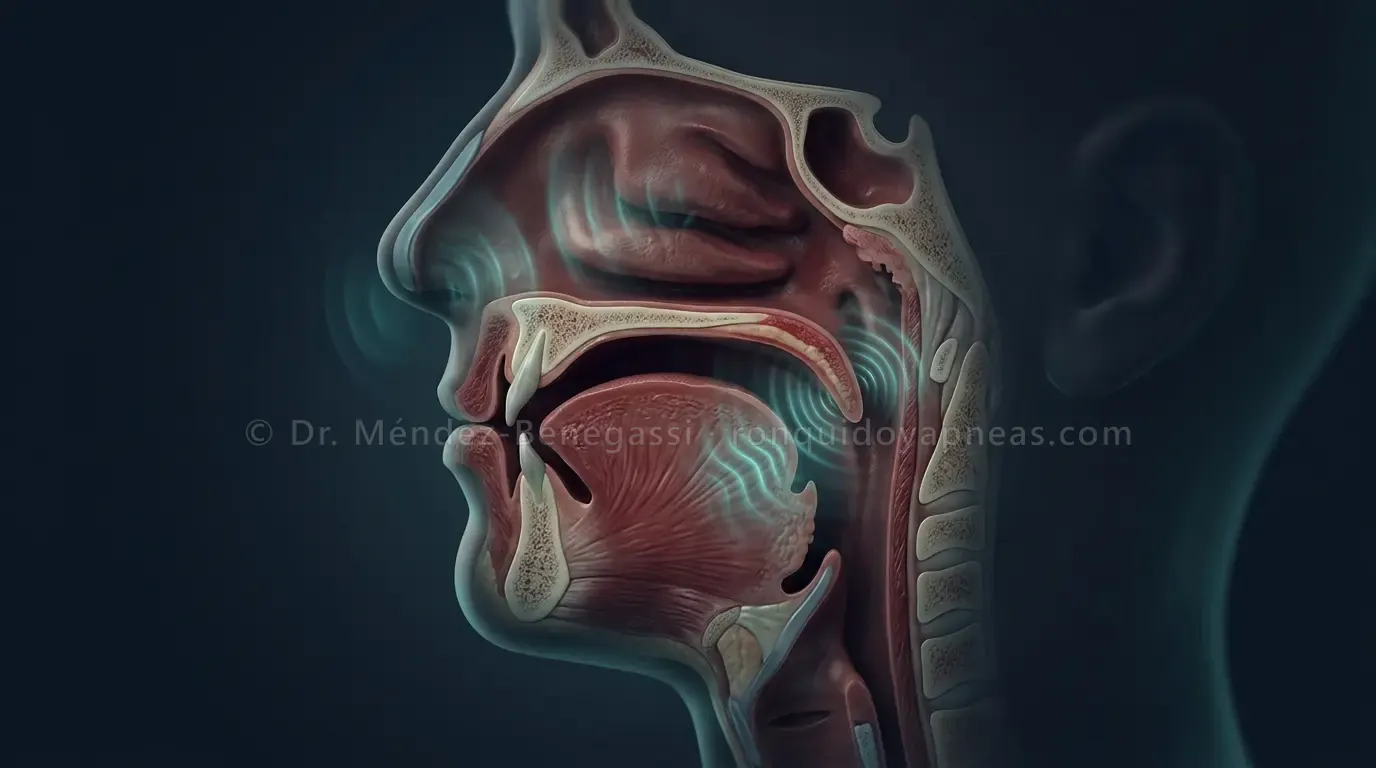
Snoring types at a glance
| Origin | Characteristic sound | Frequency | Typical treatment |
|---|---|---|---|
| Soft palate / Velopharyngeal (velum) | Low-pitched, rhythmic, tonal | ~80–300 Hz (low band) | Positional therapy, weight loss, intraoral devices, palatopharyngeal surgery |
| Oropharyngeal (lateral walls) | Mixed and variable | ~300–850 Hz (mid band) | Assess tonsillar hypertrophy, pharyngoplasty |
| Tongue base / Lingual | Noise-like, turbulent, deep low-pitched | >850 Hz, scattered energy (high band) | Mandibular advancement device (MAD), myofunctional exercises, genioglossus advancement, hypoglossal implant (Nyxoah) |
| Epiglottic / Laryngeal | Trapdoor-type collapse, very low frequency | Very low frequency, atypical pattern | Underdiagnosed cause of CPAP failure; requires DISE (sleep endoscopy) to confirm |
Frequency bands are orientative and aligned with the VOTE model of upper-airway collapse (Velum, Oropharynx, Tongue base, Epiglottis).
Each origin, explained
Nasal snoring
When airflow is obstructed at the nose (deviated septum, enlarged turbinates, rhinitis or polyps), air becomes turbulent before it even reaches the throat. Pure nasal snoring is often softer and may improve with nasal treatment, but a blocked nose also worsens vibration further down the airway and reduces CPAP tolerance.
Palatal / velopharyngeal snoring (soft palate)
This is the classic snore: a low-pitched, rhythmic, tonal sound produced when the soft palate and uvula flutter as you breathe. It is the most common origin of simple snoring. Because the vibrating tissue is accessible, it often responds to positional therapy, weight loss, intraoral devices or palatopharyngeal surgery.
The general measures (weight, alcohol, sleeping on your side) are explained in how to stop snoring.
Oropharyngeal snoring (lateral walls)
Here the lateral pharyngeal walls collapse inward, often with the tonsils playing a role. The sound is more mixed and variable, sitting in the mid-frequency band. Enlarged tonsils should be assessed, and pharyngoplasty techniques that reposition and tighten the lateral walls can be effective when they are the main collapse site.
Tongue base / lingual snoring
When the back of the tongue falls toward the throat, the sound becomes more like turbulent noise with energy spread into higher frequencies. This origin is more frequently associated with obstructive sleep apnea. Useful options include a mandibular advancement device, myofunctional therapy, genioglossus advancement, and hypoglossal nerve stimulation.
When there is also apnea and CPAP does not work out, the implant is compared with the machine in hypoglossal nerve implant vs CPAP.
Epiglottic / laryngeal collapse
The epiglottis can fold back over the airway in a "trapdoor" mechanism, producing a very low-frequency, atypical pattern. It is an underdiagnosed cause of CPAP failure and cannot be reliably identified from sound alone: a DISE (drug-induced sleep endoscopy) is needed to confirm it and to plan the right treatment.
Measure the sound of YOUR snoring
Our acoustic analyzer measures on your own device how long your snoring sounds, its relative loudness and prolonged sound pauses (free, and the audio is not uploaded). It does not tell where the snoring comes from: that is assessed at the consultation.
Open the AI snore analyzerFrequently asked questions
What type of snoring is most dangerous?
Snoring originating at the tongue base or epiglottis (laryngeal level) is the most concerning, because it is more often associated with obstructive sleep apnea and with CPAP failure. However, the loudness of a snore does not reliably predict danger: a quiet snore can still hide significant apnea. Only a sleep study can confirm whether apnea is present.
Does loud snoring mean sleep apnea?
Not necessarily. Loudness reflects how much tissue vibrates, not how severely the airway closes. Some people snore loudly with little or no apnea (simple snoring), while others have quiet breathing pauses that are dangerous. Volume is a clue, not a diagnosis: a validated sleep study is required to confirm apnea.
Can the origin of snoring be estimated at home?
Not reliably. Some studies link the pitch of snoring with the part that vibrates, but a review of 28 studies concluded that, so far, snoring sound analysis does not seem to be a viable test to choose treatment (Huang et al., Sleep Med 2021). Our snore analyzer measures on your own phone the time with sound, the relative loudness and prolonged sound pauses, but it does not tell where the snoring comes from. The collapse site is confirmed by an ENT evaluation and, when indicated, a DISE (sleep endoscopy).
What is the difference between palatal and tongue-base snoring?
Palatal (velopharyngeal) snoring tends to be lower-pitched, tonal and rhythmic, produced by vibration of the soft palate and uvula. Tongue-base (lingual) snoring tends to sound more like turbulent noise with energy spread into higher frequencies, and is more frequently linked to apnea. The distinction matters because the effective treatments differ.
Why does CPAP sometimes fail in snorers?
One underdiagnosed reason is epiglottic collapse, where the epiglottis folds back over the airway (a "trapdoor" mechanism). This pattern may not respond well to CPAP and often requires a DISE (drug-induced sleep endoscopy) to be identified, so that treatment can be tailored to the real obstruction site.
Does the type of snoring change the treatment?
Yes. Identifying where the airway vibrates guides therapy: palatal snoring may respond to positional therapy, weight loss or palatopharyngeal surgery; tongue-base snoring to a mandibular advancement device, myofunctional therapy or hypoglossal stimulation; and epiglottic collapse needs confirmation by DISE first. That is why it matters to know where it vibrates, which is confirmed by an ENT examination and, when indicated, a DISE.
This guide is for information and the acoustic analyzer only measures the sound of a recording. Neither replaces a medical diagnosis or a sleep study. If you snore loudly, wake up tired or have witnessed breathing pauses, consult a specialist.
Reviewed by Dr. Iván Méndez-Benegassi Silva · Otorhinolaryngology (ENT) Specialist with over 25 years of experience in sleep surgery and advanced rhinology · European Board Certificate (ORL-HNS) · HM Hospitales · Last reviewed: 20 Jun 2026
Take the next step in your evaluation
Dr. Méndez-Benegassi uses your data to answer your message. Email is not end-to-end encrypted: it can be read on the servers it passes through. Do not send medical reports or health data that way.
Data controller: Dr. Iván Méndez-Benegassi Silva, ENT physician.
Purpose: To read and answer your message. Tell us only what is essential; the rest is covered in the consultation.
Legal basis: The healthcare you are requesting (Art. 9.2.h GDPR).
Recipients: Your data is not shared with third parties; only the technical providers needed are involved, as data processors.
Your rights: Access, rectify or erase your data, object, restrict its processing and request its portability by writing to contacto@ronquidoyapneas.com. You may also lodge a complaint with the Spanish Data Protection Agency.
Full details in the Privacy policy.