
Septal Cartilage Graft Pharyngoplasty
Medically reviewed by Dr. Iván Méndez-Benegassi Silva · Otorhinolaryngology (ENT) Specialist with over 25 years of experience in sleep surgery and advanced rhinology · European Board Certificate (ORL-HNS) · HM Hospitales, Madrid · License No. 282855946
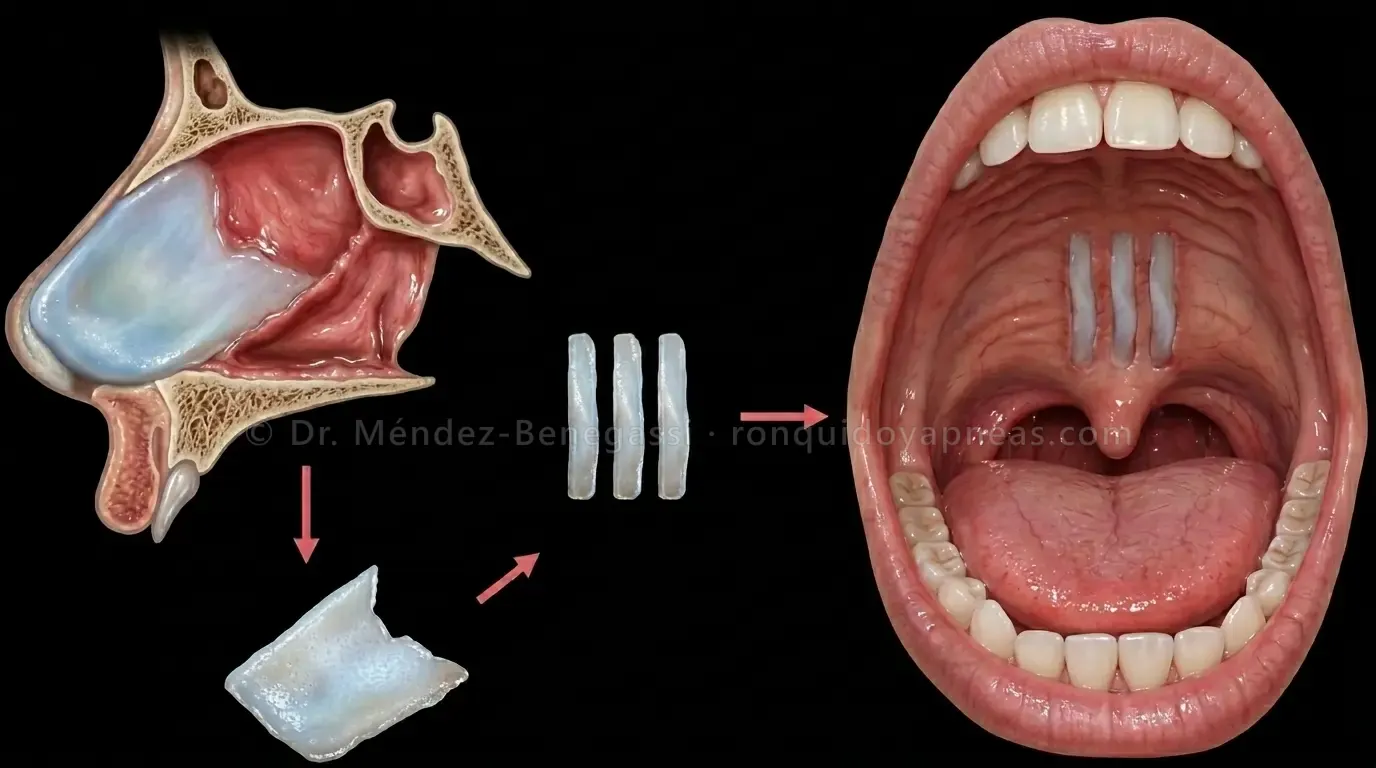
Dr. Méndez-Benegassi performs this technique. It uses the patient's own septal cartilage —harvested during a septoplasty— to graft 3-4 pieces into the soft palate, increasing its stiffness and reducing snoring. In a single, multilevel and outpatient procedure, both the nasal obstruction and the snoring are resolved at the same time.
How it works
During the septoplasty performed to correct the nasal obstruction, septal cartilage is obtained. Instead of discarding it, 3-4 pieces are grafted into the soft palate. The grafts stiffen the palate, which reduces the vibration that produces snoring. Dr. Méndez-Benegassi uses his own modification of the technique that further simplifies graft placement and reduces pain and bruising. The whole procedure, together with the septoplasty, takes about 30 minutes and requires no nasal packing.
Video: septal cartilage graft pharyngoplasty
In just over two minutes (in Spanish): what it is, who it is for, what recovery is usually like and what to try before surgery. Then the operation step by step: incisions, placement of the septal grafts and absorbable sutures.
It contains real surgical images.
Advantages
- Two problems, one surgery: it treats the nasal obstruction and the snoring at the same time, in a single multilevel and outpatient procedure.
- No rejection: it uses the patient's own (autologous) tissue.
- Proprietary modification that simplifies graft placement and reduces pain and bruising.
- Minimal postoperative pain.
- Fast procedure: about 30 minutes together with the septoplasty.
- No nasal packing required.
- Very high snoring improvement rate.
Who is it for?
It is indicated in patients with a standard soft palate and without obesity — for example, women or young men. The most suitable candidate is confirmed during the specialist consultation.
If the turbinates also block the nose, they can be reduced in the same session with a turbinate reduction (coblation turbinoplasty). To measure how blocked your nose feels before the consultation, fill in the NOSE nasal obstruction questionnaire; and to know what the days after surgery are like, read the guide on recovery after snoring and sleep apnea surgery.
Frequently asked questions
What is septal cartilage graft pharyngoplasty?
It is a surgical technique that uses the patient's own septal cartilage —harvested during a septoplasty— to graft 3-4 pieces into the soft palate. This increases the stiffness of the palate and reduces snoring.
Can it treat the nose and the snoring at the same time?
Yes. In a single, multilevel and outpatient procedure both the nasal obstruction and the snoring are addressed at the same time, because the cartilage used for the palate is obtained from the septoplasty itself.
Is there a risk of rejection?
No. Because it uses autologous tissue —the patient’s own cartilage— there is no rejection.
Is it painful?
Postoperative pain is minimal, and the snoring improvement rate is very high.
Who is it indicated for?
It is indicated in patients with a standard soft palate and without obesity — for example, women or young men.
Related
Pharyngoplasty (all techniques)
BRP, expansion and lateral pharyngoplasty.
Septoplasty
Corrects the nasal septum and provides the cartilage.
DISE — Sleep endoscopy
Locates the exact collapse site.
AI snore analyzer
Estimate the origin of your snoring.
Take the next step in your evaluation
Dr. Méndez-Benegassi uses your data to answer your message. Email is not end-to-end encrypted: it can be read on the servers it passes through. Do not send medical reports or health data that way.
Data controller: Dr. Iván Méndez-Benegassi Silva, ENT physician.
Purpose: To read and answer your message. Tell us only what is essential; the rest is covered in the consultation.
Legal basis: The healthcare you are requesting (Art. 9.2.h GDPR).
Recipients: Your data is not shared with third parties; only the technical providers needed are involved, as data processors.
Your rights: Access, rectify or erase your data, object, restrict its processing and request its portability by writing to contacto@ronquidoyapneas.com. You may also lodge a complaint with the Spanish Data Protection Agency.
Full details in the Privacy policy.
The indication and suitability of any surgical technique are determined individually in a medical consultation. This page is informational and does not replace a personalised medical assessment.