
The short answer
A blocked nose rarely causes sleep apnea on its own, but it makes things worse: people with a blocked nose at night snore more, breathe through the mouth, and tolerate CPAP and oral appliances worse [1][3][5]. Treating the nose — first with medication and, if needed, with surgery — improves nasal breathing, nasal snoring and CPAP tolerance; it rarely cures the apnea by itself [6][7][8].
Why the nose matters
Air goes in through the nose, and the narrowest point, the nasal valve, is where it meets the most resistance [2]. When the nose is blocked, you breathe through the mouth. In a population study of almost 5,000 people, those with nasal symptoms at night on 5 or more nights a month were more likely to snore habitually, and those with a nose blocked by allergy were 1.8 times more likely to have moderate or severe sleep-disordered breathing [1]. Lying down also narrows the nose: in healthy people, nasal resistance rises when they move from sitting to lying [12].
The nose also decides how well the treatments work. The more nasal resistance someone had when starting CPAP, the more likely they were to reject it [3]; with a blocked nose, many people switch to a nose-and-mouth mask, which is associated with higher pressure and fewer hours of use than a nasal mask [4]. The mandibular advancement device works with the mouth closed, breathing through the nose, and higher nasal resistance was associated with a poorer response [5].
Causes of a blocked nose
Deviated septum
The inner wall of the nose is bent and blocks one side more than the other.
SeptoplastyEnlarged turbinates
The structures that warm the air stay swollen, usually because of rhinitis.
Turbinate surgeryNasal valve collapse
The side wall of the nose closes when you breathe in [2].
Functional septorhinoplastyRhinitis
Allergic, non-allergic or caused by decongestant sprays; it is treated with medication first.
Chronic rhinitis and snoringPolyps or chronic sinusitis
Growths or inflammation of the sinuses that block the nose.
Endoscopic sinus surgery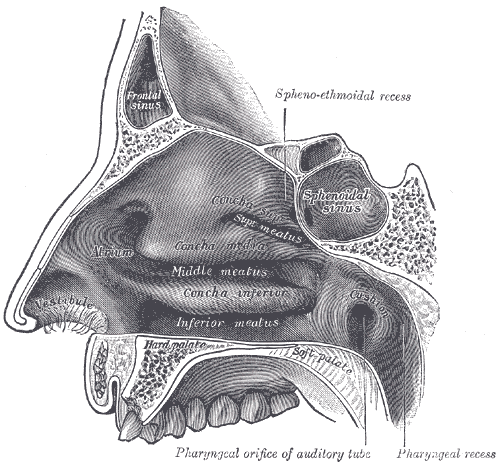
What nasal surgery can and cannot do on its own
What it can do
- Improve nasal breathing: in a randomised trial, septoplasty (with turbinate surgery when needed) did better than treatment without surgery, and the benefit lasted 2 years [9].
- Reduce daytime sleepiness: in a meta-analysis of 10 studies, the Epworth score improved by about 3.5 points [7].
- Make CPAP easier: the pressure needed dropped by about 2.7 cm H₂O and use measured by the machine rose from 3.0 to 5.5 hours a night; 57 of 64 people who were not using CPAP accepted or tolerated it after surgery [6].
What it cannot do
- Cure a moderate or severe apnea on its own: in the same meta-analysis the apnea-hypopnea index did not improve significantly [7].
- Replace the study of the throat: in a trial against sham surgery, septoplasty resolved the apnea in only 4 of 27 patients [8].
How it is assessed
- NOSE questionnaire: five questions that put a number (0 to 100) on how much the blocked nose bothers you, before and after treatment [11]. Take the NOSE questionnaire.
- Examination and nasal endoscopy: the ENT looks inside the nose with a thin camera to see the septum, turbinates and polyps; the nasal valve is diagnosed mainly by examining how it behaves when you breathe in [2].
- Sleep endoscopy (DISE): the nose is examined awake, but the throat has to be seen asleep: the DISE shows what closes only when you sleep, which is where apnea usually comes from.
- Sleep study: it says whether there is apnea and how severe it is; the figures are explained in AHI, ODI and CT90.
Nose and CPAP
A blocked nose is one of the reasons for not tolerating CPAP: it means more pressure, air escaping through the mouth and a mask that is harder to fit [3][4]. Before giving up, tell your sleep unit. A heated humidifier reduced nasal symptoms in a randomised trial, although it did not increase hours of use by itself [10]. If the nose is still blocked, treating it (medication, and surgery if there is a structural cause) lowers the pressure needed and makes the machine easier to use [6].
Nose and oral appliance
The mandibular advancement device moves the jaw forward, but you still have to breathe through the nose: with high nasal resistance the response was poorer [5]. That is why the nose is checked before fitting one, and why a DISE before the appliance can help predict whether it will work.
Combined surgery
When the DISE shows that the throat also collapses, nose surgery can be combined in the same operation with surgery of the palate or throat. One example is the septal graft pharyngoplasty, which uses the cartilage removed in the septoplasty to stiffen the soft palate; another is a pharyngoplasty. To compare all the options, read CPAP, oral appliance or surgery.
If your nose is blocked most nights and you snore or use CPAP, have both the nose and your sleep assessed.
Frequently asked questions
Can a blocked nose cause sleep apnea?
On its own it rarely explains a moderate or severe apnea, which usually comes from the throat collapsing. But a blocked nose is linked to more snoring and, in people with nasal allergy, to more sleep-disordered breathing, and it makes CPAP and oral appliances harder to tolerate.
If I have nose surgery, will I stop snoring?
If the snoring comes from the nose, it usually improves. If it also comes from the palate or the throat, nose surgery alone is not enough, which is why those areas are examined too.
Can I keep using CPAP with a blocked nose?
Yes, but tell your sleep unit: the mask, the humidifier or the pressure can often be adjusted, and the nose can be treated. With a blocked nose it is common to switch to a nose-and-mouth mask, which is associated with higher pressure and fewer hours of use.
What comes first, treating the nose or the apnea?
Both are assessed together: the sleep study says whether there is apnea and how much, and the examination says what is blocking the nose. Nasal treatment starts with medication when the cause is rhinitis; surgery is considered when there is a structural problem or medication is not enough.
Do nasal strips work?
They help some people whose nasal valve closes when breathing in, and they are useful to check whether the valve is the problem. They do not fix a deviated septum or enlarged turbinates.
References
- Young T, Finn L, Kim H. Estudio poblacional de Wisconsin (4.927 personas). J Allergy Clin Immunol, 1997. doi.org/10.1016/s0091-6749(97)70124-6
- Rhee y cols., consenso de expertos sobre la válvula nasal (AAO-HNS). Otolaryngol Head Neck Surg, 2010. doi.org/10.1016/j.otohns.2010.04.019
- Sugiura y cols. (77 pacientes). Respiration, 2007. doi.org/10.1159/000089836
- Chen y cols., metaanálisis en red (29 estudios). J Sleep Res, 2022. doi.org/10.1111/jsr.13686
- Zeng y cols. Sleep, 2008. doi.org/10.1093/sleep/31.4.543
- Camacho y cols., revisión sistemática y metaanálisis. Sleep, 2015. doi.org/10.5665/sleep.4414
- Ishii y cols., metaanálisis (10 estudios, 320 pacientes). Otolaryngol Head Neck Surg, 2015. doi.org/10.1177/0194599815594374
- Koutsourelakis y cols., ensayo aleatorizado con cirugía simulada. Eur Respir J, 2008. doi.org/10.1183/09031936.00087607
- van Egmond y cols., ensayo aleatorizado (203 pacientes). Lancet, 2019. doi.org/10.1016/S0140-6736(19)30354-X
- Worsnop y cols., ensayo aleatorizado. Intern Med J, 2010. doi.org/10.1111/j.1445-5994.2009.01969.x
- Stewart y cols. Escala NOSE. Otolaryngol Head Neck Surg, 2004. doi.org/10.1016/j.otohns.2003.09.016
- Ko y cols. Am J Rhinol, 2008. doi.org/10.2500/ajr.2008.22.3143