
Functional septorhinoplasty: rhinoplasty to breathe better
Medically reviewed by Dr. Iván Méndez-Benegassi Silva · ENT & Sleep Medicine Specialist · HM Hospitales, Madrid · License No. 282855946
Functional septorhinoplasty (also called functional rhinoplasty) is the operation that straightens the septum and also corrects the outer parts of the nose — bones and cartilage — so that air can pass freely [1]. Its main aim is to breathe better; the shape of the nose may change, but that is not the purpose of the operation.
What it is and how it differs from septoplasty and cosmetic rhinoplasty
- Septoplasty: it only straightens the septum, from inside the nose, without moving the outer parts [1]. See septoplasty (deviated septum surgery).
- Functional septorhinoplasty: straightens the septum and moves or reinforces bones and cartilage of the outside of the nose so that breathing improves [1][3].
- Cosmetic rhinoplasty: changes the shape of the nose for appearance; it is an elective operation [2]. If breathing is also a problem, both parts can be planned together: see ultrasonic rhinoplasty, cosmetic and functional.
The nasal valve and its collapse
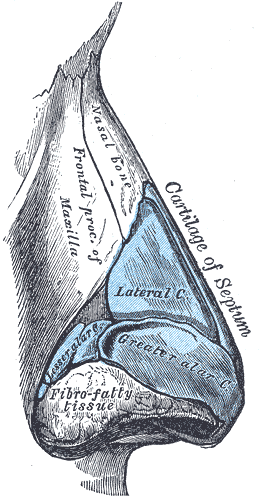
The nasal valve is the part of the nose that offers the most resistance to the air you breathe in [3]. It lies in the middle-lower part of the nose, under the side cartilages. As air speeds up through that narrow point, the pressure inside drops; if the cartilages are weak or bent, the side wall of the nose is sucked in and closes: this is nasal valve collapse [3].
Typical signs: the nose feels more blocked when you breathe in deeply or during exercise, and sometimes you can see the side of the nose closing. The diagnosis is made mainly by examining the nose; there is no single test that confirms it [3]. Adhesive nasal strips or nasal dilators help some people and are useful to check whether the valve is the problem; steroid sprays do not help the valve if there is no rhinitis [3].
When it is indicated
- A deviated septum that also twists the outside of the nose (a crooked nose) [1].
- Nasal valve collapse: the side wall of the nose draws in when you breathe in [3].
- When a septoplasty or turbinate surgery alone is not enough to open the nose [3].
- A persistent blocked nose that bothers you: the NOSE questionnaire helps put a number on it before and after [10].
Surgery that supports the side wall of the nose is a different operation from correcting the septum or the turbinates; sometimes the latter are enough, and sometimes both are needed [3].
Nose, snoring and CPAP
Experts agree that nasal valve collapse can disturb sleep [3]. A nose that closes when you breathe in pushes you to breathe through the mouth at night, which feeds snoring and makes CPAP harder. In a meta-analysis, nasal surgery lowered the CPAP pressure needed by about 2.7 cm H₂O and increased use of the machine [8].
Honestly: nasal surgery alone improves sleepiness but does not significantly lower the apnea index [9], because the airway usually collapses lower down, in the throat. That is why, if there is apnea, the throat is also studied (DISE, sleep endoscopy). The whole picture is in the guide blocked nose, snoring and sleep apnea.
What the operation is like
- Anaesthesia and duration: it is done under general anaesthesia [1]. It can take between 1 and 5 hours, depending on what needs correcting [1][2].
- Technique: "closed", with cuts inside the nose, or "open", with a small cut in the skin between the nostrils [1]. In a meta-analysis, both gave similar results in breathing, appearance, swelling and complications [7]. To support the valve, cartilage grafts are often used (for example from the septum itself) [3][6].
- External splint: a small plastic or metal splint is placed on the outside of the nose for one to two weeks [1][2].
- Bruising: bruising around the eyes is common for a few days and usually settles within a week [1].
- Hospital stay: sometimes you go home the same day and sometimes you stay one night [1]. Your surgeon will explain what is planned in your case.
Recovery week by week, and when the final result is seen
- First days
- Blocked nose and some discomfort that is controlled with painkillers; bruising around the eyes is common [1]. Internal splints or packs, if used, usually come out in 3 to 5 days [2].
- Weeks 1-2
- The external splint is removed after one to two weeks [1][2]. Bruising usually settles within a week [1]. Usual time off work: about two weeks; no strenuous exercise or contact sports, and ENT UK advises not flying for 14 days [1].
- Weeks 3-12
- Most of the swelling goes down within a few weeks, but the nose can take up to three months to settle [1]; swelling improves by 2 to 3 months [2].
- Up to a year
- The final result may not be visible for up to a year, sometimes longer [2]. As for breathing, in a meta-analysis of 16 studies the NOSE score fell on average by 43 to 50 points (out of 100) during the first year [4].
This is what the guidelines describe as usual; your surgeon will give you the instructions for your case. For surgery in general, see recovering from sleep apnea surgery.
Risks
- Further surgery: Between 5 and 10 out of 100 people need another operation to adjust the shape of the nose, and in about 1 out of 10 the septum bends again [1].
- Shape and support: Loss of support of the nose or contour irregularities [2].
- Breathing: Rarely, breathing can be worse than before [2].
- Skin: Tiny permanent red spots on the skin of the nose [2].
- Common to nasal surgery: It is normal for the nose to bleed a little after the operation; infection is rare; numbness of the tip of the nose, the upper teeth or the lip usually settles with time [1].
In studies of surgery on the nasal valve, the NOSE score improved substantially on average, although the studies are mostly observational and differ a lot from each other [5].
Frequently asked questions
Is functional septorhinoplasty the same as functional rhinoplasty?
Yes: functional rhinoplasty is another name for functional septorhinoplasty. It is the operation that straightens the septum and corrects the structure of the outside of the nose, especially the nasal valve, to breathe better. If only the septum needs straightening, the operation is a septoplasty.
Will the shape of my nose change?
It can, because outer bones and cartilage are moved or reinforced; sometimes the nose ends up straighter. The aim is breathing, and any change in shape is discussed before the operation.
How long will I wear the splint?
The external splint usually stays in place for one to two weeks. Any internal splints or packing are removed earlier, usually within a few days.
When can I exercise or fly?
For the first two weeks, avoid strenuous exercise and contact sports; ENT UK also advises not flying for 14 days. Your surgeon will tell you when to resume contact sports.
Will it improve my snoring or my sleep apnea?
It can reduce snoring that comes from the nose and make CPAP or an oral appliance easier to use. On its own it rarely cures sleep apnea, because the airway usually collapses lower down, in the throat.
Can I wear glasses afterwards?
While you wear the external splint, no. After that, ask your surgeon when you can rest glasses on your nose again, because it depends on what was done to the bones.
Is it covered by my health insurance?
It depends on your policy. Check with your insurer whether it covers the operation and whether prior authorisation is needed. If a purely cosmetic change is also wanted, ask about that part separately.
Prefer to start on your own? the NOSE questionnaire measures how blocked your nose feels in two minutes.
References
- ENT UK. Septorhinoplasty (2022). www.entuk.org/patients/conditions/61/septorhinoplasty/
- MedlinePlus. Rhinoplasty (2025). medlineplus.gov/ency/article/002983.htm
- Rhee y cols., consenso de expertos sobre la válvula nasal (AAO-HNS). Otolaryngol Head Neck Surg, 2010. doi.org/10.1016/j.otohns.2010.04.019
- Floyd y cols., revisión sistemática y metaanálisis (16 estudios). Otolaryngol Head Neck Surg, 2017. doi.org/10.1177/0194599817691272
- Daoud y cols., revisión sistemática (72 estudios). Diagnostics (Basel), 2026. doi.org/10.3390/diagnostics16091324
- Jackson y cols., revisión sistemática (15 estudios). Otolaryngol Head Neck Surg, 2025. doi.org/10.1002/ohn.70010
- Abi Zeid Daou y cols., revisión sistemática y metaanálisis. Plast Reconstr Surg Glob Open, 2025. doi.org/10.1097/GOX.0000000000007047
- Camacho y cols., revisión sistemática y metaanálisis. Sleep, 2015. doi.org/10.5665/sleep.4414
- Ishii y cols., metaanálisis. Otolaryngol Head Neck Surg, 2015. doi.org/10.1177/0194599815594374
- Stewart y cols. Escala NOSE. Otolaryngol Head Neck Surg, 2004. doi.org/10.1016/j.otohns.2003.09.016
Where I see patients in Madrid
ENT, snoring and sleep apnea clinic at three HM Hospitales centres. Appointments for all three on the same phone number.
HM Madrid
HM Madrid University Hospital
Pl. del Conde del Valle de Súchil, 16
28015 MadridWednesdays 4:00 PM - 7:00 PM
How to get thereHM Valdebebas
HM Valdebebas Polyclinic
Av. de Juan Antonio Samaranch, 51
28055 MadridTuesdays 4:00 PM - 7:00 PM
How to get thereHM Tres Cantos
HM Tres Cantos University Hospital
C. Santiago Ramón y Cajal, 23
28760 Tres CantosTuesdays and Wednesdays 9:30 AM - 1:30 PM
How to get there
Transoral robotic surgery (TORS) is performed by Dr. Méndez-Benegassi himself with the HM Hospitales Da Vinci Xi robot; the appointment is booked at any of these three clinics, where the case is assessed and you are told where the operation takes place.
Appointments: 919 370 000