
Permanent nose filler: your own cartilage instead of hyaluronic acid
Medically reviewed by Dr. Iván Méndez-Benegassi Silva · Otorhinolaryngology (ENT) Specialist with over 25 years of experience in sleep surgery and advanced rhinology · European Board Certificate (ORL-HNS) · HM Hospitales, Madrid · License No. 282855946

Root (nasion)
Raise the root or camouflage a hump
Bridge
Fill dips and irregularities
Supratip
Improve a dip above the tip
Tip
Projection or asymmetries
Columella
Improve the profile
Nasolabial angle
Lift and rotate the tip
What is a permanent nose filler?
A permanent nose filler uses cartilage from your own body —usually from the nasal septum— cut into small dice or cubes or, when cut even finer, turned into a mouldable paste, depending on its thickness (diced cartilage). It is used for the same things as a hyaluronic acid filler: filling dips in the bridge of the nose and evening out small asymmetries. The key difference: the result is permanent, and for that very reason it cannot be undone. It is a small procedure that can often be done under local anaesthesia.
Note: here "permanent" does not mean a synthetic filler that the body never reabsorbs. Those can cause problems years later; what is used is your own cartilage.
What I found when I compared both techniques
For my Master’s thesis at the Universidad Complutense de Madrid I compared hyaluronic acid with diced cartilage, because no study had compared them directly. I carried out a systematic review —the method used to gather all the published evidence on a question— of 13 studies with 4,642 patients treated with diced cartilage, and compared them with the published systematic reviews on hyaluronic acid non-surgical rhinoplasty.
The main conclusions:
- Both techniques achieve more than 90% satisfied patients and few complications [2][8].
- In the clinical series, particles smaller than 0.2 mm left the smoothest bridge, with fewer visible irregularities [9].
- The choice depends on what you value most: something temporary and reversible, or something permanent.
A later systematic review, from 2024 and with 30 studies, confirmed that reabsorption is minimal: the cartilage disappeared completely in only 0.27% of patients [6].
What it can correct
In my thesis, hyaluronic acid and diced cartilage share almost the same uses. The numbers match the image at the top of the page:
- 1Root (nasion): raise the root or camouflage a hump
- 2Bridge: fill dips and irregularities
- 3Supratip: improve a dip above the tip
- 4Tip: projection or asymmetries
- 5Columella: improve the profile
- 6Nasolabial angle: lift and rotate the tip
Both can also correct small deviations or asymmetries of the bridge or the tip, and a nostril rim that sits slightly too high.
Hyaluronic acid or diced cartilage: side by side
| Aspect | Hyaluronic acid | Diced cartilage |
|---|---|---|
| What it is | A gel that the body reabsorbs, injected with a needle or cannula | Your own cartilage, finely diced into a paste |
| Where | In the consulting room | In the operating room, as an outpatient |
| Anaesthesia | Topical or local | Local or general |
| Time | Minutes | More than an hour in total |
| How long it lasts | Between 8 and 14 months [1] | Permanent: it disappears completely in fewer than 3 out of 1,000 [6] |
| Can it be undone? | Yes, with an enzyme (hyaluronidase) | No; only with another procedure |
| Satisfied patients | Nearly 95 out of 100 [2] | 95 out of 100 in a series of 128 patients [8] |
| Touch-ups | It has to be repeated to keep the result | Partial reabsorption in 1 to 2 out of 100; another operation in about 1.5 out of 100 [5][6] |
| Cost and complexity | Lower | Higher: it is surgery |
| Serious complications | Rare, about 3 in 1,000: loss of vision, skin damage, stroke [3] | Not described in the published series, which are small; when it is injected, the risk is not zero [8] |
How I do it
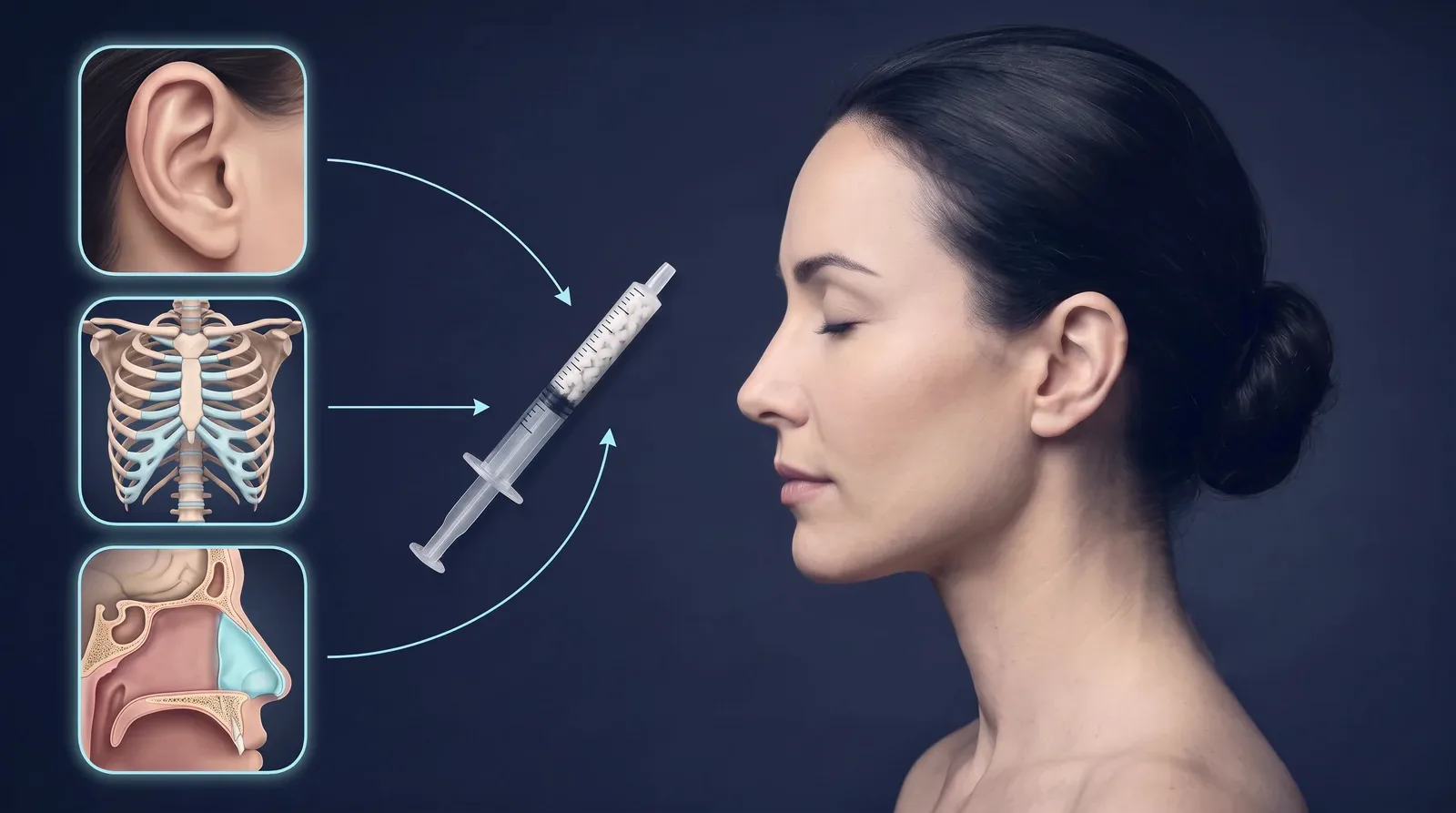
- Where the cartilage comes from: usually from the septum, because it is in the same area and causes the fewest problems. In more complex rhinoplasties I use rib cartilage. Ear cartilage is elastic rather than firm, so it is harder to turn into a fine paste; it can be useful, but less so for this [8][10].
- How I prepare it: the cartilage is cut, never hammered or crushed to make it lose its shape: heavily crushed cartilage is reabsorbed more and needs more reoperations [12]. I cut it into particles smaller than 0.5 mm, and above all smaller than 0.2 mm, combining two techniques described in the literature, ultradiced cartilage [9] and cartilage shaving [8]: it goes into a 1 ml syringe and a scalpel blade is passed through it again and again. The aim is for the cartilage cells to survive and, at the same time, for it to adapt as closely as possible to the skin. In an experimental study, ultrafine diced cartilage (under 0.5 mm) kept more living cells and more blood vessels than block cartilage [11]; and with such fine particles the graft shows less [9].
- Where it goes: a pocket is made to measure, exactly in the area to be treated, so that the diced cartilage does not move out of place.
- Anaesthesia: the usual is general anaesthesia, or doing it as part of a septoplasty or the rhinoplasty itself, using the cartilage that is removed anyway. Many times it can also be done under local anaesthesia.
- The first weeks: for about three weeks the paste can still be remodelled. That is why I see you in the consulting room once a week: small displacements or irregularities that appear are corrected there and then [5].
I also do hyaluronic acid non-surgical rhinoplasty. But I always offer the surgical option too, because it is the only one that gives a permanent result.
Video: the permanent nose filler step by step
In two minutes (in Spanish): what can be corrected, where the cartilage comes from and how it is prepared. Then, real images of a case: the dip in the bridge, the diced cartilage in the syringe, the pocket and the correction.
It contains real surgical images (from 1:17).
The risks of hyaluronic acid in the nose
In the published reviews, most side effects are mild and short-lived: bruising, swelling or a slight asymmetry [3].
The serious ones are rare, but they exist: the nose has small arteries connected to those of the eye, and the filler can block one. In a 2025 review of more than 7,000 patients, loss of vision, skin damage from lack of blood supply or stroke occurred in about 3 out of 1,000 [3]. The nose is the area of the face with the most published cases of vision loss after a filler, 4 out of 10, and in most of them the sight did not come back [4]. Many of these cases are published as isolated reports, which some reviews leave out: in my thesis I found at least 59 such cases due to hyaluronic acid.
Its great advantage is that it can be dissolved with hyaluronidase. With diced cartilage, no vascular complications of this kind have been described in the published series, but they are small, and when the cartilage is injected the risk is not zero [8].
The limits of diced cartilage, honestly
- It cannot be dissolved: removing it requires another procedure. That is why the nose is never overcorrected.
- Partial reabsorption: a small part may be reabsorbed. In a systematic review of more than 4,000 patients with free diced cartilage, it happened in fewer than 1 in 100, and 1.5 in 100 needed another operation, mostly because of overcorrection or irregularities [5].
- Irregularities: in a meta-analysis that pools several techniques, about 5 out of 100 had a visible irregularity [7]; the finer the particles, the less the graft shows [9].
- Thin skin: the graft is more likely to be felt or seen, so the indication is more careful [9].
- It is not for every nose: a nose that is too projected because of a high septum ("tension nose"), a wide bridge or wide nostrils, a markedly crooked nose or septum, or a nasal valve that collapses need a rhinoplasty, not a filler. See functional septorhinoplasty and ultrasonic rhinoplasty.
Which one suits you?
Hyaluronic acid, if…
- You want to see how the change looks before committing.
- You prefer something reversible.
- You do not want to go into an operating room.
- You accept repeating it every so often.
Diced cartilage, if…
- You want a permanent result.
- You have already had filler, you like how it looks and you are tired of repeating it.
- You are having nose surgery anyway (rhinoplasty or septoplasty) and the cartilage can be used.
- You have small irregularities after a previous rhinoplasty.
If you also want to know who should operate on your nose, read rhinoplasty: ENT or plastic surgeon?
Frequently asked questions
Is there a permanent non-surgical nose job?
Not with hyaluronic acid: a review of 674 patients found that its effect lasts between 8 and 14 months. The closest thing to a permanent one is filling the nose with your own diced cartilage: it does the same job, but it stays. It is a small procedure, because the cartilage has to be taken first, usually from inside the nose.
What is diced or ultradiced cartilage?
It is your own cartilage turned into small dice or cubes or, when cut even finer, into a paste, depending on its thickness. "Diced" means cut into cubes; "ultradiced" is the finest version. It is cut, not crushed, and the finer it is, the smoother the bridge of the nose looks.
How long does the result last?
It is permanent: the cartilage is your own and stays in place. It very rarely disappears completely, but a small part can be reabsorbed, and sometimes a small touch-up is needed.
Can it be done under local anaesthesia?
Often, yes. Even so, it is usually done under general anaesthesia or as part of a septoplasty or the rhinoplasty itself, making use of the cartilage that is removed from the septum.
Where is the cartilage taken from?
Usually from the septum, the wall that divides the nose inside: it is in the same area and causes the fewest problems. In more complex rhinoplasties, rib cartilage is used. Ear cartilage is elastic and harder to work into a fine paste, so it is used less for this.
Can it be undone if I do not like it?
Not as easily as hyaluronic acid, which can be dissolved with an enzyme. Removing cartilage requires another operation and is not always simple. That is why the nose is never overcorrected, and why, in the first weeks, the paste can still be shaped to fix small displacements.
What are the risks of hyaluronic acid in the nose?
Most side effects are mild and temporary: redness, swelling or small bruises. Rarely, the filler blocks an artery; that can damage the skin and, very rarely, the eyesight. It is uncommon, but it is the main reason to choose an experienced injector and to know the alternatives.
Why not use a permanent synthetic filler?
Because fillers that the body never reabsorbs can cause problems years later, such as lumps or inflammation, and they are hard to remove. Your own cartilage is not a foreign material.
Can I have diced cartilage if I have had hyaluronic acid before?
Yes. At the consultation we check whether any filler is left and what to do with it first. Knowing how the filler looked on you also helps to plan the correction.
Where does Dr. Méndez-Benegassi see patients for this in Madrid?
The assessment is done in an ENT consultation: the nose is examined inside and out to see whether a filler, diced cartilage or a rhinoplasty is the right choice. Dr. Méndez-Benegassi sees patients in Madrid at his three HM Hospitales clinics —HM Madrid (Chamberí), Policlínico HM Valdebebas (Hortaleza) and HM Tres Cantos— and offers video consultations to people who live elsewhere.
Accredited Memberships & Scientific Societies
Dr. Méndez-Benegassi brings together the three essential pillars for advanced rhinoplasty: functional airway surgery, European facial plastic surgery, and facial aesthetic medicine.

Spanish Society of Otorhinolaryngology and Head & Neck Surgery
ENT Specialist · Airway, Valve & Functional Septum

European Academy of Facial Plastic Surgery
Active Member · European Facial Plastic & Reconstructive Surgery

Spanish Society of Aesthetic Medicine
Full Member · Master's with Honors in Facial Aesthetics (UCM)
Take the next step in your evaluation
Dr. Méndez-Benegassi uses your data to answer your message. Email is not end-to-end encrypted: it can be read on the servers it passes through. Do not send medical reports or health data that way.
Data controller: Dr. Iván Méndez-Benegassi Silva, ENT physician.
Purpose: To read and answer your message. Tell us only what is essential; the rest is covered in the consultation.
Legal basis: The healthcare you are requesting (Art. 9.2.h GDPR).
Recipients: Your data is not shared with third parties; only the technical providers needed are involved, as data processors.
Your rights: Access, rectify or erase your data, object, restrict its processing and request its portability by writing to contacto@ronquidoyapneas.com. You may also lodge a complaint with the Spanish Data Protection Agency.
Full details in the Privacy policy.
References
- Radulesco y cols., revisión sistemática (8 estudios, 674 pacientes). Aesthetic Plast Surg, 2021. PMID 33660013. doi.org/10.1007/s00266-021-02182-x
- Williams y cols., revisión sistemática (23 estudios, 1.600 pacientes). Plast Reconstr Surg, 2020. PMID 32590640. doi.org/10.1097/PRS.0000000000006892
- Ma y cols., revisión sistemática (37 estudios, 7.339 pacientes). Aesthetic Plast Surg, 2025. PMID 40897966. doi.org/10.1007/s00266-025-05194-z
- Doyon y cols., revisión de los casos publicados de pérdida de visión por rellenos. Aesthet Surg J, 2024. PMID 38630871. doi.org/10.1093/asj/sjae091
- Ledo y cols., revisión sistemática del free diced cartilage (6 estudios, 4.044 pacientes). Facial Plast Surg, 2021. PMID 32886948. doi.org/10.1055/s-0040-1714664
- Segreto y cols., revisión sistemática de injertos de cartílago fragmentado (30 estudios). J Plast Reconstr Aesthet Surg, 2024. PMID 38941779. doi.org/10.1016/j.bjps.2024.05.036
- Li y cols., metaanálisis (14 estudios, 2.380 pacientes). Facial Plast Surg Aesthet Med, 2022. PMID 34357798. doi.org/10.1089/fpsam.2021.0002
- Manafi y cols., cartílago raspado inyectable en 128 pacientes. World J Plast Surg, 2015. PMID 26284177. pubmed.ncbi.nlm.nih.gov/26284177/
- Taş, estudio comparativo del cartílago «ultradiced» (217 pacientes). Plast Reconstr Surg, 2021. PMID 33710070. doi.org/10.1097/PRS.0000000000007794
- Trivisonno y cols., cartílago fluido en 14 pacientes. Materials (Basel), 2019. PMID 30935163. doi.org/10.3390/ma12071062
- Perkasa-Hendropriyono y cols., estudio experimental en conejos (cartílago ultrafino frente a bloque). Plast Reconstr Surg Glob Open, 2025. PMID 40078616. doi.org/10.1097/GOX.0000000000006615
- Wells y cols., revisión sistemática y metaanálisis del cartílago machacado (11 estudios, 1.132 pacientes). J Plast Reconstr Aesthet Surg, 2024. PMID 39098291. doi.org/10.1016/j.bjps.2024.06.019

Where I see patients in Madrid
I see patients in person at my HM Hospitales clinics (HM Madrid, HM Valdebebas and HM Tres Cantos), or by personalized video consultation if you prefer.
HM Madrid
HM Madrid University Hospital
Pl. del Conde del Valle de Súchil, 16
28015 MadridWednesdays 4:00 PM - 7:00 PM
How to get thereHM Valdebebas
HM Valdebebas Polyclinic
Av. de Juan Antonio Samaranch, 51
28055 MadridTuesdays 4:00 PM - 7:00 PM
How to get thereHM Tres Cantos
HM Tres Cantos University Hospital
C. Santiago Ramón y Cajal, 23
28760 Tres CantosTuesdays and Wednesdays 9:30 AM - 1:30 PM
How to get there