
CPAP, oral appliance or surgery: how to choose
Medically reviewed by Dr. Iván Méndez-Benegassi Silva · Otorhinolaryngology (ENT) Specialist with over 25 years of experience in sleep surgery and advanced rhinology · European Board Certificate (ORL-HNS) · HM Hospitales, Madrid · License No. 282855946
CPAP is the reference treatment for moderate-to-severe apnea, very effective but requiring adaptation. A mandibular advancement device suits snoring and mild-to-moderate apnea or CPAP intolerance. Surgery is for a correctable anatomical site or when other options fail. The choice depends on severity (AHI), anatomy (a DISE helps) and your preferences — and is decided by the specialist after a study.
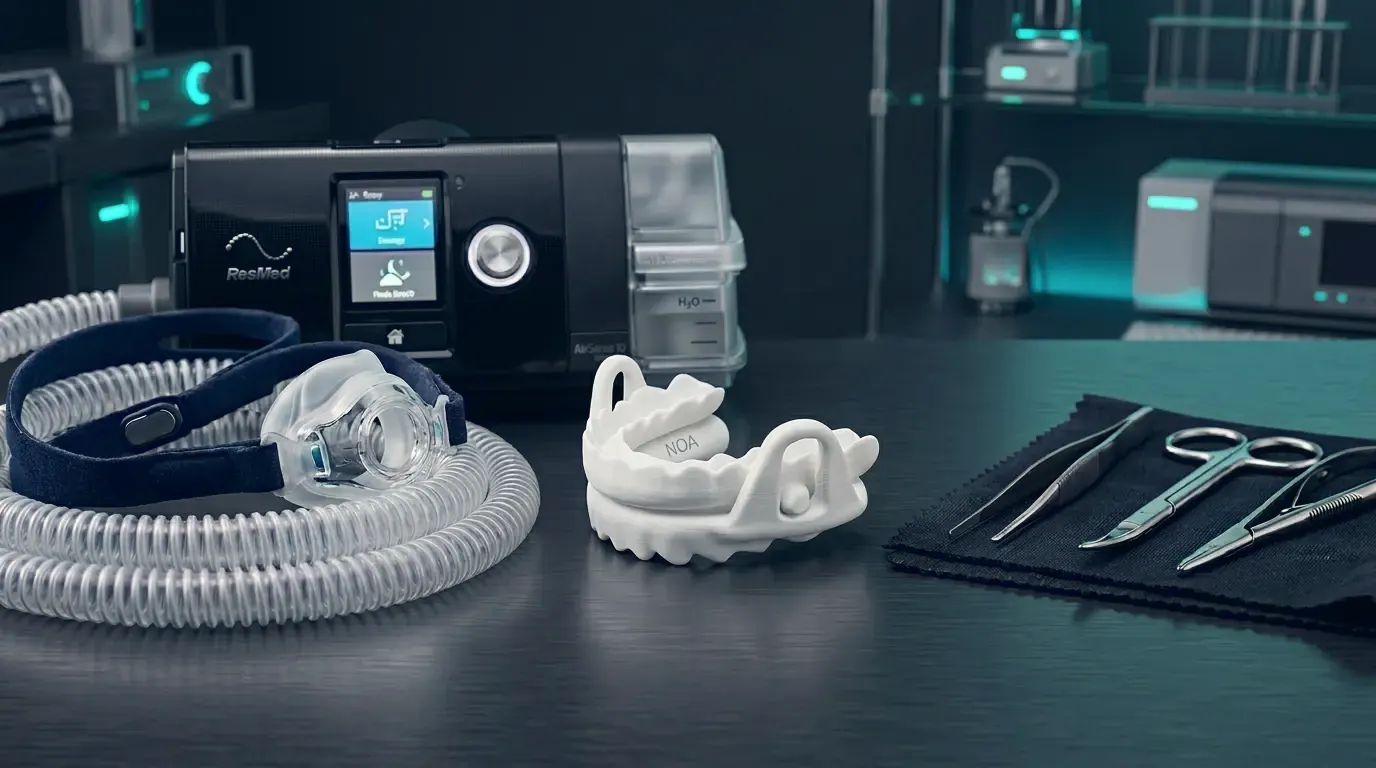
The three options compared
| Option | Typical indication | Advantages | Drawbacks |
|---|---|---|---|
| CPAP (positive pressure) | Moderate–severe apnea | Very effective; reference treatment | Requires adaptation and nightly adherence |
| Mandibular advancement device (MAD) | Snoring and mild–moderate apnea, or CPAP intolerance | Comfortable, portable, good adherence | Less effective in severe apnea; dental fitting |
| Surgery (nasal, pharyngeal, tongue base, TORS, hypoglossal implant) | Correctable anatomical site, or failure/intolerance of the above | Can be definitive; addresses the anatomical cause | Invasive procedure; careful case selection |
AHI = apnea–hypopnea index, the measure of apnea severity from a sleep study. This table is orientative; the specialist tailors the plan to each patient.
Each option, explained
CPAP: the reference treatment
CPAP (continuous positive airway pressure) uses a mask to deliver a gentle stream of pressurised air that splints the airway open all night. It is the most effective treatment for moderate-to-severe obstructive sleep apnea. Its strength is reliability; its challenge is adaptation and consistent nightly use, since the benefit depends on adherence.
If you struggle to get used to it, read CPAP intolerance: what real alternatives do I have?; and if you are going on a trip, CPAP for travel and summer.
Mandibular advancement device (oral appliance)
A mandibular advancement device is a custom mouthpiece that holds the lower jaw slightly forward, widening the space behind the tongue. It is a good option for simple snoring and mild-to-moderate apnea, and a valuable alternative for people who cannot tolerate CPAP. It is portable and comfortable, but generally less effective than CPAP in severe apnea.
Before ordering one, it is worth checking whether it will work for you: we explain how in DISE before the oral appliance.
Surgery: correcting the anatomy
Surgery targets a specific, correctable obstruction. Depending on the site, this may mean nasal surgery, pharyngoplasty, tongue-base procedures, robotic TORS surgery or a hypoglossal nerve stimulator implant. It is considered when there is a clear anatomical target or when CPAP and oral appliances have failed or are not tolerated, and it requires careful patient selection.
Nasal surgery — a septoplasty for the septum or a turbinate reduction for the turbinates — is often a first step to tolerate CPAP or the oral appliance better. The implant is compared with the machine in hypoglossal nerve implant vs CPAP, and the days after an operation are explained in recovery after snoring and sleep apnea surgery.
How the choice is made
The decision rests on three things: the severity of the apnea (the AHI from a sleep study), the anatomy of the airway and where it collapses, and your own preferences and tolerance. A sleep endoscopy (DISE) often helps by showing the exact collapse site, which makes treatment selection more precise.
The specialist decides after a study
These treatments are frequently complementary rather than competing, and the right combination is individual. None of them should be chosen on volume of snoring alone. A specialist puts together the sleep study, the airway examination and your priorities to recommend the most suitable plan for you.
Find the right treatment for you
The right option is chosen after a study and an airway examination. Consult the specialist to plan your treatment.
See the specialistFrequently asked questions
CPAP, oral appliance or surgery — which is best for me?
There is no single best option for everyone. The right choice depends on how severe your apnea is (the AHI), where and how your airway collapses (anatomy), and your own preferences and tolerance. CPAP is the reference treatment for moderate-to-severe apnea, an oral appliance suits snoring and mild-to-moderate apnea, and surgery is considered when there is a correctable anatomical problem or the other options fail. A specialist decides after a proper study.
What is CPAP and how well does it work?
CPAP delivers a gentle stream of pressurised air through a mask that keeps the airway open during sleep. It is the most effective treatment for moderate-to-severe obstructive sleep apnea and works for almost everyone who uses it consistently. Its main challenge is adaptation and adherence: the benefit depends on wearing it most nights.
When is a mandibular advancement device a good option?
A mandibular advancement device (oral appliance) moves the lower jaw slightly forward, which opens the airway behind the tongue. It is a good option for simple snoring and for mild-to-moderate sleep apnea, and a useful alternative for people who cannot tolerate CPAP. It is custom-fitted, portable and generally well accepted, though it is less effective than CPAP in severe apnea.
When is surgery considered for snoring or apnea?
Surgery is considered when there is a specific, correctable anatomical site (for example nasal obstruction, large tonsils or a particular collapse pattern) or when CPAP and oral appliances have failed or are not tolerated. Options range from nasal surgery and pharyngoplasty to tongue-base procedures, robotic TORS surgery and hypoglossal nerve stimulation. Careful case selection, often guided by a DISE, is essential.
How does the doctor decide which treatment to use?
The decision is based on the severity of the apnea measured by a sleep study (the AHI), the anatomy of your airway — which a sleep endoscopy (DISE) can clarify — and your preferences and lifestyle. Often these treatments are complementary rather than mutually exclusive, and the plan is tailored to you by the specialist.
Does private health insurance cover it?
It depends on your policy. Many private health insurance plans (for example Adeslas, Sanitas or DKV) contemplate the sleep study and the treatments — CPAP, a mandibular advancement device or surgery — either through their network of providers or by reimbursement, but cover and conditions vary from one policy to another. The most reliable step is to confirm with your insurer what your specific plan includes before starting.
This guide is educational and does not replace medical advice. Treatment for snoring or sleep apnea must be chosen by a specialist after a sleep study and an individual evaluation, not based on snoring alone.
Reviewed by Dr. Iván Méndez-Benegassi Silva · Otorhinolaryngology (ENT) Specialist with over 25 years of experience in sleep surgery and advanced rhinology · European Board Certificate (ORL-HNS) · HM Hospitales · Last reviewed: 20 Jun 2026
Take the next step in your evaluation
Dr. Méndez-Benegassi uses your data to answer your message. Email is not end-to-end encrypted: it can be read on the servers it passes through. Do not send medical reports or health data that way.
Data controller: Dr. Iván Méndez-Benegassi Silva, ENT physician.
Purpose: To read and answer your message. Tell us only what is essential; the rest is covered in the consultation.
Legal basis: The healthcare you are requesting (Art. 9.2.h GDPR).
Recipients: Your data is not shared with third parties; only the technical providers needed are involved, as data processors.
Your rights: Access, rectify or erase your data, object, restrict its processing and request its portability by writing to contacto@ronquidoyapneas.com. You may also lodge a complaint with the Spanish Data Protection Agency.
Full details in the Privacy policy.