
Advanced Nasosinusal Surgery: Sinusitis & Polyposis
Medically reviewed by Dr. Iván Méndez-Benegassi Silva · Otorhinolaryngology (ENT) Specialist with over 25 years of experience in sleep surgery and advanced rhinology · European Board Certificate (ORL-HNS) · HM Hospitales, Madrid · License No. 282855946
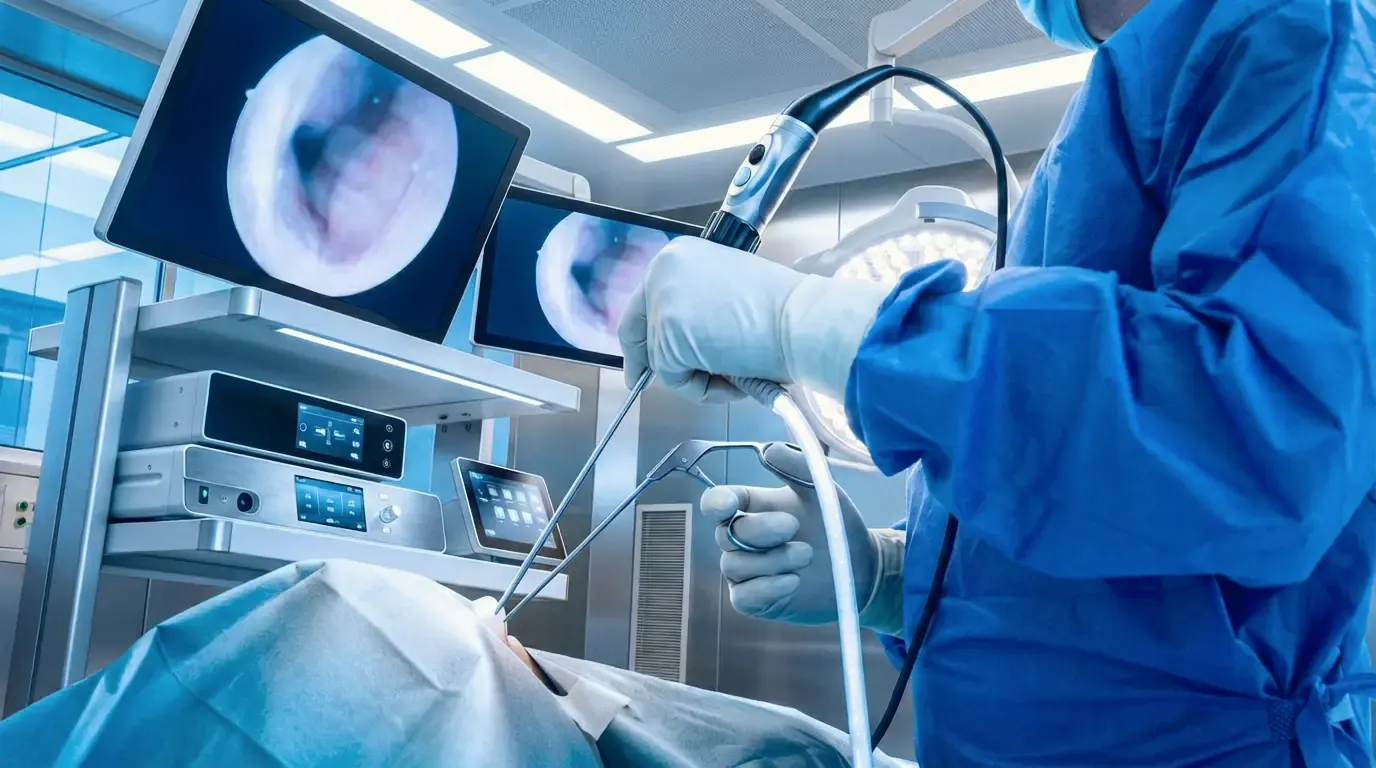
Chronic inflammation of the paranasal sinuses or the presence of polyps causes permanent congestion and secretions that disrupt rest. Functional Endoscopic Sinus Surgery (FESS) is the gold standard for cleaning and opening these cavities.
What It Involves
Endoscopic Polypectomy
Removal of polyps that act as "valves" blocking the nose.
Paranasal Sinus Drainage
Opening of natural ventilation channels to eliminate chronic infection foci.
Impact on Sleep
By clearing the complete upper airway, nasal-origin snoring may decrease and tolerance of CPAP or a MAD usually improves, allowing fluid and effortless nasal breathing.
The nose and apnea: what this surgery can and cannot do
A blocked nose — from polyps, chronic sinus inflammation, a deviated septum or enlarged turbinates — raises the resistance to airflow and forces you to breathe through the mouth. That worsens snoring, dries the throat and, above all, makes CPAP far harder to tolerate (mouth leaks, more pressure needed, dryness). If that is your case, the guide CPAP intolerance: what real alternatives do I have? reviews the options.
To be clear and honest: nasal surgery on its own does not cure sleep apnea. What it does is clear the airway — it improves nasal breathing, usually lets us lower the CPAP pressure, and improves adherence to CPAP or the mandibular advancement device (MAD). It is an enabling step that makes the rest of the treatment work, not a substitute for it.
How we assess it before operating
- Nasal endoscopy (nasofibroscopy) to see exactly what is blocking the nose: polyps, septal deviation, turbinate hypertrophy or nasal valve collapse.
- Rhinomanometry when needed, to measure the actual nasal resistance objectively.
- CT scan of the sinuses in chronic sinusitis and polyposis to map the cavities before surgery.
These short procedures (often 20-40 minutes for the septum or turbinates) have a fast recovery, and are usually planned as a first step to optimise any other apnea treatment.
Before the consultation you can measure how blocked your nose feels with the NOSE nasal obstruction questionnaire; it also lets you compare the result before and after surgery.
How it is done, step by step
- 1Anaesthesia: it is performed under general anaesthesia so you feel nothing during the procedure.
- 2Endoscopic access: the surgeon works entirely through the nostrils with an endoscope and HD cameras, with no external incisions or scars.
- 3Opening and cleaning: the natural drainage channels of the paranasal sinuses are opened and any polyps blocking the nose are removed.
- 4Correcting accompanying problems: if needed, the septum or turbinates are addressed in the same session to clear the airway fully.
- 5Closure and dressings: at the end, dissolvable material or, occasionally, packing may be left in place for a short time.
Recovery and risks
It is often outpatient or with a short admission. In the following days nasal congestion, scabbing and a mild bloody discharge are normal and improve progressively. Saline washes and the follow-up reviews to clean the cavities are key, and strenuous exertion is avoided for a few weeks.
As in any surgery there are risks, generally infrequent: bleeding, infection, scar tissue or adhesions, and the possible recurrence of polyps in polyposis. Rare complications around the eye socket or the base of the skull are minimised with endoscopic technique and prior imaging. The risks and expectations of your specific case are explained before signing the informed consent.
Frequently asked questions
When is chronic sinusitis operated on?
Surgery is considered when chronic sinusitis or nasal polyps persist despite well-conducted medical treatment (nasal corticosteroids, washes and, when indicated, antibiotics or oral steroids). The decision is individual and supported by a nasal endoscopy and a CT scan of the sinuses; it is not the first step, but an option when symptoms and the airway do not improve.
What is FESS (endoscopic sinus surgery)?
FESS (Functional Endoscopic Sinus Surgery), also called CENS in Spanish, is surgery performed entirely through the nostrils with an endoscope and HD cameras, without external incisions or scars on the face. It opens the natural drainage channels of the paranasal sinuses and removes polyps, restoring ventilation of the cavities.
What is recovery like?
It is usually done under general anaesthesia and is often outpatient or with a short admission. In the following days there may be nasal congestion, scabbing and mild bloody discharge that improve progressively. Saline washes and follow-up reviews to clean the cavities are key; strenuous exertion is avoided for a few weeks.
Is the smell lost to polyps recovered?
Many patients recover part or all of their smell when the polyps and inflammation that block the olfactory area are removed, but it cannot be guaranteed: it depends on how long the loss has lasted and the underlying inflammation. In polyposis, maintenance medical treatment after surgery is usually needed to preserve the result.
How is it related to snoring and night-time breathing?
A blocked nose increases airflow resistance and forces mouth breathing, which worsens snoring and makes CPAP harder to tolerate. Clearing the nose improves nasal breathing and CPAP or MAD adherence, but on its own it does not cure sleep apnea: it is an enabling step within the overall treatment.
Take the next step in your evaluation
Dr. Méndez-Benegassi uses your data to answer your message. Email is not end-to-end encrypted: it can be read on the servers it passes through. Do not send medical reports or health data that way.
Data controller: Dr. Iván Méndez-Benegassi Silva, ENT physician.
Purpose: To read and answer your message. Tell us only what is essential; the rest is covered in the consultation.
Legal basis: The healthcare you are requesting (Art. 9.2.h GDPR).
Recipients: Your data is not shared with third parties; only the technical providers needed are involved, as data processors.
Your rights: Access, rectify or erase your data, object, restrict its processing and request its portability by writing to contacto@ronquidoyapneas.com. You may also lodge a complaint with the Spanish Data Protection Agency.
Full details in the Privacy policy.

Where I see patients in Madrid
I see patients in person at my HM Hospitales clinics (HM Madrid, HM Valdebebas and HM Tres Cantos), or by personalized video consultation if you prefer.
Private consultation, no waiting lists
Call the appointments line: you get your appointment during the same call, at any of my three clinics.
Call · 910 786 601- HM Madrid
Wednesdays 3:00 PM - 4:00 PM - HM Valdebebas
Tuesdays 3:00 PM - 4:00 PM - HM Tres Cantos
Tuesdays 1:30 PM - 2:30 PM
€150, paid at the reception desk of the clinic. It is not processed through insurance, except for reimbursement insurance.
Coming with your health insurance? Book with HM: 919 370 000.
HM Madrid
HM Madrid University Hospital
Pl. del Conde del Valle de Súchil, 16
28015 MadridWith insurance (book with HM): Wednesdays 4:00 PM - 7:00 PM
How to get thereHM Valdebebas
HM Valdebebas Polyclinic
Av. de Juan Antonio Samaranch, 51
28055 MadridWith insurance (book with HM): Tuesdays 4:00 PM - 7:00 PM
How to get thereHM Tres Cantos
HM Tres Cantos University Hospital
C. Santiago Ramón y Cajal, 23
28760 Tres CantosWith insurance (book with HM): Tuesdays and Wednesdays 9:30 AM - 1:30 PM
How to get there