
Why do I snore? Causes of snoring
Medically reviewed by Dr. Iván Méndez-Benegassi Silva · Otorhinolaryngology (ENT) Specialist with over 25 years of experience in sleep surgery and advanced rhinology · European Board Certificate (ORL-HNS) · HM Hospitales, Madrid · License No. 282855946
You snore because the upper airway narrows during sleep and the air passing through makes the soft tissues vibrate. The most common causes are nasal obstruction, a long or floppy soft palate, the tongue base falling backward, excess weight, alcohol or sedatives, tobacco, age and sleeping on your back. Simple snoring is only noise; loud, irregular snoring can signal apnea.
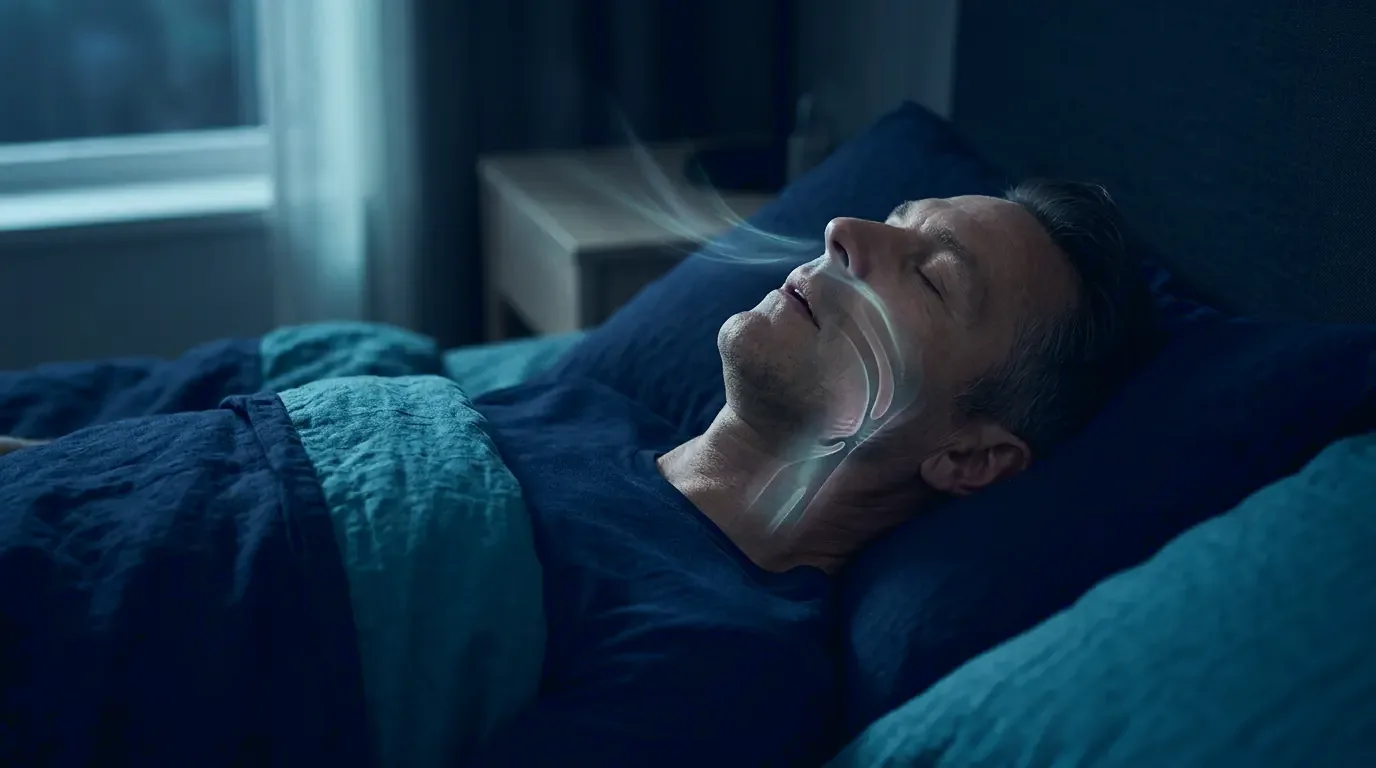
What snoring really is
Snoring is the sound of the soft tissues of the upper airway vibrating as the air passage narrows during sleep. When you fall asleep, the throat muscles relax; if the airway becomes narrow enough, breathing turns the soft palate, uvula and surrounding tissues into a vibrating reed. The narrower the passage, the louder and more turbulent the sound tends to be.
The most common causes
Nasal obstruction
A blocked nose is one of the most common reasons people snore. A deviated septum, enlarged turbinates, rhinitis or polyps make air turbulent and often push you to breathe through the mouth, which favours vibration in the throat. Improving nasal breathing can reduce snoring on its own and helps other treatments work better.
To measure how blocked your nose feels, fill in the NOSE nasal obstruction questionnaire. Depending on the cause, it is treated with a septoplasty (deviated septum), a turbinate reduction (enlarged turbinates) or endoscopic sinus surgery (polyps and chronic sinusitis).
A long or floppy soft palate and uvula
The soft palate and uvula are the curtain of tissue at the back of the mouth. When they are long, bulky or especially relaxed during sleep, they flutter as air passes by and produce the classic low-pitched snore. This is the most frequent origin of simple snoring.
The tongue falling backward
During deep sleep the base of the tongue can fall backward toward the throat, especially when you lie on your back. This narrows the airway at a lower level and is more often linked to obstructive sleep apnea, so it deserves particular attention when snoring is loud and irregular.
If someone has seen you stop breathing, read snoring vs sleep apnea: how to tell them apart.
Excess weight
Extra weight is associated with more fat around and inside the throat (peripharyngeal fat), which narrows the airway and makes it collapse more easily during sleep. Even a modest weight reduction can noticeably lessen snoring and lower the risk of sleep apnea.
Alcohol, sedatives, tobacco and age
Alcohol and sedatives relax the throat muscles, so the airway collapses and vibrates more. Tobacco inflames and swells the lining of the airway. With age the tissues lose tone and the throat becomes more collapsible. All of these tip the balance toward louder, more frequent snoring.
Sleeping on your back
Lying face-up lets gravity pull the tongue and soft palate backward, narrowing the airway. Many people snore much more in this position. When snoring is clearly worse on the back, sleeping on the side (positional therapy) can make a real difference.
You will find more practical measures, with what works and what does not, in how to stop snoring; and if the one who cannot sleep is your partner, in my partner snores.
What the evidence shows
A few practical points are backed by recent systematic reviews and meta-analyses. We list them honestly: most measures help snoring modestly, and some popular gadgets have little objective proof.
Weight: a 2024 meta-analysis estimated that a 10% reduction in body-mass index is associated with roughly a 36% fall in the apnea–hypopnea index, with a smaller added effect beyond a 20% reduction.
Malhotra A, et al. Weight reduction and the impact on apnea-hypopnea index: A systematic meta-analysis. Sleep Medicine. 2024;121:26–31. PMID 38908268.
Alcohol: a 2020 systematic review and meta-analysis found that alcohol worsens the severity of snoring and increases the apnea–hypopnea index (mean +3.98 events/hour) while lowering oxygen saturation.
Burgos-Sanchez C, et al. Impact of Alcohol Consumption on Snoring and Sleep Apnea: A Systematic Review and Meta-analysis. Otolaryngology–Head and Neck Surgery. 2020;163(6):1078–1086. PMID 32513091.
Sleeping position: position-dependent (supine-predominant) OSA is common, with reported prevalences of about 20–75% depending on the criteria used, and sleeping on the side lowers the apnea–hypopnea index in these patients.
Battaglia E, et al. Positional Therapy: A Real Opportunity in the Treatment of Obstructive Sleep Apnea? An Update from the Literature. Life (Basel). 2025;15(8):1175. PMID 40868823.
Nasal obstruction: a 2024 systematic review concluded that isolated nasal surgery improves subjective sleep quality, sleepiness and snoring, but does not significantly change objective sleep-study measures such as the apnea–hypopnea index.
Correa EJ, et al. Role of Nasal Surgery in Adult Obstructive Sleep Apnea: A Systematic Review. Sleep Science. 2024;17(3):e310–e321. PMID 39268344.
Nasal strips and dilators: a 2026 systematic review and meta-analysis found no clinically meaningful improvement in objective snoring or sleep-disordered breathing; they may serve only as an adjunct in mild symptoms.
Alotaibi S, et al. Clinical Effectiveness of Nasal Dilators in Sleep-Disordered Breathing: A Systematic Review and Meta-Analysis. Cureus. 2026. PMID 41487318.
Simple snoring or a sign of apnea?
Simple snoring is only noise: the airway vibrates but does not close. Obstructive sleep apnea is different — the airway repeatedly collapses, breathing pauses and oxygen drops. Loud, irregular snoring with witnessed pauses, choking or marked daytime sleepiness should be evaluated. Snoring is a useful clue, but only a sleep study can confirm whether apnea is present.
Measure the sound of YOUR snoring
Our acoustic analyzer measures on your own device how long your snoring sounds, its relative loudness and prolonged sound pauses (free, and the audio is not uploaded). It does not tell where the snoring comes from: that is assessed at the consultation.
Open the AI snore analyzerFrequently asked questions
Why do I snore?
You snore because, during sleep, the muscles of the throat relax and the upper airway narrows. When you breathe, the air passing through this narrow space makes the soft tissues (soft palate, uvula, tongue base) vibrate, and that vibration is the snore. Anything that narrows the airway — a blocked nose, a long soft palate, extra weight or sleeping on your back — makes it more likely.
Does sleeping on my back make me snore more?
For many people, yes. When you lie on your back, gravity pulls the tongue and soft palate backward, narrowing the airway and increasing vibration. Snoring that clearly worsens face-up (positional snoring) sometimes improves simply by sleeping on your side, which is the basis of positional therapy.
Why do alcohol and sedatives make snoring worse?
Alcohol, sleeping pills and other sedatives relax the muscles of the throat even more than normal sleep does. A more relaxed, floppy airway collapses and vibrates more easily, so snoring tends to be louder and apnea more frequent. Avoiding alcohol in the hours before bed is one of the simplest measures.
Can a blocked nose cause snoring?
Yes. A deviated septum, enlarged turbinates, rhinitis or polyps force you to breathe through a narrower or more turbulent passage, and often through the mouth, which favours vibration further down the throat. Treating nasal obstruction can reduce snoring and also improves tolerance of CPAP when it is needed.
Is snoring always harmful?
Not always. Simple snoring is just noise, without breathing pauses, and may only disturb your bed partner. However, loud, irregular snoring with witnessed pauses, choking or daytime sleepiness can be a sign of obstructive sleep apnea. Snoring is a clue, not a diagnosis: a sleep study is needed to tell them apart.
What can I do to stop snoring?
The measures with the best evidence are: lose weight if you are overweight, avoid alcohol and sedatives in the hours before bed, and sleep on your side if your snoring is worse face-up (positional therapy). Treating nasal obstruction (a deviated septum, turbinates, rhinitis) can also help. Over-the-counter nasal strips or dilators may feel comfortable but have not been shown to reliably reduce measured snoring. If you have witnessed breathing pauses, choking or daytime sleepiness, see a specialist, because there may be sleep apnea behind the snoring.
Do nasal strips and over-the-counter anti-snoring products work?
The honest answer is that the objective evidence is weak. Nasal strips and dilators widen the nostrils and make breathing through the nose feel easier, and some people notice their snoring is quieter, but a 2026 systematic review and meta-analysis found no clear reduction in measured snoring or sleep apnea from these devices. They may be a reasonable comfort aid in mild snoring of nasal origin, but they do not treat obstructive sleep apnea and do nothing when the snoring comes from the soft palate or the tongue base. If snoring is loud and persistent or there are breathing pauses, they are not a substitute for medical evaluation.
This guide is for information and the acoustic analyzer only measures the sound of a recording. Neither replaces a medical diagnosis or a sleep study. If you snore loudly, wake up tired or have witnessed breathing pauses, consult a specialist.
Reviewed by Dr. Iván Méndez-Benegassi Silva · Otorhinolaryngology (ENT) Specialist with over 25 years of experience in sleep surgery and advanced rhinology · European Board Certificate (ORL-HNS) · HM Hospitales · Last reviewed: 20 Jun 2026
Take the next step in your evaluation
Dr. Méndez-Benegassi uses your data to answer your message. Email is not end-to-end encrypted: it can be read on the servers it passes through. Do not send medical reports or health data that way.
Data controller: Dr. Iván Méndez-Benegassi Silva, ENT physician.
Purpose: To read and answer your message. Tell us only what is essential; the rest is covered in the consultation.
Legal basis: The healthcare you are requesting (Art. 9.2.h GDPR).
Recipients: Your data is not shared with third parties; only the technical providers needed are involved, as data processors.
Your rights: Access, rectify or erase your data, object, restrict its processing and request its portability by writing to contacto@ronquidoyapneas.com. You may also lodge a complaint with the Spanish Data Protection Agency.
Full details in the Privacy policy.