
Preservation Rhinoplasty in Madrid: NOVA Spare Roof & Sail Maneuver
Medically reviewed by Dr. Iván Méndez-Benegassi Silva · ENT & Sleep Medicine Specialist · HM Hospitales, Madrid · License No. 282855946
Direct Training with the Technique CreatorProf. Dr. Miguel Gonçalves Ferreira
The NOVA Spare Roof technique and Sail Maneuver were developed by Prof. Dr. Miguel Gonçalves Ferreira (Porto, Portugal; published in Facial Plastic Surgery & Aesthetic Medicine, 2025). Dr. Iván Méndez-Benegassi Silva trained directly with the creator, mastering the 3D anatomical mechanics required to preserve the nasal vault without disarticulating lateral keystone attachments.
Preserving vs. Cutting: Why Keep Your Natural Bridge?
Think of your nasal bridge like the original roof of a house. In traditional rhinoplasty, the surgeon cuts away the hump from above, breaking the natural arch and leaving an open hole (“open roof”) that must be rebuilt with cartilage grafts. In preservation rhinoplasty, your natural roof is kept completely intact: we gently lower it from its foundation, eliminating the bump while preserving your natural smooth contours.
How Does NOVA Spare Roof Work? Step-by-Step Descent
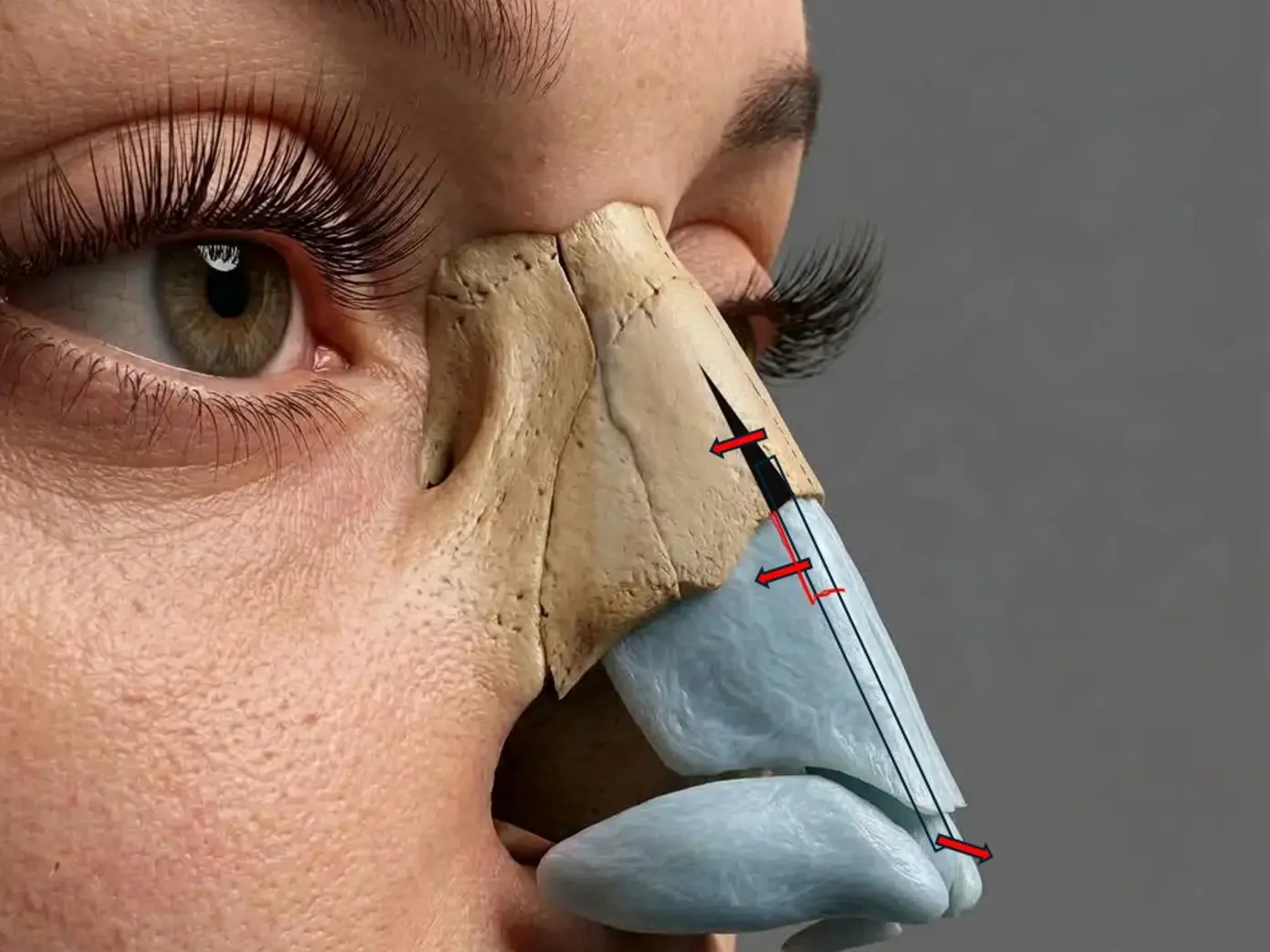
Prior Diamond Burring of the Hump
Before lowering the bridge, a fine diamond burr or piezotome gently planes the surface of the bone and cartilage. This eliminates natural micro-irregularities (such as S-shaped bony ridges) so the roof settles into the exact planned profile.
Excision of Underlying Osteocartilaginous Lamina
A calibrated strip of bone and cartilage is excised from underneath the bridge (the septal strip). This creates the necessary free space for descent while keeping the superficial roof 100% untouched.
Calibrated Wedge Cut of the Upper Lateral Cartilage
A calibrated triangular wedge is removed and the upper lateral cartilage is released, liberating tension and preparing the cartilage flap (“the sail”).
Controlled Downward Pressure (Push-Down)
Gentle downward pressure is applied to the pre-burred dorsum. It settles smoothly into the freed bed, achieving the desired profile without step-offs.
Overlapped Cartilage Suture (Sail Maneuver)
The upper lateral cartilage is sutured in an overlapped (acabalgado / overlay) position using internal sutures. This provides permanent solid fixation and reinforces the internal nasal valve without requiring external skin needle punctures.
Traditional Rhinoplasty vs. NOVA Preservation Rhinoplasty
| Concept | Traditional Reduction | NOVA Preservation |
|---|---|---|
| Dorsal Roof | Resected and broken (open roof defect) | 100% Intact & preserved (smooth natural contour) |
| Lateral Keystone Area | Disarticulated and severed | Preserved intact (Sail Maneuver) |
| Internal Nasal Valve | Requires reconstruction with spreader grafts | Protected and reinforced (overlapped cartilage) |
| Postoperative Feel | Risk of palpable irregularities or bony edges | Completely smooth, natural, and faster recovery |
Ideal Candidate
- Primary surgery (first time, no prior rhinoplasty).
- Moderate to prominent dorsal hump.
- Desire for a natural, smooth bridge without an "operated" look.
- Protection of nasal breathing and internal valve support.
When Another Technique is Better
- Severe S-shaped crooked noses with marked bridge asymmetry.
- Complex revision rhinoplasty where dorsal cartilage was already resected.
- Saddle nose deformities requiring structural cartilage grafting.
- In these cases, structural or ultrasonic rhinoplasty is planned.
Gentle Postoperative Experience: No Painful Packing
Thanks to diamond burring and internal microsutures, trauma to adjacent tissues is minimal. Dr. Méndez-Benegassi does not use classic nasal packing: you breathe through your nose from day one without the fear or pain of packing removal.
Frequently Asked Questions
What is preservation rhinoplasty and how does it differ from traditional rhinoplasty?
In traditional rhinoplasty, the nasal hump is cut away (resected), opening the nasal roof and requiring spreader grafts to reconstruct it. In preservation rhinoplasty, your natural bridge of bone and cartilage is kept 100% intact and lowered from below, preserving a smooth, authentic bridge with no palpable steps or sharp edges.
What is the NOVA Spare Roof technique and why is the hump burred beforehand?
NOVA Spare Roof is a modern technique where the dorsal hump is treated as a geometric triangle. Before lowering it, the bridge is finely smoothed with a diamond burr or piezosurgery to eliminate native irregularities and adapt the profile. Then, it descends smoothly into the freed bed, perfecting the Dorsal Aesthetic Lines.
What is the Sail Maneuver and why does it avoid cutting the lateral keystone?
Traditional push-down techniques required disarticulating the lateral keystone area (the junction between nasal bone and upper lateral cartilage) and severing the pyriform ligament. The Sail Maneuver creates calibrated mirror osteotomies, allowing the dorsum to descend while keeping the lateral keystone and pyriform ligament completely intact for maximum structural stability.
How do NOVA Spare Roof and the earlier Spare Roof B differ, and why do we prefer NOVA?
In Spare Roof B, securing the cartilage required external transcutaneous needle sutures through the skin ("hump-apex suture") and disarticulating the lateral keystone. In NOVA Spare Roof (2025), after excising an underlying osteocartilaginous strip and sectioning a calibrated cartilage wedge, the pre-burred dorsum is pressed down and the cartilage is sutured in an overlapped (acabalgado / overlay) position with internal sutures. We prefer NOVA because it completely avoids skin punctures, leaves the lateral keystone intact, and actively reinforces the internal nasal valve.
Who is an ideal candidate for preservation rhinoplasty and when is it not recommended?
It is ideal for primary patients (no previous rhinoplasty) with a moderate or prominent hump who want to eliminate the bump while preserving their natural bridge and breathing. It is not recommended for severely crooked S-shaped noses, complex revision cases with destroyed dorsal cartilage, or saddle nose deformities that require structural cartilage grafting.
Will I have painful nasal packing and how is the recovery?
In the vast majority of cases, no: Dr. Méndez-Benegassi avoids classic packing and uses internal micro-sutures or biodegradable splints, allowing you to breathe from day one without painful packing removal. A light external splint is worn for 7 days, after which most patients resume social and work activities.
Surgical Safety & Hospitals in Madrid
Consultations are held at HM Madrid, HM Tres Cantos, and HM Valdebebas. Surgical interventions are performed at the Hospital Universitario HM Sanchinarro, equipped with high-resolution surgical suites, precision piezoelectric technology, optical microscopy, and full intensive care backup.
References
- Ferreira MG, Lyrio TM, Tamanqueira P, Ardila Bernal ADP, Dourado N, Santos M. NOVA Spare Roof Technique and the Sail Maneuver—Vectorial Rhinoplasty Without Lateral Keystone Area Disarticulation. Facial Plast Surg Aesthet Med, 2025. doi.org/10.1089/fpsam.2024.0349
- Ferreira MG, et al. Spare Roof Technique in reduction rhinoplasty: preserving the natural cartilaginous vault. Aesthet Surg J, 2016. doi.org/10.1093/asj/sjw075
- Ferreira MG, Ishida LC, Ishida LH, Santos M. Ferreira-Ishida Technique: Spare Roof Technique B. Step-by-Step Guide to Preserving the Bony Cap While Dehumping. Plast Reconstr Surg, 2022. PMID 35467610. doi.org/10.1097/PRS.0000000000009060
- Ribeiro y cols., revisión sistemática y metaanálisis (10 estudios): rinoplastia de preservación frente a convencional. J Plast Reconstr Aesthet Surg, 2025. PMID 40580891. doi.org/10.1016/j.bjps.2025.05.044
- Tham y cols., metaanálisis de 22 estudios sobre resultados estéticos y funcionales en rinoplastia de preservación. Facial Plast Surg Aesthet Med, 2022. PMID 35172105. doi.org/10.1089/fpsam.2021.0312
- Stewart y cols., validación de la escala NOSE para valoración de obstrucción nasal. Otolaryngol Head Neck Surg, 2004. PMID 14990910. doi.org/10.1016/j.otohns.2003.09.016

Where I see patients in Madrid
Preservation rhinoplasty consultation at HM Hospitales centres in Madrid, or personalized video consultation with Dr. Méndez-Benegassi.
HM Madrid
HM Madrid University Hospital
Pl. del Conde del Valle de Súchil, 16
28015 MadridWednesdays 4:00 PM - 7:00 PM
How to get thereHM Valdebebas
HM Valdebebas Polyclinic
Av. de Juan Antonio Samaranch, 51
28055 MadridTuesdays 4:00 PM - 7:00 PM
How to get thereHM Tres Cantos
HM Tres Cantos University Hospital
C. Santiago Ramón y Cajal, 23
28760 Tres CantosTuesdays and Wednesdays 9:30 AM - 1:30 PM
How to get there