

Logo Ronquido y Apneas

    We use cookies to improve your experience and analyze traffic. Do you give us permission?

    NOSEValidated Clinical Questionnaire · 2 min

    NOSE Scale

    Nasal Obstruction Evaluation

    0 / 5 completed
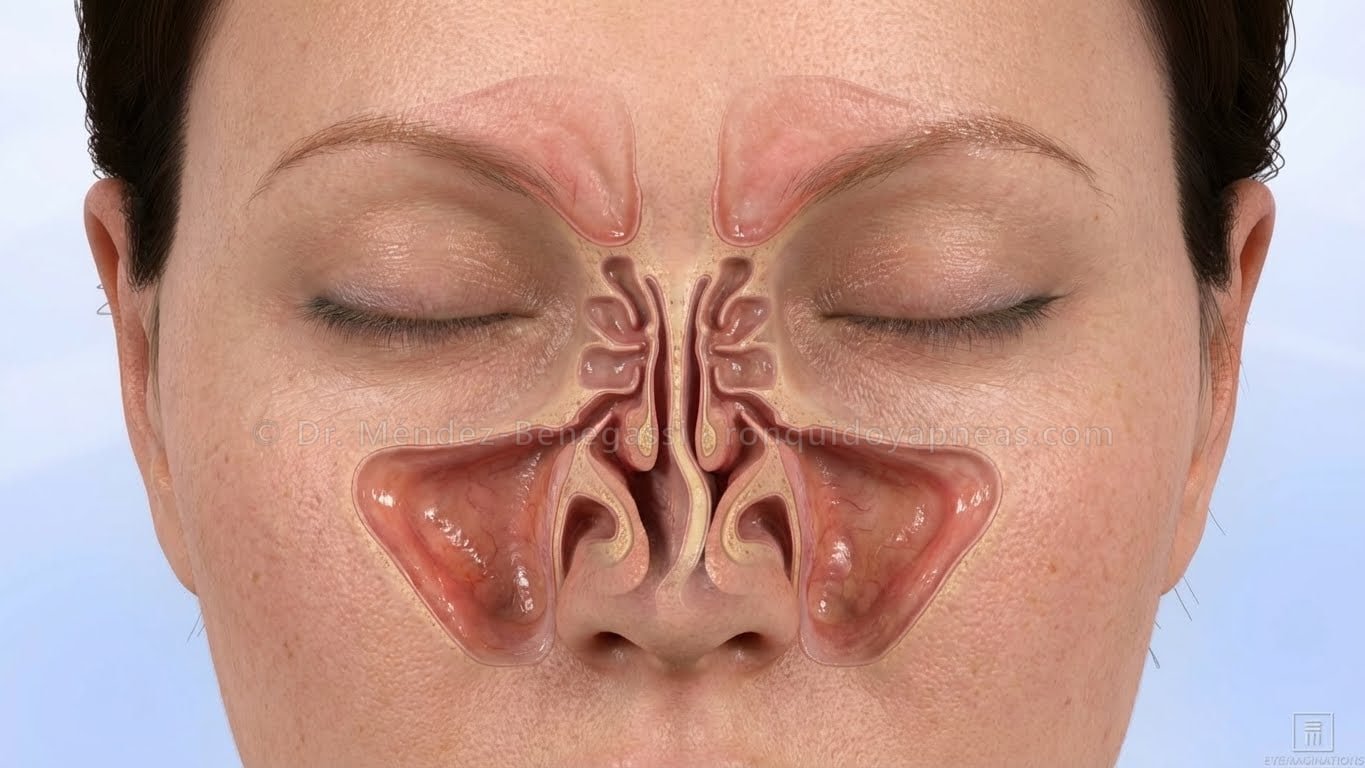
    Nasosinusal anatomy - Illustration of nasal passages and paranasal sinuses

    Anatomy of the nasal passages and paranasal sinuses

    If your nose is narrow, air enters with too much force, creating suction that makes your throat vibrate or close (snoring/apnea). When you open your mouth to breathe, your tongue falls back and tissues relax, facilitating airway collapse.

    Rate how much each symptom has bothered you (0-4):

    0 = No problem • 1 = Very mild • 2 = Moderate • 3 = Fairly bad • 4 = Severe

    1. Nasal congestion or stuffiness

    2. Nasal blockage or obstruction

    3. Trouble breathing through my nose

    4. Trouble sleeping

    5. Unable to get enough air through my nose during exercise or exertion

    What the NOSE scale is

    The NOSE scale (Nasal Obstruction Symptom Evaluation) is a short questionnaire that measures how much a blocked nose bothers you. It was developed and validated in 2004 by Stewart and colleagues at four university centres in the United States, in adults with a deviated septum [1]. It measures what you feel, not the size of your nose or the cause of the blockage.

    In Spanish, the validated version is the NOSE-e (Larrosa and colleagues, 2015), tested in 58 patients before and 3 months after a septoplasty and in 58 people without symptoms [3]. Its authors concluded that it is a valid tool to measure how blocked the nose feels [3].

    What it is for

    It puts a number on the obstruction before deciding on a treatment, and shows how much you have improved afterwards: it is repeated after a septoplasty, turbinate surgery or a functional rhinoplasty. In the validation of the Spanish version, the average score was 63 in patients before surgery and 7 in people without symptoms [3]. It does not replace the examination: the cause of the blocked nose is found by the ENT with an endoscopy.

    The five questions

    All of them refer to the past month [1]:

    1. Nasal congestion or stuffiness
    2. Nasal blockage or obstruction
    3. Trouble breathing through my nose
    4. Trouble sleeping
    5. Unable to get enough air through my nose during exercise or exertion

    How it is scored

    Each question is answered from 0 ("not a problem") to 4 ("very severe problem"). The five answers are added up (0 to 20) and the total is multiplied by 5, so the result goes from 0 (no problem) to 100 (the most severe problem) [1][3]. For example, if you answer 2, 3, 2, 1 and 2, the total is 10 and your score is 50.

    How to read your score

    Lipan and Most analysed the answers of 345 patients and proposed these grades [2]:

    • 5-25: mild obstruction
    • 30-50: moderate obstruction
    • 55-75: severe obstruction
    • 80-100: extreme obstruction

    In their study, 30 points was the score that best separated people with nasal obstruction from people without it [2]. It is a guide, not a diagnosis.

    If your score is high

    The ENT looks for the cause with a nasal endoscopy. A deviated septum is corrected with a septoplasty; enlarged turbinates are reduced with a turbinate reduction (coblation turbinoplasty); a nasal valve that closes when breathing in, or a crooked nose, is corrected with a functional septorhinoplasty; and polyps or chronic sinusitis are treated with endoscopic sinus surgery. If the cause is a chronic rhinitis, treatment starts with medication. How all this affects snoring, apnea and CPAP is explained in blocked nose, snoring and sleep apnea. Repeating the questionnaire after treatment shows how much you have improved.

    If your breathing blockage is accompanied by an external hump, deviated axis or you seek aesthetic improvement, ultrasonic rhinoplasty allows reshaping nasal bones with micrometric precision without uncontrolled fractures, preserving mucosa and respiratory function. In Dr. Méndez-Benegassi's Madrid consultation, an in-person photographic simulation can be performed at no cost (orientative) to assess cosmetic and functional goals together.

    Frequently asked questions

    Does a high score mean I need surgery?

    No. The scale measures how much your nose bothers you, not why. The cause is often a rhinitis, which is treated first with medication; surgery is considered when there is a structural problem, such as a deviated septum, or when treatment is not enough.

    When should I repeat it?

    After a treatment, once enough time has passed to notice its effect. In the validation of the Spanish version it was repeated 3 months after the septoplasty.

    Is it valid if I have a cold?

    The scale asks about the past month. If that month you had a heavy cold or an allergy flare, the score may come out higher than usual for you; in that case, repeat it once it has passed.

    Does the NOSE scale tell me whether I have sleep apnea?

    No. It measures nasal obstruction. Sleep apnea needs other questionnaires and, above all, a sleep study.

    References

    1. Stewart MG y cols. Development and validation of the Nasal Obstruction Symptom Evaluation (NOSE) scale. Otolaryngol Head Neck Surg, 2004;130(2):157-163. doi.org/10.1016/j.otohns.2003.09.016
    2. Lipan MJ, Most SP. Development of a severity classification system for subjective nasal obstruction. JAMA Facial Plast Surg, 2013;15(5):358-361. doi.org/10.1001/jamafacial.2013.344
    3. Larrosa F y cols. Adaptation and validation of the Spanish version of the NOSE scale (NOSE-e). Rhinology, 2015;53(2):176-180. doi.org/10.4193/Rhino14.137

    The original English NOSE scale is © American Academy of Otolaryngology–Head and Neck Surgery Foundation (2003). The validated Spanish version is the NOSE-e (Larrosa et al., 2015).

    Stewart MG, et al. Development and validation of the Nasal Obstruction Symptom Evaluation (NOSE) scale. Otolaryngol Head Neck Surg. 2004;130(2):157-163.