
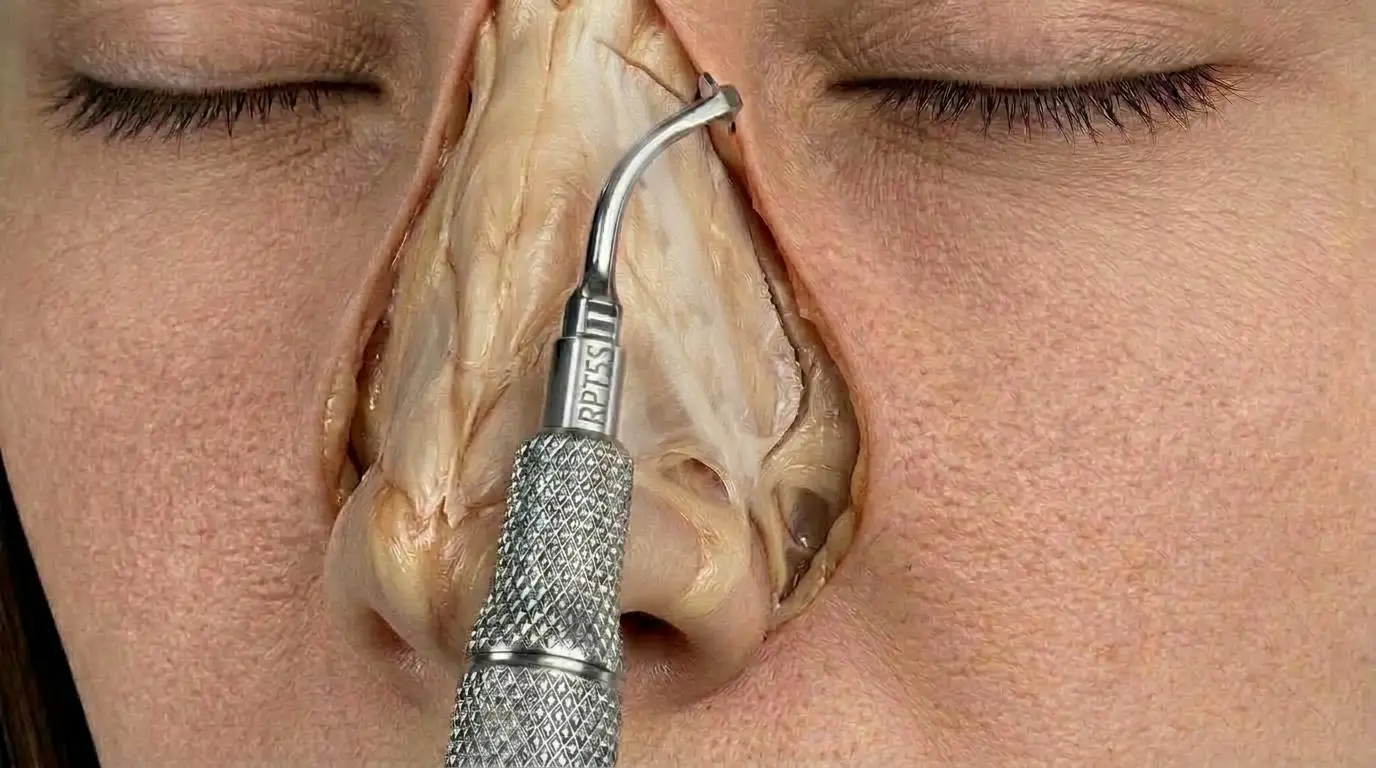
The short answer
Rhinoplasty is the most technically demanding procedure in facial surgery because the nose is not just an aesthetic feature: it is the airway gateway for breathing, exercise, and sleep. The decisive factor is not a rivalry between specialties, but choosing a surgeon subspecialized in the nose. An ENT subspecialized in facial plastic surgery combines deep mastery of internal airflow dynamics (septum, valves, turbinates) with advanced cosmetic refinement.
Training & Approach: Understanding the Difference
ENT / Facial Plastic Surgeon
Specialized exclusively in the head, neck, and upper respiratory tract during residency and subsequent subspecialty fellowships.
- Deep expertise in internal septum, turbinates, and mucosal health.
- Focus on internal nasal valve dynamics and airflow preservation.
- Accredited member of EAFPS (European Academy of Facial Plastic Surgery).
General Plastic Surgeon
Comprehensive training across full-body reconstruction, burns, breast surgery, body contouring, and facial aesthetics.
- Excellent expertise in tissue transposition and body aesthetics.
- Broader surgical scope (breasts, abdomen, face).
- Requires specific nasal fellowship for complex internal valve work.
The Golden Rule: Form and Function Are Inseparable
According to the official AAO-HNS Clinical Practice Guideline on Rhinoplasty [1], altering the external nasal framework inevitably influences the internal airway. The narrowest segment of the human respiratory tract is the internal nasal valve. According to Poiseuille’s Law, narrowing this area by merely 1 millimeter can multiply airway resistance fourfold.
When a rhinoplasty focuses only on reducing volume without reinforcing the cartilage framework, patients may develop delayed inspiratory collapse, pinched tip deformity, or worsening of snoring and sleep apnea. An ENT and facial plastic surgeon plans the procedure as a unified functional and aesthetic septorhinoplasty.
State-of-the-Art Techniques: Ultrasonic & Preservation
Ultrasonic Rhinoplasty (Piezoelectric)
Replaces mechanical chisels with ultrasonic micro-oscillations that sculpt bone with millimeter precision without tearing delicate mucosal vessels, significantly reducing bruising and swelling.
Preservation Rhinoplasty (NOVA Spare Roof)
Preserves the natural cartilaginous dorsal roof and keystone area, modifying only the underlying septum to lower the bridge smoothly without destroying anatomical anatomy.
Accredited Medical Societies & Trust
When researching a surgeon, check their affiliations with recognized scientific societies dedicated to facial surgery:
Accredited Memberships & Scientific Societies
Dr. Méndez-Benegassi brings together the three essential pillars for advanced rhinoplasty: functional airway surgery, European facial plastic surgery, and facial aesthetic medicine.

Spanish Society of Otorhinolaryngology and Head & Neck Surgery
ENT Specialist · Airway, Valve & Functional Septum

European Academy of Facial Plastic Surgery
Active Member · European Facial Plastic & Reconstructive Surgery

Spanish Society of Aesthetic Medicine
Full Member · Master's with Honors in Facial Aesthetics (UCM)
4 Questions to Ask at Your First Consultation
Will you examine my nasal septum and internal valve with an endoscope?
A thorough internal exam ensures preexisting deviations, turbinate hypertrophy, or valve weakness are identified before making any cosmetic plan.
How will you protect the nasal airway from collapsing when I breathe in hard?
The surgeon should explain their use of spreader grafts, alar battens, or preservation techniques.
Do you use piezoelectric ultrasonic instruments or preservation techniques?
Ultrasonic tools allow precise bone reshaping without thermal or soft-tissue damage.
Do you belong to specialized facial plastic surgery academies (EAFPS, SEORL)?
Membership confirms continuous surgical education, ethical standards, and subspecialized peer review.
Personalized Assessment in Madrid
I evaluate and plan each rhinoplasty case personally, combining full internal endoscopic examination with advanced cosmetic simulation. Consultations are available at HM Madrid, HM Valdebebas, or HM Tres Cantos, or via online video consultation.
Book consultationFrequently asked questions
Is an ENT or a plastic surgeon better for rhinoplasty?
Both medical specialties can perform rhinoplasty. The key factor is not just the basic specialty title, but dedicated subspecialization in facial plastic surgery and rhinoplasty. An ENT specialized in facial plastic surgery possesses in-depth training in internal nasal anatomy (septum, valves, turbinates) ensuring that aesthetic refinements do not compromise airflow and breathing.
Can cosmetic rhinoplasty cause breathing problems later?
Yes. Aggressive reduction of nasal bone or cartilage without structural support can weaken the internal nasal valve or cause lateral wall collapse upon inhalation. An ENT and facial plastic surgeon prioritizes structural grafts and preservation techniques to protect or improve airway patency.
Can a deviated septum and cosmetic hump be corrected in the same surgery?
Yes. In fact, it is the ideal approach. Septorhinoplasty corrects the internal nasal septum (using its cartilage for structural grafts) while shaping the dorsal bridge and tip in a single surgical intervention with one recovery period.
What should I ask during the initial consultation?
Ask whether an anterior rhinoscopy or nasal endoscopy will be performed to examine the septum and internal valves, what techniques will be used to maintain cartilage support (such as ultrasonic tools or preservation techniques), and whether the surgeon belongs to dedicated facial plastic surgery academies like EAFPS or SEORL.
References
- Ishii LE, Tollefson TT, Basura GJ, et al. Clinical Practice Guideline: Improving Nasal Form and Function after Rhinoplasty. Otolaryngol Head Neck Surg. 2017;156(2_suppl):S1-S30. doi.org/10.1177/0194599816683153
- Most SP, Rudy SF. Septorhinoplasty: Form and Function. Facial Plast Surg Clin North Am. 2017;25(2):133-144. doi.org/10.1016/j.fsc.2016.12.001
- Rhee JS, Weaver EM, Park SS, et al. Clinical consensus statement: Diagnosis and management of nasal valve compromise. Otolaryngol Head Neck Surg. 2010;143(1):48-59. doi.org/10.1016/j.otohns.2010.04.019
- Ferreira MG, Ishida LH. The "Spare Roof Technique" in preservation rhinoplasty. Facial Plast Surg. 2021;37(1):48-57. doi.org/10.1055/s-0041-1722915
- Gerbault O, Daniel RK, Kosins AM. Ultrasonic Rhinoplasty. Aesthet Surg J. 2016;36(3):293-301. doi.org/10.1093/asj/sjv247