
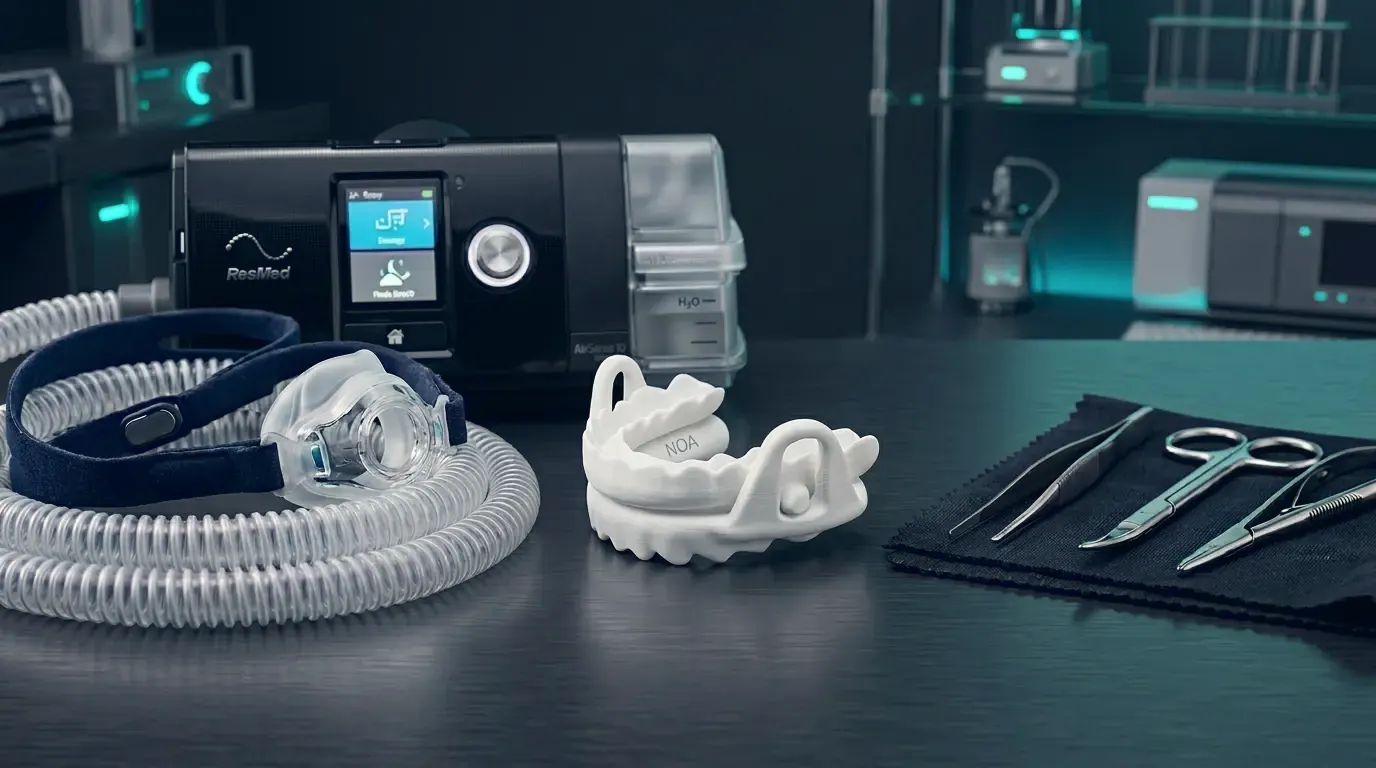
CPAP is the gold-standard treatment for sleep apnea — but up to half of patients end up not using it consistently because of the mask, the noise, dryness or claustrophobia. The good news: not tolerating CPAP does not mean staying untreated. There are effective alternatives, and the right one depends on where your airway collapses.
First step: find the point of collapse (DISE)
Before choosing an alternative, we need to know where and how your throat closes during sleep. The drug-induced sleep endoscopy (DISE) shows the exact site of obstruction and predicts which treatment will work — so we never treat blind.
What if the problem is your nose?
A blocked nose makes CPAP harder: the more nasal resistance someone had when starting, the more likely they were to reject it (Sugiura et al., Respiration, 2007). It causes mouth leaks and dryness and forces the pressure up. The NOSE nasal obstruction questionnaire measures in two minutes how blocked your nose feels, and the guide blocked nose, snoring and sleep apnea explains the causes and how they are studied.
When the cause is a deviated septum (septoplasty), enlarged turbinates (turbinate surgery) or a chronic rhinitis (rhinitis and snoring), treating it usually allows a lower pressure and better tolerance of CPAP or the oral appliance: in a meta-analysis, nasal surgery lowered the pressure needed by about 2.7 cm H₂O and increased use of the machine (Camacho et al., Sleep, 2015). On its own it does not cure the apnea.
References: Sugiura, Respiration 2007 · Camacho, Sleep 2015
Checklist of Physiological Barriers to CPAP Tolerance
Giving up CPAP is often not a matter of willpower but of specific obstacles, such as a blocked nose or insomnia, that can be treated. Check each barrier below:
Nasal Airway Resistance & Obstruction
High nasal resistance forces mouth opening during sleep, causing mouth air leaks, dry throat and requiring high CPAP pressure.
Comorbid Insomnia and Sleep Apnea (COMISA)
Frequent nocturnal awakenings cause patients to perceive the mask as an obstacle to falling back asleep, leading to removal at 2-3 AM.
Minimally Symptomatic Phenotype (Low Sleepiness)
Absence of daytime sleepiness reduces perceived immediate benefit, increasing the risk of early abandonment.
Stress Reactivity and Facial Sensitivity
Claustrophobia or anxiety upon mask fitting, especially with full-face interfaces.
Evidence-Based Second-Line Alternatives (If Intolerance Persists)
When CPAP cannot be tolerated despite anatomical and behavioral optimization, sleep medicine guidelines support specific second-line alternatives:
Custom dental splint advancing the mandible. First-line evidence-based alternative in mild-to-moderate OSA or certified CPAP intolerance.
Smart vibrational device preventing supine sleep if apneas are predominantly positional (supine AHI > 2x non-supine AHI).
Reconstructive procedures (expansion pharyngoplasty, nasal surgery, hypoglossal implant). A prior Drug-Induced Sleep Endoscopy (DISE) is recommended to see where the airway closes.
DISE RequiredPatient Decision Aid (Spanish Law 41/2002 on Patient Autonomy). This analysis is educational and orientative, based on published clinical consensus. It does not replace medical titration by your pulmonologist or sleep unit.
The real alternatives to CPAP
Mandibular advancement device (MAD)
A custom dental splint that gently moves the lower jaw forward, opening the airway. First-line option for mild-to-moderate apnea and snoring, and for travellers (no machine, no power).
Positional therapy
If your apnea happens mainly lying on your back, a smart device that nudges you onto your side can resolve a large part of it without any mask.
Myofunctional therapy
Targeted tongue and throat muscle training that tones the airway. A complement that improves results from other treatments.
Airway surgery (pharyngoplasty)
Reconstructive techniques (barbed pharyngoplasty) that widen the throat by repositioning muscle, without cutting it away. For palate/lateral-wall collapse.
Robotic surgery (TORS)
The da Vinci robot reaches the tongue base and epiglottis through the mouth, with no external incisions, for deep obstructions a mask cannot fix.
Hypoglossal nerve implant (Nyxoah)
A pacemaker for the tongue: it moves it forward with each breath. A minimally invasive surgical alternative to CPAP for moderate-to-severe apnea in selected patients.
How do we choose the right one?
There is no single best alternative — there is the best one for your anatomy and your apnea severity. A mild, positional case may resolve with a device or an oral appliance; a tongue-base collapse may need robotic surgery; a CPAP-intolerant patient with the right collapse pattern may be a candidate for the hypoglossal implant. We map this with the sleep study and the DISE, and we explain the trade-offs of each option in our guide comparing CPAP, oral appliance and surgery. The implant is compared head to head with the machine in hypoglossal nerve implant vs CPAP.
If you have given up on CPAP, the worst option is to leave the apnea untreated. Get assessed to find the alternative that fits you.
Frequently asked questions
Is it covered by my private health insurance?
It depends on your policy. Many private health insurance plans (for example Adeslas, Sanitas or DKV) cover the sleep study and some alternatives to CPAP — such as a mandibular advancement device or airway surgery — either through their medical network or by reimbursement. Coverage, prior authorisation and any co-payment vary from one plan to another, so the best step is to confirm the specific terms directly with your insurer.
What happens if I give up on CPAP?
CPAP intolerance and abandoning CPAP are very common, but stopping the machine without a replacement means the apnea goes untreated again, with its impact on rest, daytime sleepiness and cardiovascular health. So-called CPAP failure is not the end of the road: it is the moment to reassess where the airway collapses and consider an alternative — an oral appliance, positional or myofunctional therapy, surgery or the hypoglossal implant — guided by a sleep study and a DISE.
Take the next step in your evaluation
Dr. Méndez-Benegassi uses your data to answer your message. Email is not end-to-end encrypted: it can be read on the servers it passes through. Do not send medical reports or health data that way.
Data controller: Dr. Iván Méndez-Benegassi Silva, ENT physician.
Purpose: To read and answer your message. Tell us only what is essential; the rest is covered in the consultation.
Legal basis: The healthcare you are requesting (Art. 9.2.h GDPR).
Recipients: Your data is not shared with third parties; only the technical providers needed are involved, as data processors.
Your rights: Access, rectify or erase your data, object, restrict its processing and request its portability by writing to contacto@ronquidoyapneas.com. You may also lodge a complaint with the Spanish Data Protection Agency.
Full details in the Privacy policy.