
Positional Sleep Apnea Treatment
Medically reviewed by Dr. Iván Méndez-Benegassi Silva · Otorhinolaryngology (ENT) Specialist with over 25 years of experience in sleep surgery and advanced rhinology · European Board Certificate (ORL-HNS) · HM Hospitales, Madrid · License No. 282855946
Many patients suffer from Positional Obstructive Sleep Apnea (POSA), where events occur predominantly in supine position (on the back).
What is positional sleep apnea (POSA)?
POSA is a subtype of sleep apnea where the breathing events depend on body position. It is defined as POSA when the number of apneas while lying on the back (supine) is at least double that while on the side. It is common: on average around 56% of people with obstructive sleep apnea are positional (Ravesloot et al., Journal of Clinical Sleep Medicine, 2017, reporting a range of roughly 56-75% across studies).
Why does the back make it worse? Lying face-up, gravity pulls the tongue and soft palate backwards and narrows the airway; on your side, that same airway stays more open. Identifying it matters: if your apnea is essentially positional, simply avoiding the supine position can be an effective treatment on its own.
Electronic Vibration Devices
Small sensors that detect when the patient turns onto their back and emit a gentle vibration to make them change position without waking up.
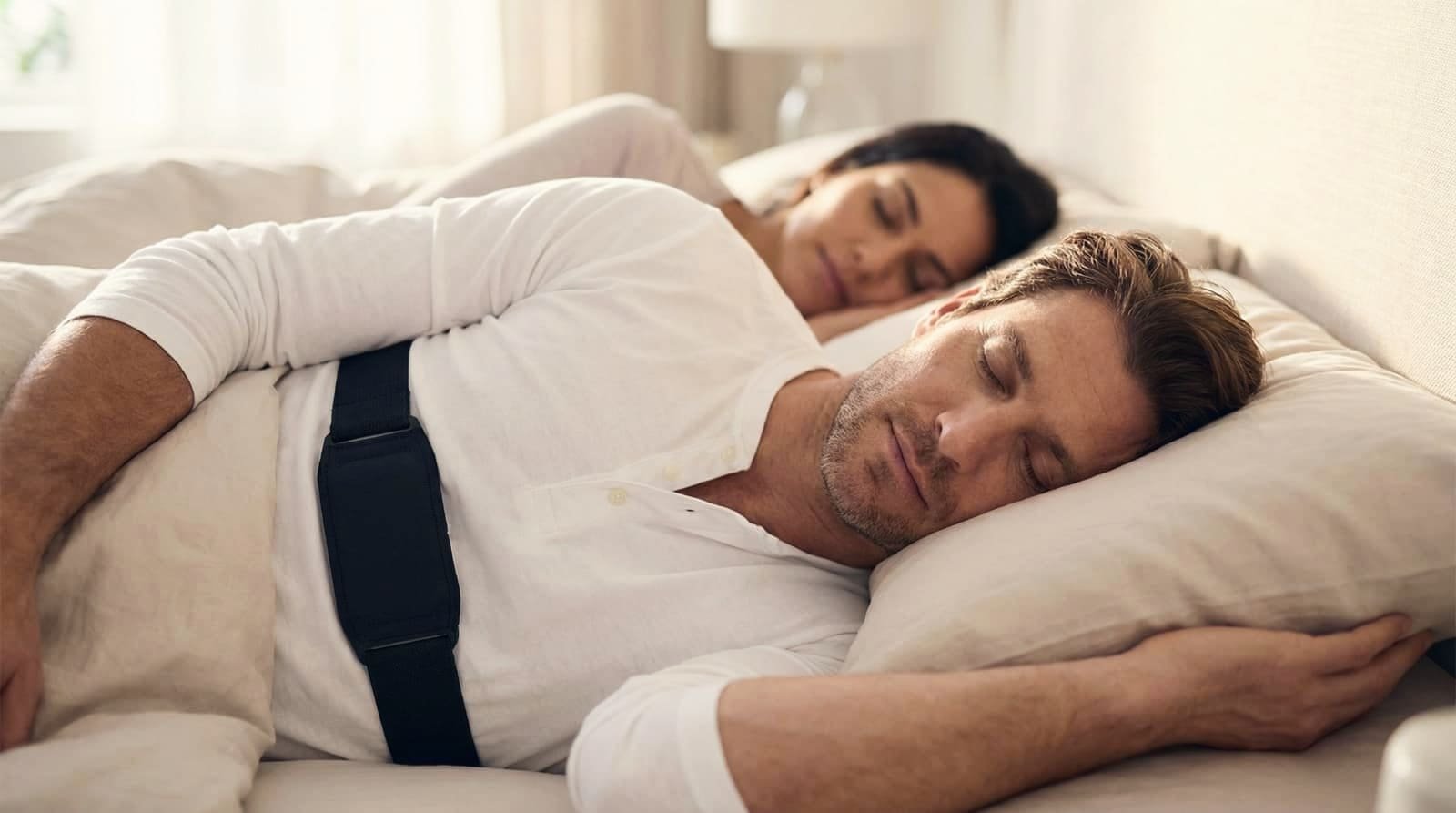
The evidence is solid. A systematic review and meta-analysis of new-generation vibratory devices (Ravesloot et al., Journal of Clinical Sleep Medicine, 2017) found a mean AHI reduction of about 54% in positional patients. In a randomized controlled trial of 101 patients, the Sleep Position Trainer brought the total AHI down from 18 to 10 events/hour in two months (Laub, Tønnesen & Jennum, Journal of Sleep Research, 2017). In a controlled comparison against the classic tennis-ball method, treatment success (AHI below 5) was reached in 68% of Sleep Position Trainer users versus 43% with the tennis ball, with better, less fragmented sleep (Eijsvogel et al., Journal of Clinical Sleep Medicine, 2015) — and the modern devices show far higher long-term adherence.
Postural Training
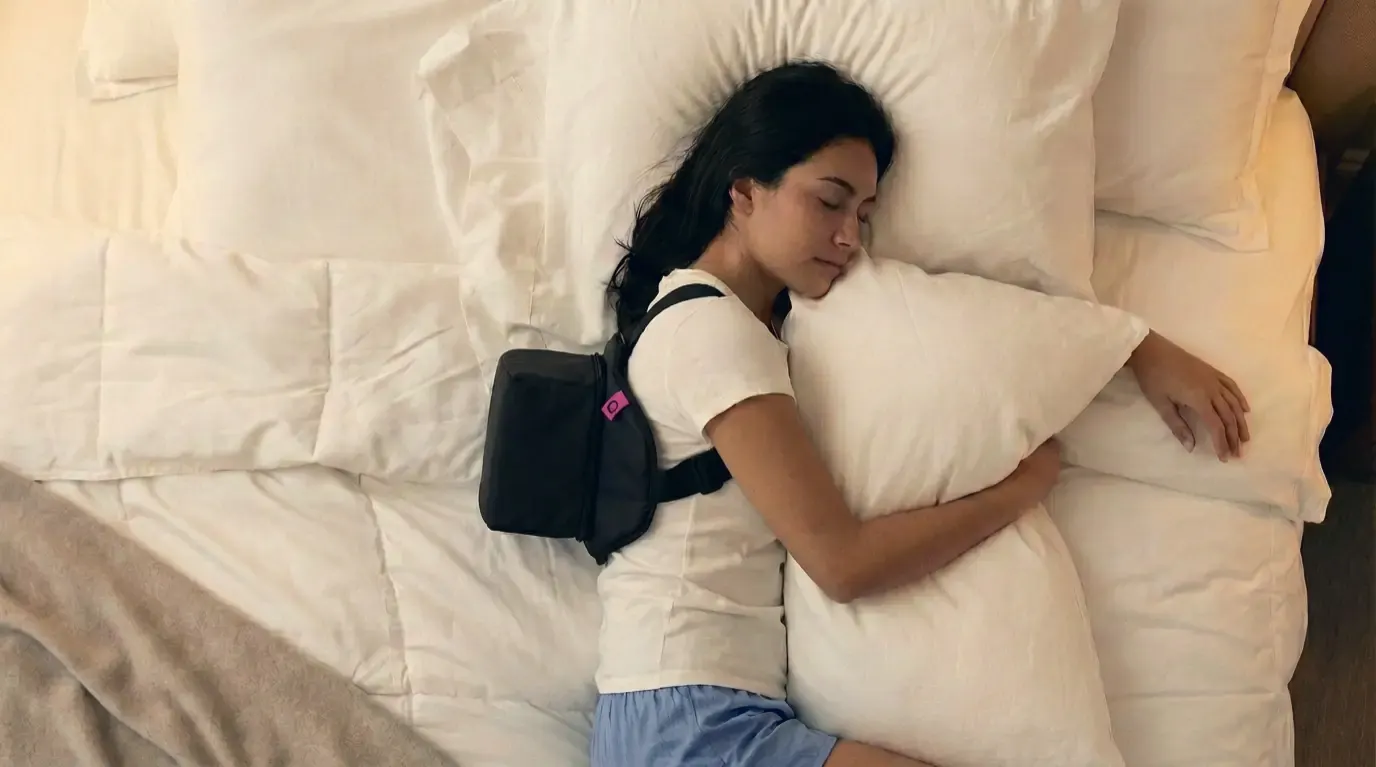
Mechanical methods designed to ensure lateral rest, optimizing air intake in a non-invasive way. The original technique sewed a tennis ball onto the back of the pyjamas to stop the patient rolling supine; it works, but many people abandon it because it is uncomfortable. The postural backpack is a more tolerable mechanical evolution of the same idea, and the electronic vibration devices solve the adherence problem altogether.
Who is it for?
- Sole treatment in pure positional apnea: When the AHI outside the supine position is already low (under 15), staying off your back can control the disease by itself.
- Add-on therapy: It lowers the CPAP pressure needed, or combines with a mandibular advancement device (MAD) when there is also an anatomical component.
- Confirmed on DISE: During the sleep endoscopy we perform a positional manoeuvre: lying on the side is more effective than just turning the head, and it shows whether the airway truly opens before we indicate the therapy.
Compared head-to-head with a MAD in positional apnea, both effectively lower the AHI; in a systematic review and meta-analysis of randomized trials, the MAD reduced events further outside the supine position and improved daytime sleepiness more (Mohamed et al., BMC Oral Health, 2024). That is why, when there is also an anatomical component, the two are often combined rather than chosen one over the other.
Advantages
- No mask, no tubes, no noise or pressure on the face.
- Completely reversible and with no surgical risk.
- Minimal cost and far better long-term adherence than CPAP.
- Recognised by international guidelines (AASM) as an option for the positional patient.
We confirm it is working
Positional therapy is not a "fit and forget" device. After starting it we repeat a sleep study (home respiratory polygraphy) to confirm the disease is actually controlled — this verification is exactly what the consensus guidelines recommend, and it is how we make sure the therapy is enough for you.
Frequently asked questions
Does the tennis ball on the back work to stop sleeping on your back?
It works because of the simple idea behind it: anything that stops you turning onto your back keeps the airway more open. The drawback is comfort — the original tennis-ball method is uncomfortable and many people abandon it. The postural backpack and, above all, the electronic vibration devices apply the same principle in a more tolerable way and with much better long-term adherence.
How much can the AHI drop with positional therapy?
In patients whose apnea is genuinely positional, avoiding the supine position can lower the AHI substantially, and in pure positional cases it may control the disease on its own. The exact reduction depends on each person and on how positional the apnea is. We confirm the result with a follow-up sleep study rather than assuming it.
Does it help if my apnea is not only positional?
It can still help as an add-on therapy. In mixed cases it is combined with an oral appliance (MAD) or with CPAP, where it can reduce the pressure needed. When the apnea is severe outside the supine position, positional therapy alone is not enough and another treatment leads.
What devices exist (belts, vibrating sensors)?
There are mechanical options — the classic tennis ball sewn onto the pyjamas and the more comfortable postural backpack — and electronic options: small sensors worn on the chest or neck that detect the supine position and emit a gentle vibration to prompt a change of side without waking you. The electronic devices are the best tolerated and the easiest to keep using over time.
Take the next step in your evaluation
Dr. Méndez-Benegassi uses your data to answer your message. Email is not end-to-end encrypted: it can be read on the servers it passes through. Do not send medical reports or health data that way.
Data controller: Dr. Iván Méndez-Benegassi Silva, ENT physician.
Purpose: To read and answer your message. Tell us only what is essential; the rest is covered in the consultation.
Legal basis: The healthcare you are requesting (Art. 9.2.h GDPR).
Recipients: Your data is not shared with third parties; only the technical providers needed are involved, as data processors.
Your rights: Access, rectify or erase your data, object, restrict its processing and request its portability by writing to contacto@ronquidoyapneas.com. You may also lodge a complaint with the Spanish Data Protection Agency.
Full details in the Privacy policy.