
Mandibular Advancement Device (MAD)
Medically reviewed by Dr. Iván Méndez-Benegassi Silva · Otorhinolaryngology (ENT) Specialist with over 25 years of experience in sleep surgery and advanced rhinology · European Board Certificate (ORL-HNS) · HM Hospitales, Madrid · License No. 282855946
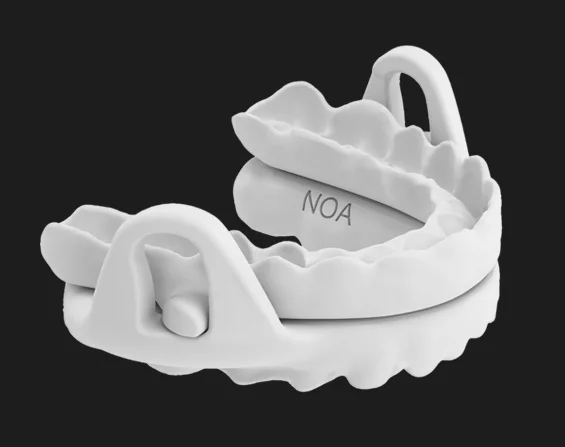
The MAD — also called an oral appliance or anti-snoring splint — is a custom intraoral device the patient wears only for sleeping. Its function is to slightly advance the jaw and, with it, the tongue, increasing the diameter of the airway and reducing or eliminating vibration (snoring) and obstruction (apneas).
Dentist or doctor? Diagnosis first, fabrication after
Many people think of the device as "the dentist’s snoring guard". In reality it is a two-step, coordinated treatment: first a sleep physician confirms the diagnosis and the indication; only then does a qualified dentist fabricate and adjust the custom appliance. Buying a generic device without a prior diagnosis can quiet the snoring while leaving the apnea untreated.
- The sleep physician diagnoses and indicates: sleep study (sleep test) plus, in our clinic, validation of the collapse pattern with DISE.
- A dental health check beforehand, to rule out gum or tooth problems that would contraindicate the device.
- An expert dentist fabricates the custom device and titrates the millimetric advancement.
- Joint follow-up of both efficacy and the bite.
Source: international consensus document on obstructive sleep apnea (Arch Bronconeumol, 2021) — recommends custom, adjustable devices with a prior dental assessment and follow-up by an expert dentist working with the sleep unit.
Orthoapnea NOA®
We work with the Orthoapnea NOA® device, manufactured in Spain with medical-grade biocompatible material. Its articulated design allows millimetric, patient-by-patient titration of jaw advancement.
- Custom-made from dental impressions
- Adjustable millimetric advancement
- Freedom of lateral jaw movement
- Medical-grade biocompatible material
DISE: the right way to indicate the device
The most reliable way to know whether a device will work for you is to watch your airway while you sleep. In Drug-Induced Sleep Endoscopy (DISE) we reproduce the effect of the appliance with a mandibular advancement maneuver (jaw thrust) or a simulation bite: if the airway opens at that moment, the definitive device is more likely to work too. This is why we check it BEFORE fabricating — to avoid making (and charging for) a device that was never going to help.
The evidence backs this: a positive jaw-thrust maneuver during DISE is significantly associated with a good oral-appliance response, while a lateral oropharyngeal collapse that persists despite advancement points to a poor response. DISE shows the airway collapsing in real time, which reflects real sleeping conditions better than a static image.
Honest note: DISE guides the indication, it is not an absolute guarantee — a positive test predicts response, and the final efficacy is confirmed with follow-up.
References: Veugen et al., prospective study — a positive jaw-thrust maneuver during DISE predicts oral-appliance success (J Clin Sleep Med, 2024); Cebola et al., systematic review of DISE vs CT to predict MAD effectiveness (PLOS One, 2025); European Respiratory Society review confirming DISE improves patient selection for MAD (Breathe/ERS, 2022).
The appliance test during sleep endoscopy (DISE-SAM protocol): measuring the advancement with the SAM
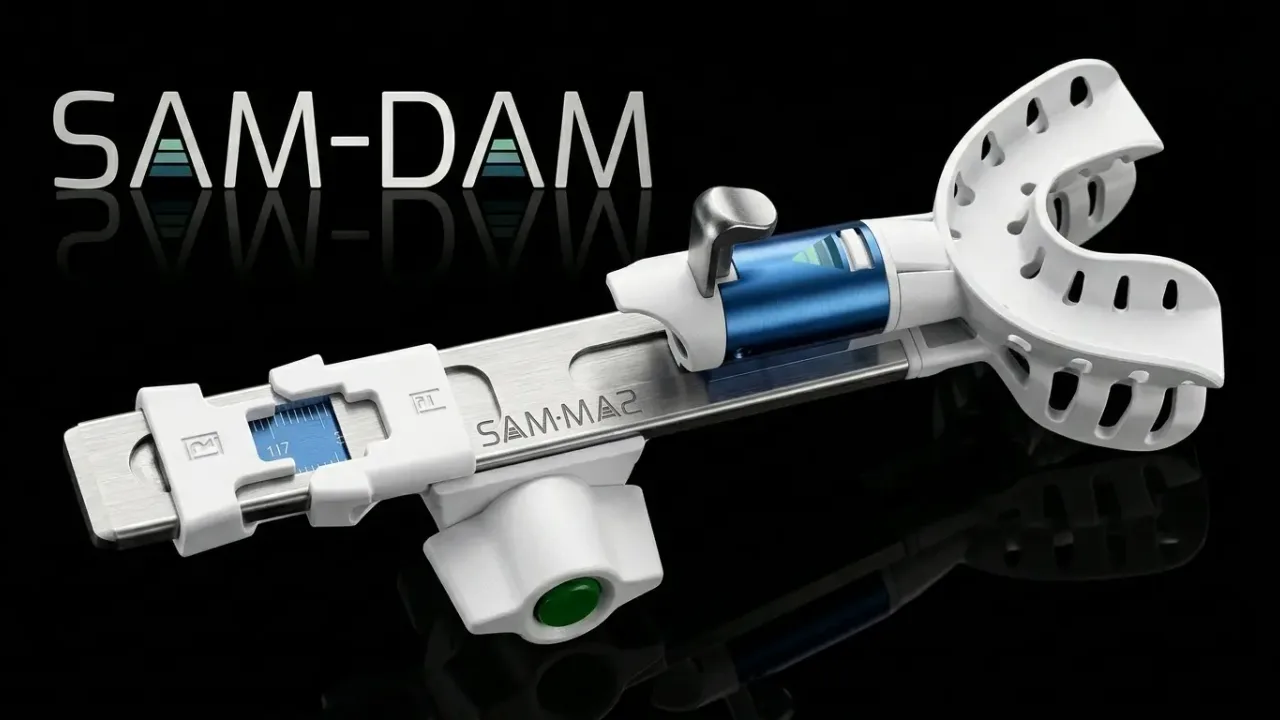
To turn the DISE from "a look" into a more objective, reproducible measurement, we use a titratable mandibular positioner — the SAM (Mandibular Advancement Selector) — during the endoscopy. Instead of guessing the advancement, the SAM moves the jaw in millimetric, measurable steps (a range from −20 to +20 mm) while we watch how the airway responds at each level and score the collapse (VOTE). This identifies the minimum effective advancement for each patient and reduces examiner bias.
The protocol gives a clear, four-tier recommendation:
- S (Single): the device alone, when advancement clears all the collapse.
- A (Alternative): the device as an alternative, when it improves at least half of the collapse levels.
- M (Multiple): only combined with surgery or CPAP.
- No recommendation: when advancement does not open the airway or makes it worse.
In the validation study of 161 patients, the device was recommended in 73.9% of cases — and, crucially, the recommendation did not depend on apnea severity: 64.8% of patients with severe apnea could still benefit, because what matters is whether the collapse responds to advancement, not the AHI number alone.
Reference: Fernández-Sanjuán P, et al. Optimizing Mandibular Advancement Maneuvers during Sleep Endoscopy with a Titratable Positioner: DISE-SAM Protocol. J Clin Med. 2022;11(3):658 (doi:10.3390/jcm11030658). Awarded the 2020 Clinical Research Award by the American Academy of Dental Sleep Medicine.
Indication depends on the collapse pattern, not only severity
Beyond apnea severity (mild-to-moderate, or severe with CPAP intolerance), the decisive factor is WHERE and HOW the airway collapses. The DISE classifies the pattern, and the pattern predicts the MAD response:
Favorable (responds)
- Anteroposterior tongue-base collapse: the strongest positive predictor (~3.7× higher odds of response).
- Anteroposterior palatal collapse.
- Grade 1 (mild) epiglottic collapse.
- Partial (non-complete) collapses.
Adverse (may worsen)
- Complete concentric palatal collapse: predicts deterioration (~5.3× higher odds).
- Complete latero-lateral collapse of the oropharyngeal walls: strongest predictor of deterioration (~6.6× higher odds).
- Grade 2 (complete) epiglottic collapse.
This is what the DISE advancement simulation checks before fabricating the device: whether your collapse pattern is one that tends to respond.
Clinical Efficacy
The MAD is considered the first-line alternative to CPAP by the main international sleep medicine guidelines (AASM, ERS). Its efficacy has been scientifically demonstrated for:
- Simple snoring: Eliminates or significantly reduces palatal and oropharyngeal vibration.
- Mild-moderate OSA: As primary treatment, with response rates above 70% when properly selected with DISE.
- Severe OSA with CPAP intolerance: Alternative for patients who cannot tolerate positive pressure.
- Combined therapy: Can be combined with positional therapy or myofunctional therapy for enhanced results.
If you are not getting on with CPAP, CPAP intolerance: what real alternatives do I have? compares all the options; and if you use CPAP and worry about taking it on a trip, read CPAP for travel and summer.
References: AASM/AADSM clinical practice guideline for oral appliance therapy (J Clin Sleep Med, 2015); European Respiratory Society review — MAD is the most used non-CPAP treatment and DISE improves patient selection (Breathe/ERS, 2022); custom devices are significantly more effective than boil-and-bite ones at reducing the AHI (Sleep Medicine Reviews, 2021).
Adaptation and Side Effects
Most patients adapt within 1-2 weeks. Possible initial effects include:
- Temporary salivation increase
- Mild jaw discomfort upon waking (resolves in minutes)
- Slight bite changes (monitored at follow-up visits)
Regular follow-up with the specialist makes it possible to fine-tune the advancement and to detect any dental change early.
Enhance your results
Combining the MAD with Myofunctional Therapy (tongue and pharyngeal muscle training) can reduce the advancement needed and improve long-term outcomes.
Learn about Myofunctional TherapyFrequently asked questions
Does the device move the teeth over time?
A custom, well-titrated device produces minimal, slow and largely reversible bite changes in most people. That is precisely why follow-up visits exist: the specialist monitors the bite and detects any change early so it can be managed. It is not the same as wearing it without supervision.
How long does it take to get used to it?
Most patients adapt within one to two weeks. At first there may be extra salivation or mild jaw discomfort on waking that resolves within minutes. The millimetric advancement is increased gradually, which makes adaptation easier.
Is it only for snoring or also for apnea?
Both. It can eliminate or greatly reduce simple snoring, and it is considered the first-line alternative to CPAP for mild-to-moderate obstructive sleep apnea. The right indication depends on the collapse pattern, which is why we validate it with DISE beforehand.
Is it covered by private insurance / how much does it cost?
It depends on each policy. Many private plans reimburse part or all of an oral appliance for sleep apnea, but coverage and conditions vary, so the best step is to ask your insurer directly with the medical indication in hand. Cost is discussed individually in consultation, not online.
Does it work if I cannot tolerate CPAP?
Yes, that is one of its main uses. For people who do not tolerate positive pressure, the device is the recognised alternative, including selected severe cases. Whether it will be effective for you depends on your collapse pattern, which is assessed before fabrication.
Is an over-the-counter (boil-and-bite) device as good as a custom one?
No. Thermoformed pharmacy devices are not adjustable, fit poorly and offer no specialist follow-up to control efficacy or protect the bite. A custom device is made to your impressions, allows millimetric titration and is supervised; that difference is what determines whether it is both safe and effective.
Does the dentist or the sleep doctor provide the device?
Both, in a coordinated way. First the sleep physician confirms the diagnosis and the indication — with the sleep study and, in our clinic, by validating the collapse pattern with DISE; then an expert dentist fabricates the custom device and adjusts it, after checking your oral health. Buying an appliance without that prior diagnosis can silence the snoring and leave the apnea untreated.
Do I need a sleep study before the device?
Yes. You have to diagnose before you treat: a sleep study (home sleep test or polysomnography) measures how many apneas you have and how severe they are. On that diagnosis we decide whether the device is the right option and, in our clinic, we check with DISE whether your airway responds to jaw advancement before fabricating it.
What is the DISE-SAM protocol and the SAM (Mandibular Advancement Selector)?
The DISE-SAM protocol is the appliance test done during sleep endoscopy (DISE). The SAM (Mandibular Advancement Selector) is a titratable positioner that advances the jaw in millimetric, measurable steps while we see how the airway responds at each level. With that, the recommendation about whether a mandibular advancement device is likely to work, and what minimum advancement each patient needs, is more objective and reproducible. In its validation study (161 patients), the device was recommended in 73.9% of cases, independently of apnea severity.
Take the next step in your evaluation
Dr. Méndez-Benegassi uses your data to answer your message. Email is not end-to-end encrypted: it can be read on the servers it passes through. Do not send medical reports or health data that way.
Data controller: Dr. Iván Méndez-Benegassi Silva, ENT physician.
Purpose: To read and answer your message. Tell us only what is essential; the rest is covered in the consultation.
Legal basis: The healthcare you are requesting (Art. 9.2.h GDPR).
Recipients: Your data is not shared with third parties; only the technical providers needed are involved, as data processors.
Your rights: Access, rectify or erase your data, object, restrict its processing and request its portability by writing to contacto@ronquidoyapneas.com. You may also lodge a complaint with the Spanish Data Protection Agency.
Full details in the Privacy policy.