
CPAP is the gold standard for sleep apnea, but many patients cannot live with the mask. The hypoglossal nerve implant — a "pacemaker for the tongue" — is a surgical alternative for selected patients. Here is how they really compare.
The DISE decides candidacy
The implant is not for everyone with apnea. A drug-induced sleep endoscopy (DISE) must confirm the collapse pattern: if the throat closes in a complete concentric ring, the implant will not work and we choose another path. This selection is exactly what makes results reliable.
Who fits: the numbers
The implant is reserved for moderate-to-severe apnea in well-selected patients. The usual criteria are:
- ·Apnea-hypopnea index (AHI) between 15 and 65 events per hour.
- ·Body-mass index (BMI) under 32: in higher BMI the bulkier tongue and throat respond worse.
- ·Documented CPAP intolerance or failure.
- ·A DISE that rules out complete concentric collapse.
Two models, two designs
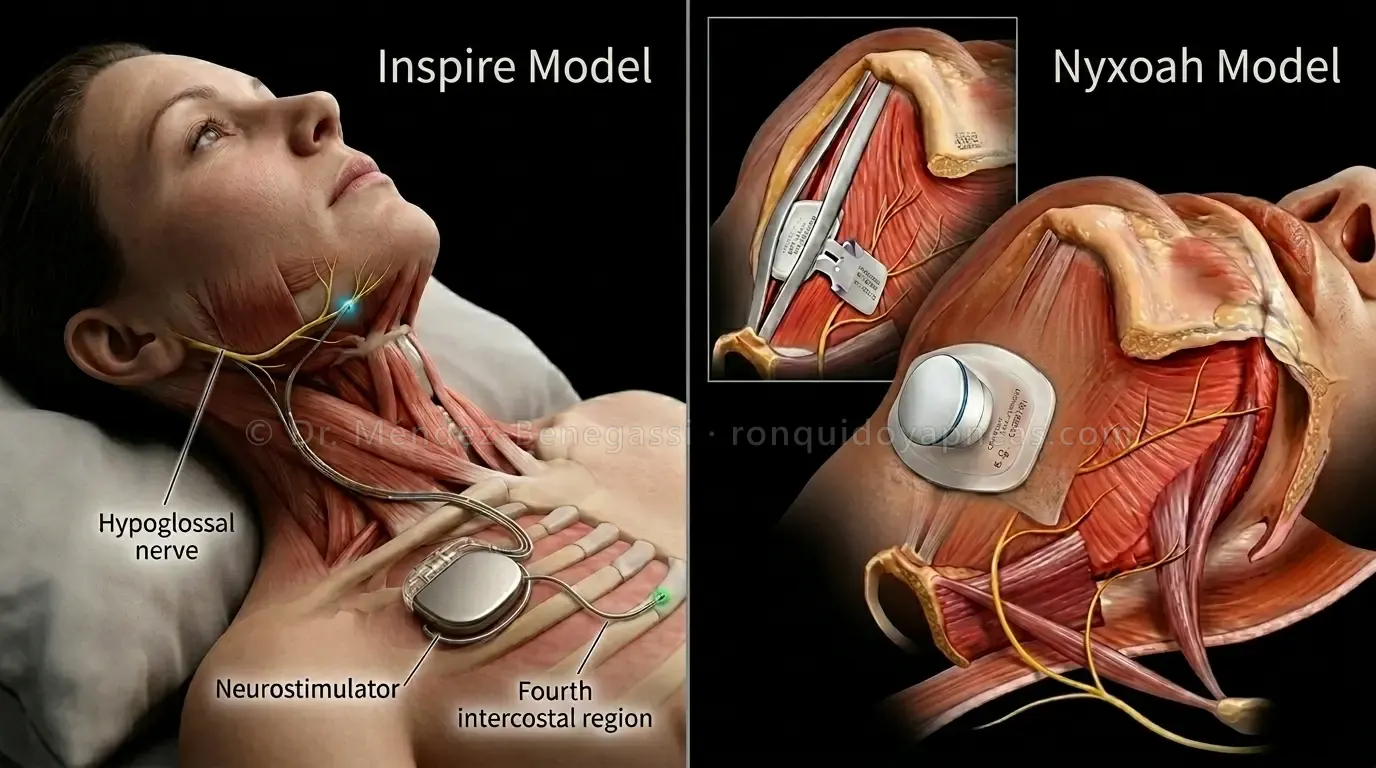
Not all hypoglossal implants are built the same. Where the stimulator sits depends on the model:
Inspire: a complete implant. A pulse generator is placed under the skin of the chest (below the collarbone), connected to a cuff on the hypoglossal nerve. You switch it on each night with a handheld remote.
Nyxoah Genio: the implanted chip carries no battery. It is powered each night by a small external disposable patch worn under the chin — nothing is implanted in the chest.
Who is each one for?
CPAP first if you tolerate it: it is non-surgical, works at any severity and is reversible every night.
Hypoglossal implant if you cannot tolerate CPAP, have moderate-to-severe apnea and the DISE confirms a suitable collapse pattern.
Not a candidate for the implant? There are other surgical and conservative options — see the CPAP alternatives guide.
Want to know if the implant fits your case? It starts with a sleep study and a DISE.
Take the next step in your evaluation
Dr. Méndez-Benegassi uses your data to answer your message. Email is not end-to-end encrypted: it can be read on the servers it passes through. Do not send medical reports or health data that way.
Data controller: Dr. Iván Méndez-Benegassi Silva, ENT physician.
Purpose: To read and answer your message. Tell us only what is essential; the rest is covered in the consultation.
Legal basis: The healthcare you are requesting (Art. 9.2.h GDPR).
Recipients: Your data is not shared with third parties; only the technical providers needed are involved, as data processors.
Your rights: Access, rectify or erase your data, object, restrict its processing and request its portability by writing to contacto@ronquidoyapneas.com. You may also lodge a complaint with the Spanish Data Protection Agency.
Full details in the Privacy policy.