
The mandibular advancement device (MAD) is an excellent treatment for snoring and mild-to-moderate apnea — but it does not work for everyone, and a custom appliance is an investment. The question is: how do we know if it will work for YOU before you pay for it? The answer is a sleep endoscopy with an advancement simulation.
What the DISE answers
The drug-induced sleep endoscopy (DISE) lets us look at your throat during medication-induced sleep and, crucially, simulate the forward movement of the jaw that the MAD produces. We watch live whether your airway opens with that movement.
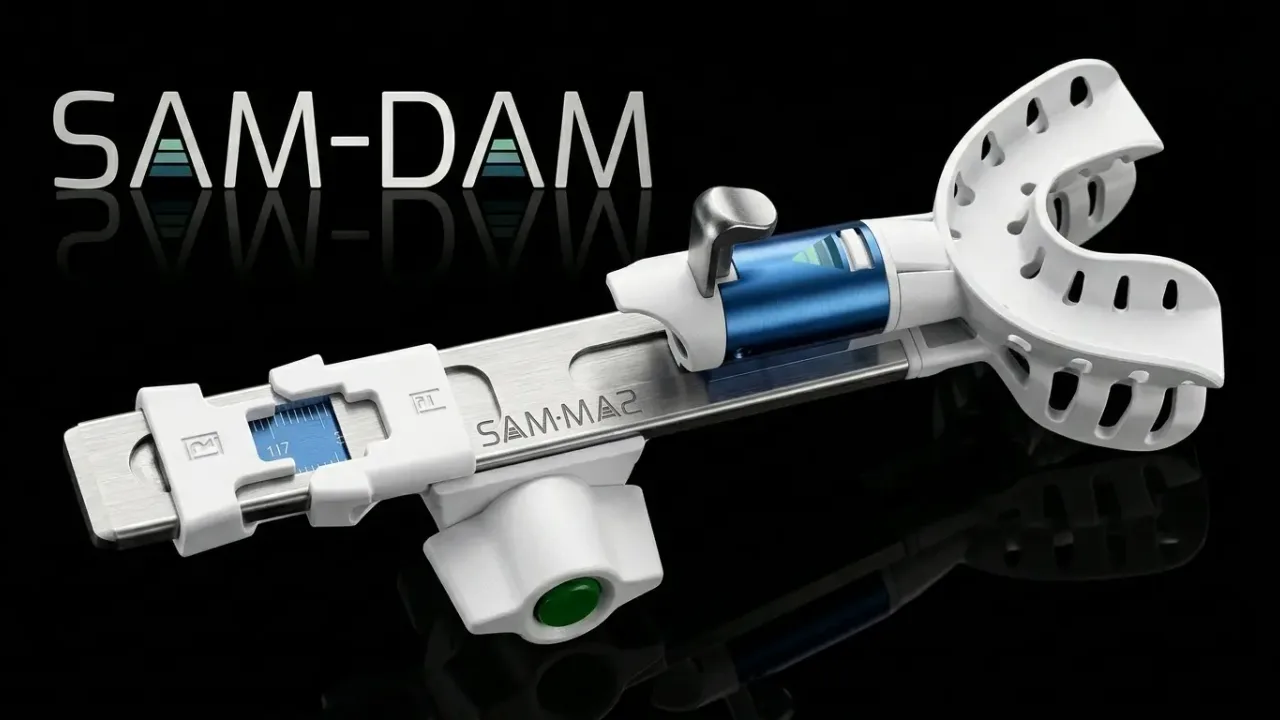
We do this with a positioner that moves the jaw forward in measured steps, the Mandibular Advancement Selector (SAM). This appliance test during sleep endoscopy is called the DISE-SAM protocol, a measurable and repeatable method. You can read the technical detail on the mandibular advancement device.
How it works, step by step
Light, controlled sedation
In the operating room, medication induces a sleep as close as possible to natural sleep — no intubation, you wake up within minutes.
We watch the airway live
A flexible camera shows at which level of the throat the airway closes, and how, while you sleep.
Jaw-advancement simulation
We hold the lower jaw forward with a titratable mandibular advancement selector (SAM), in steps measured in millimetres, and watch whether the airway opens on screen.
Evidence-based decision
If the airway opens with advancement, a MAD is more likely to work for you. If it does not, you know before ordering an appliance that would probably not be enough.
Why not just try the appliance?
A pharmacy "boil-and-bite" appliance is bulky, can harm the jaw joint and — lacking millimetric adjustment — tends to unseat during the night and stop working, and over time it can shift the teeth in unwanted ways. A custom MAD takes weeks and money. Above all, fitting one without knowing the collapse pattern is treating blind: the most common reasons a device fails are poor adaptation, lateral collapse of the oropharyngeal walls, and trapdoor-type epiglottic collapse — not problems the appliance solves.
It is not only about severity — the collapse pattern decides
A MAD is not indicated by your apnea severity alone (mild-to-moderate, or severe if you cannot tolerate CPAP). It also depends on WHERE and HOW the airway closes. The DISE classifies that pattern, and the pattern predicts whether the appliance will respond:
Patterns that respond well
- Tongue-base collapse closing front-to-back (anteroposterior): the best predictor — close to four times more likely to respond.
- Anteroposterior collapse of the soft palate.
- Mild (grade 1) epiglottic collapse.
- Partial, not complete, collapses.
Patterns where the MAD may fail or worsen it
- Complete concentric collapse of the palate (the airway closes like a ring): predicts worsening — over five times the risk.
- Complete side-to-side collapse of the pharyngeal walls: the strongest predictor of worsening — over six times the risk.
- Complete (grade 2) epiglottic collapse.
This is why the advancement simulation does not just check "does it open?" but also which pattern you have — that is what separates a MAD that works from one that disappoints.
If the simulation shows the MAD will not be enough, that is valuable information too: we move to the right option, comparing it in our CPAP vs appliance vs surgery guide, or in the CPAP alternatives guide.
Considering an oral appliance? Make the decision with evidence, not guesswork.
The titratable mandibular positioner (SAM) versus the manual jaw thrust
Not all advancement simulations are equal. The classic way is to push the jaw forward by hand during the endoscopy — quick, but impossible to measure or repeat. The titratable mandibular positioner (SAM, Mandibular Advancement Selector) turns that maneuver into a measurement in millimetres that can be repeated, which is the foundation of the DISE-SAM protocol.
Titratable positioner (SAM)
- Advancement measured in millimetres (−20 to +20 mm).
- Measurable and reproducible — it can be repeated with the same method.
- More objective recommendation (DISE-SAM protocol).
- Identifies the minimum effective advancement for you.
Manual jaw thrust
- Approximate push, not measured.
- Depends on the examiner — hard to repeat.
- Subjective, examiner-dependent result.
- No measured figure for the appliance.
Frequently asked questions
What is the titratable mandibular positioner (SAM)?
It is a positioner placed during drug-induced sleep endoscopy (DISE) that advances the lower jaw in millimetric, measurable and reproducible steps (from −20 to +20 mm). It lets us see, level by level, how much advancement is needed to open your airway and whether the oral appliance is likely to work for you. It is the basis of the DISE-SAM protocol (the appliance test during sleep endoscopy).
How is it different from the traditional manual jaw thrust?
Pushing the jaw forward by hand during the endoscopy is neither measurable nor reproducible and depends on the examiner. The SAM gives a measured advancement figure and reduces that bias, so the recommendation is more objective and repeatable.
Does it work even if my apnea is severe?
It can. In the validation study the appliance recommendation did not depend on severity: 64.8% of patients with severe apnea could still benefit, because what matters is whether your collapse responds to advancement, not the AHI figure.
References
- Fernández-Sanjuán P, et al. Optimizing Mandibular Advancement Maneuvers during Sleep Endoscopy with a Titratable Positioner: DISE-SAM Protocol. J Clin Med. 2022;11(3):658. doi:10.3390/jcm11030658. (Mandibular advancement device recommended in 73.9% of 161 patients, independently of apnea severity. 2020 Clinical Research Award, American Academy of Dental Sleep Medicine.)
- Veugen CCAFM, et al. The predictive value of mandibular advancement maneuvers during drug-induced sleep endoscopy for treatment success of oral appliance treatment: a prospective study. J Clin Sleep Med. 2024. (A positive jaw-thrust maneuver predicts a good appliance response; persistent lateral oropharyngeal collapse predicts a poor one.)
- Cebola P, et al. Computed tomography versus sleep endoscopy (DISE) to predict the effectiveness of mandibular advancement devices in adults with OSA: a systematic review. PLOS One. 2025. doi:10.1371/journal.pone.0327974.
Take the next step in your evaluation
Dr. Méndez-Benegassi uses your data to answer your message. Email is not end-to-end encrypted: it can be read on the servers it passes through. Do not send medical reports or health data that way.
Data controller: Dr. Iván Méndez-Benegassi Silva, ENT physician.
Purpose: To read and answer your message. Tell us only what is essential; the rest is covered in the consultation.
Legal basis: The healthcare you are requesting (Art. 9.2.h GDPR).
Recipients: Your data is not shared with third parties; only the technical providers needed are involved, as data processors.
Your rights: Access, rectify or erase your data, object, restrict its processing and request its portability by writing to contacto@ronquidoyapneas.com. You may also lodge a complaint with the Spanish Data Protection Agency.
Full details in the Privacy policy.