
CPAP for Travel and Summer: Maintaining Your Treatment
Reviewed by Dr. Iván Méndez-Benegassi Silva
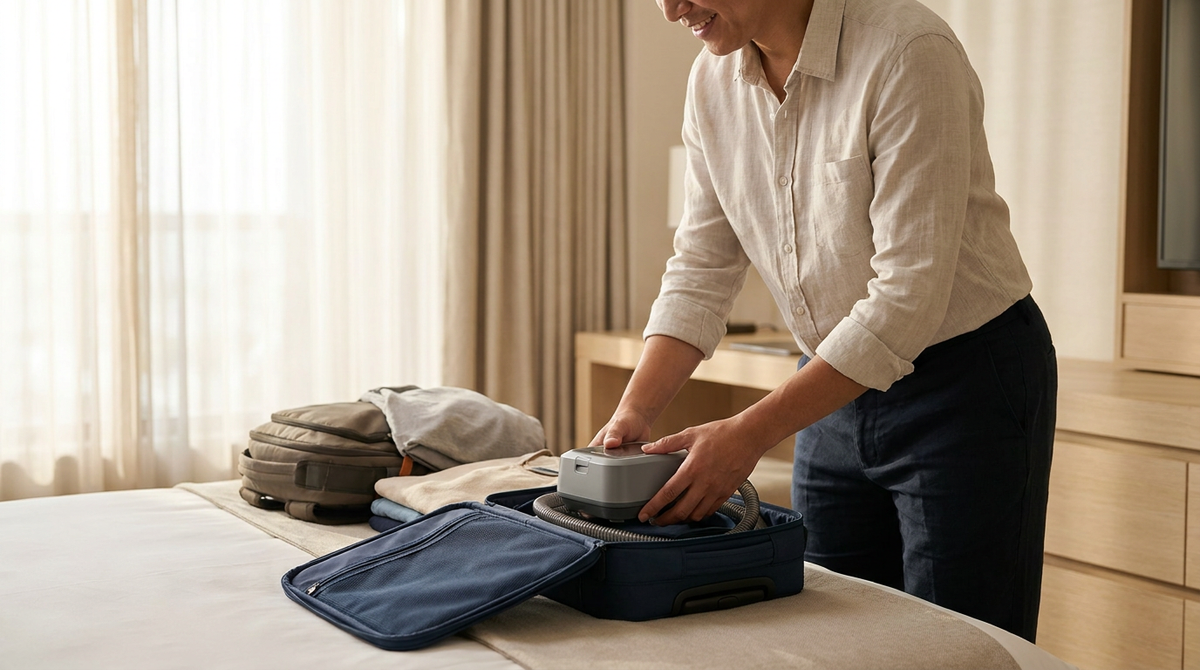
This guide provides practical advice for CPAP users to maintain treatment continuity during travel and the summer season, covering equipment preparation and adaptation to different environments. It is crucial to remember that this information is general and does not replace consultation with a specialist.
The Importance of CPAP Treatment Continuity
CPAP (Continuous Positive Airway Pressure) treatment is the gold standard therapy for moderate to severe obstructive sleep apnea (OSA). Its primary function is to keep the airway open during sleep, preventing breathing interruptions. For it to be effective, consistent use is crucial. The threshold generally used to consider treatment adherent is at least 4 hours per night on 70% of nights [4].
Interrupting treatment, even for a few days of holiday, reverses the benefits quickly. In a randomised trial that withdrew CPAP for two weeks, the apnea-hypopnea index rose from 2.8 to 33.2 events per hour and sleepiness returned within days [3]. Therefore, planning how to maintain CPAP use is fundamental for overall health and well-being, especially during periods of increased mobility like summer.
Preparing Your CPAP Equipment for Travel
Before any trip, it is essential to perform a thorough check of your CPAP equipment. Ensure that all components are working correctly and that you have the necessary accessories. This includes checking the condition of the mask, tubing, and humidifier, if you use one.
It is advisable to carry a universal power adapter if traveling internationally, as well as an external battery or a car power inverter if you plan stays in places without access to mains electricity. Device portability is an important factor to consider when choosing CPAP equipment, especially for frequent travelers.
Traveling with Your CPAP: Practical Tips
When flying, most airlines allow CPAP equipment as additional carry-on luggage at no extra cost, as it is considered a medical device. It is advisable to carry a copy of your medical prescription or a certificate confirming the need for the device.
During transit, keep the equipment in its original case to protect it from bumps and dirt. If you use a humidifier, empty the water before flying to prevent spills and potential damage. Regular cleaning of the equipment is even more important during travel to prevent infections, especially in new environments.
Adapting to Different Environments and Climates
Summer and travel can involve changes in climate and environment, which may affect the comfort of CPAP use. If you travel to places with dry climates or intense air conditioning, your CPAP's heated humidifier can be a great ally in preventing nasal and oral dryness. Make sure you have access to distilled water for its use.
In noisy environments, such as hotels or campsites, consider bringing earplugs for yourself or your companions, although modern CPAP devices are usually quite quiet. Telemonitoring can help detect and correct adaptation problems, although trial results are mixed [5].
Managing Common Travel Problems
If you experience difficulties with your CPAP during travel, such as mask leaks or dryness, try adjusting the mask or checking the humidifier's humidity levels. In some cases, a spare mask or a different type (nasal, oronasal, or nasal pillows) may be helpful if your current one does not adapt well to the conditions.
If air pressure is uncomfortable, some automatic CPAP (APAP) devices adjust pressure according to needs, which can improve tolerance. If pressure intolerance persists, a BPAP (Bilevel Positive Airway Pressure) device, which offers two pressure levels, could be considered. Do not hesitate to contact your specialist if problems persist, as proper follow-up is key to adherence.
Alternatives and Additional Considerations
Although CPAP is the primary treatment, in cases of intolerance or specific situations, alternatives exist. These include positional therapy, mandibular advancement devices (MADs), or, in some cases, surgery. However, these alternatives are usually considered if CPAP is not tolerated or if the case is mild-moderate. The choice of the appropriate alternative depends on a medical evaluation that identifies the point of airway collapse.
Remember that this guide offers general information. Evaluation and follow-up by a specialist are essential to ensure the effectiveness and safety of your treatment, especially in the face of any changes or difficulties. Remote follow-up can help correct side effects without waiting for the next appointment, although it does not improve adherence in every study [5].
Frequently asked questions
Can I take my CPAP on a plane?
Yes, most airlines allow CPAP equipment as additional carry-on luggage free of charge, as it is a medical device. It is advisable to carry a medical prescription.
What should I do if my CPAP causes dryness in a different climate?
If you travel to a dry climate, use your CPAP's heated humidifier and ensure you have distilled water. Adjusting humidity levels can improve comfort.
Do I need a special power adapter for my CPAP abroad?
Yes, if you are traveling internationally, it is highly recommended to bring a universal power adapter to ensure compatibility with different plug types and voltages.
References
- Treatment of Obstructive Sleep Apnea: Choosing the Best Positive Airway Pressure Device. (2020)
- Treatment of Obstructive Sleep Apnea: Choosing the Best Positive Airway Pressure Device. (2017)
- Effects of Continuous Positive Airway Pressure Therapy Withdrawal in Patients with Obstructive Sleep Apnea: A Randomized Controlled Trial (2011)
- Positive Airway Pressure (PAP) Devices for the Treatment of Obstructive Sleep Apnea (LCD L33718) (2024)
- One-Year Adherence to Continuous Positive Airway Pressure With Telemonitoring in Sleep Apnea Hypopnea Syndrome: A Randomized Controlled Trial (2021)
Informational content reviewed by Dr. Méndez-Benegassi. It does not replace a medical consultation.