
Snoring vs sleep apnea: how to tell them apart
Medically reviewed by Dr. Iván Méndez-Benegassi Silva · Otorhinolaryngology (ENT) Specialist with over 25 years of experience in sleep surgery and advanced rhinology · European Board Certificate (ORL-HNS) · HM Hospitales, Madrid · License No. 282855946
Simple snoring is only noise: the airway vibrates but breathing and oxygen stay normal. Obstructive sleep apnea adds repeated breathing pauses of at least ten seconds, with oxygen drops and brief arousals. Witnessed pauses, choking, snoring that stops and restarts with a gasp, and daytime sleepiness point toward apnea — and only a sleep study can confirm it.
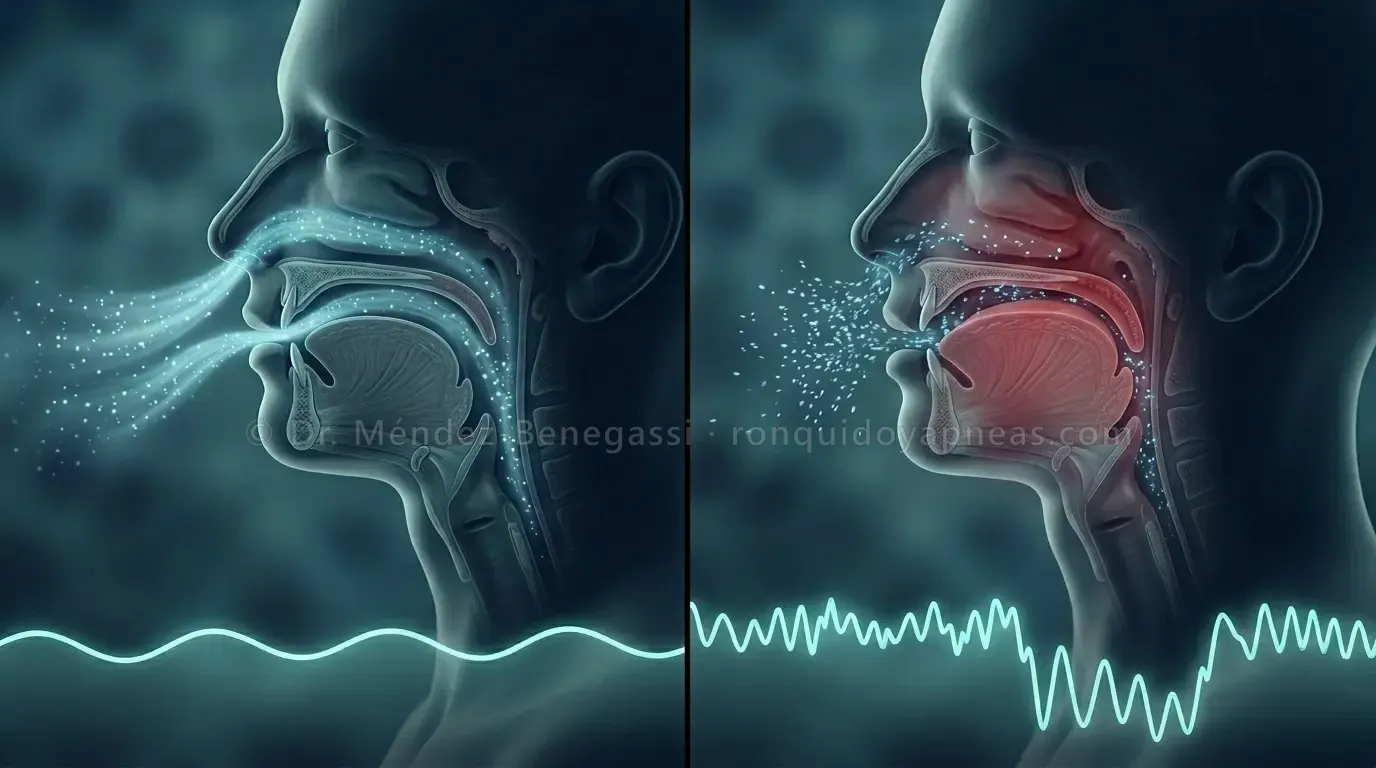
Simple snoring vs sleep apnea at a glance
| Feature | Simple snoring | Obstructive sleep apnea |
|---|---|---|
| Breathing | Continuous, no pauses | Repeated pauses (≥10 s) |
| Blood oxygen | Normal | Drops during the pauses |
| Sound | Regular, rhythmic snoring | Snoring that stops and restarts with a gasp |
| Daytime sleepiness | Usually absent or mild | Often marked |
| Health risk | Mainly social (disturbs the partner) | Cardiovascular, metabolic, accidents |
| How it is confirmed | Clinical evaluation | Sleep study (sleep apnea test / polysomnography) |
This table is a general orientation. Only a sleep study can confirm whether apnea is present.
Understanding the difference
Simple snoring: just noise
In simple (primary) snoring the airway narrows enough to make the soft tissues vibrate, but air keeps flowing and oxygen stays normal. The main problem is the noise itself, which can disturb a bed partner. There are no significant breathing pauses and, by definition, no apnea.
Obstructive sleep apnea: interrupted breathing
In obstructive sleep apnea the airway does not just narrow, it repeatedly collapses and closes. Breathing stops for at least ten seconds at a time, oxygen levels fall and the brain triggers a brief arousal to reopen the airway. These cycles can repeat many times an hour and fragment sleep without you being aware of it.
Signs that point toward apnea
Several clues suggest that snoring may be more than noise: breathing pauses seen by a partner, snoring that suddenly stops and then restarts with a loud gasp or snort, choking awakenings, and pronounced daytime sleepiness. This stop-and-start pattern, rather than the loudness alone, is what should raise concern.
Why loud, interrupted snoring deserves a study
Loud, irregular snoring that cuts out and resumes with a gasp is a typical pattern of obstructed breathing. Because the loudness of a snore does not reliably predict apnea, this pattern is a reason to look further rather than to reassure. A screening tool can flag it, but only a sleep study measures how often breathing actually stops.
The diagnosis needs a sleep study
A definitive diagnosis of sleep apnea requires an objective sleep test: a home sleep apnea test (respiratory polygraphy) or, when needed, an in-lab polysomnography. These record breathing, oxygen and other signals overnight. Questionnaires and acoustic analysis help decide who should be tested, but they do not replace the test itself.
Is your snoring just noise?
Use the acoustic analyzer to estimate your snoring, then check your apnea risk with validated questionnaires.
Frequently asked questions
What is the difference between snoring and sleep apnea?
Simple snoring is just noise: the soft tissues of the airway vibrate, but breathing continues normally and oxygen stays stable. Obstructive sleep apnea is a disorder in which the airway repeatedly collapses, causing pauses in breathing of at least ten seconds, drops in oxygen and brief arousals. In short, snoring is a sound while apnea is interrupted breathing.
Can snoring turn into sleep apnea?
Snoring does not literally "become" apnea, but it can be the first sign that the airway is narrowing, and the same factors that cause snoring (weight gain, alcohol, age, nasal obstruction) can also lead to apnea over time. That is why loud, worsening or irregular snoring is worth evaluating rather than ignoring.
What signs suggest my snoring could be apnea?
Suspicious signs include witnessed breathing pauses, snoring that suddenly stops and then restarts with a loud gasp or snort, choking awakenings, and marked daytime sleepiness or fatigue. Morning headaches, high blood pressure and waking unrefreshed also point toward apnea rather than simple snoring.
Is loud snoring more dangerous than quiet snoring?
Loudness alone does not reliably predict danger. Some people snore very loudly with little or no apnea, while others have quieter breathing pauses that are harmful. What matters more than volume is the pattern: irregular snoring with pauses and gasps, plus daytime sleepiness, is the combination that warrants a sleep study.
How is sleep apnea diagnosed for certain?
A definitive diagnosis requires a sleep study — a home sleep apnea test (respiratory polygraphy) or, in selected cases, an in-lab polysomnography. These record breathing, oxygen and other signals overnight to measure how often the airway closes. No app or acoustic analysis can replace this test; they can only suggest who should have one.
This guide and the acoustic analyzer are an orientative screening aid. They do not replace a sleep study or a medical diagnosis. If your snoring is loud and irregular or you have witnessed breathing pauses, consult a specialist.
Reviewed by Dr. Iván Méndez-Benegassi Silva · Otorhinolaryngology (ENT) Specialist with over 25 years of experience in sleep surgery and advanced rhinology · European Board Certificate (ORL-HNS) · HM Hospitales · Last reviewed: 20 Jun 2026
Take the next step in your evaluation
Dr. Méndez-Benegassi uses your data to answer your message. Email is not end-to-end encrypted: it can be read on the servers it passes through. Do not send medical reports or health data that way.
Data controller: Dr. Iván Méndez-Benegassi Silva, ENT physician.
Purpose: To read and answer your message. Tell us only what is essential; the rest is covered in the consultation.
Legal basis: The healthcare you are requesting (Art. 9.2.h GDPR).
Recipients: Your data is not shared with third parties; only the technical providers needed are involved, as data processors.
Your rights: Access, rectify or erase your data, object, restrict its processing and request its portability by writing to contacto@ronquidoyapneas.com. You may also lodge a complaint with the Spanish Data Protection Agency.
Full details in the Privacy policy.