
My partner snores
Medically reviewed by Dr. Iván Méndez-Benegassi Silva · Otorhinolaryngology (ENT) Specialist with over 25 years of experience in sleep surgery and advanced rhinology · European Board Certificate (ORL-HNS) · HM Hospitales, Madrid · License No. 282855946
If your partner snores, it is not only their problem: the broken nights harm your own sleep, mood and health too. And because they are asleep, you are usually the one who notices the silent pauses and gasping — the warning signs of sleep apnea. Loud, irregular snoring with pauses, choking or daytime sleepiness should be assessed. The good news: treating it helps you both, and many couples even start sleeping together again.
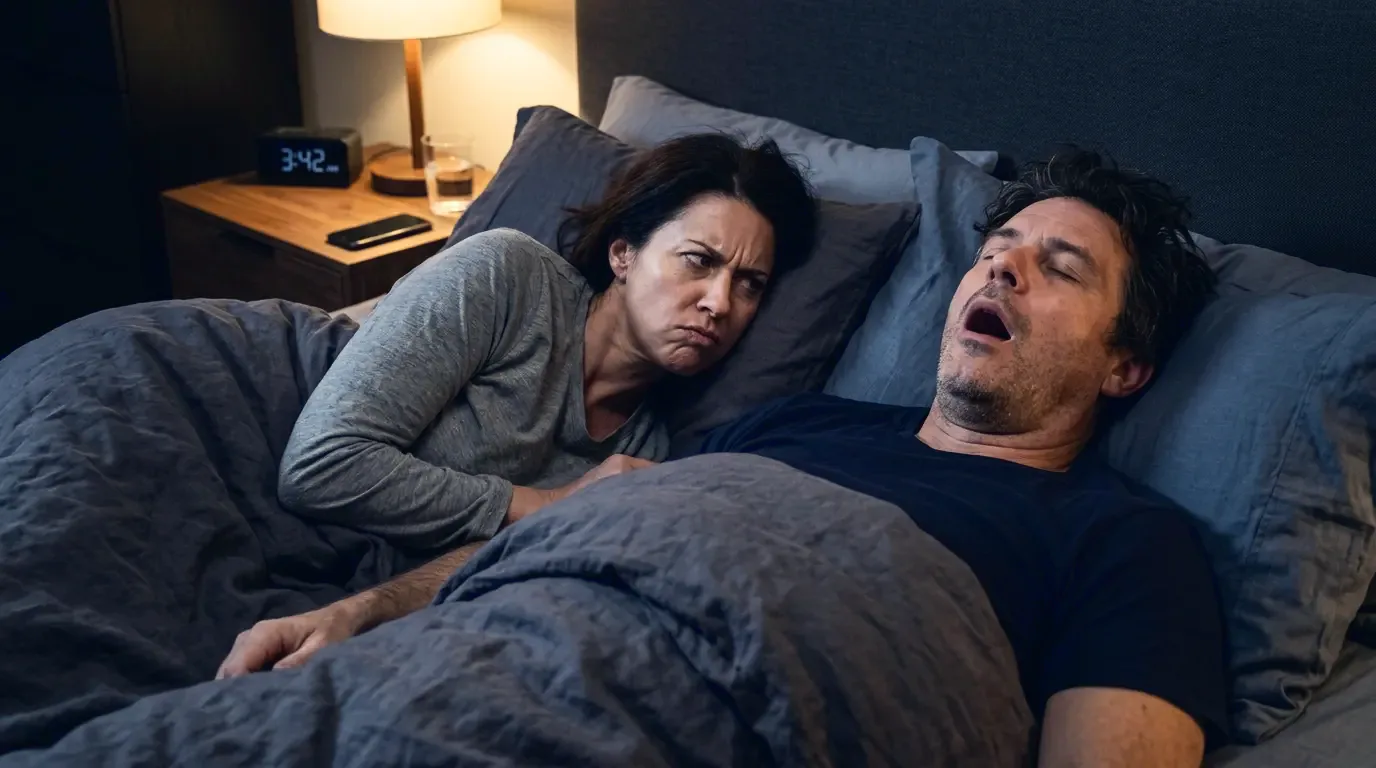
It is not only their problem — it harms you too
Sharing a bed with someone who snores loudly means your sleep is interrupted again and again, even if you do not fully wake up. In a classic study, when the person who snored was treated, the bed partner’s micro-awakenings dropped from 21 to 12 per hour and their sleep efficiency rose from 74% to 87% — the authors estimated this as roughly 62 extra minutes of sleep per night for the partner.
That lost sleep is not harmless: bed partners report more daytime tiredness and worse quality of life, which improves once the snorer is treated. A literature review found that a large majority of partners — close to two out of three — describe moderate-to-severe disruption of their own sleep. In short, snoring quietly wears down the health of the person who is NOT snoring.
And it is genuinely loud: in an acoustic study of more than 1,100 people, around one in eight snored above 55 dBA — comparable to a loud conversation right next to your ear, sustained for hours.
You are the one who can spot the danger
The person with sleep apnea is asleep and usually unaware that they stop breathing. You, lying beside them, are the one who sees the silent pauses, the gasps and the sudden snorts as breathing restarts. This “witnessed apnea” is so valuable that the most widely used screening questionnaire, STOP-Bang, includes “has anyone observed you stop breathing during your sleep?” as one of its key questions. If you have seen your partner stop breathing, that is not a detail to brush aside — it is one of the strongest reasons to seek an assessment.
When it is more than just noise
Not all snoring is dangerous. Simple snoring is steady noise without pauses. Watch for these signs that point to obstructive sleep apnea, where the airway actually closes:
- Loud, irregular snoring that stops and starts.
- Silent pauses in breathing, followed by a gasp or snort.
- Choking or a feeling of suffocation at night.
- Daytime sleepiness, morning headaches or trouble concentrating.
- Falling asleep at the wheel or while sitting still.
Snoring is a clue, not a diagnosis: only a sleep study can confirm whether there is apnea. But your observations are exactly what the specialist needs to decide.
Snoring, the relationship, and why treating it helps both of you
Night after night of broken sleep strains a couple. Many end up sleeping in separate rooms — a “sleep divorce” driven not by the relationship but by the noise. In one study of couples affected by sleep apnea, a large share were sleeping apart; after the patient started treatment, about 72% began sleeping together again, with a measurable improvement in the quality of the relationship.
Your role does not end at noticing the problem. Research shows that partner support improves how well people stick to treatments such as CPAP — and better-controlled apnea means quieter, safer nights for both of you. Treating snoring and apnea is, in the end, a shared win.
Record and measure your partner’s snoring
Our acoustic analyzer measures on your own device how long the snoring sounds, its relative loudness and prolonged sound pauses (free, and the audio is not uploaded): simple information to take to the consultation. It does not tell where the snoring comes from.
Open the AI snore analyzerFrequently asked questions
My partner snores every night — should I worry?
Soft, steady snoring without pauses is usually just noise. You should worry when the snoring is loud and irregular, stops and starts, or comes with gasping, choking or silent pauses in breathing. Those pauses, plus daytime sleepiness or morning headaches in your partner, point to obstructive sleep apnea, which is more than a nuisance and deserves a medical assessment.
How does my partner’s snoring affect my own health?
More than people think. The noise and movements fragment your sleep night after night. In a classic study, when the snorer was treated the bed partner’s micro-awakenings fell from 21 to 12 per hour and their sleep efficiency rose from 74% to 87% — which the authors estimated as roughly 62 extra minutes of sleep per night. Chronically broken sleep means daytime tiredness, irritability and worse quality of life for you, the partner, not only for the person who snores.
Why am I the one who has to notice the breathing pauses?
Because the person with apnea is asleep and usually has no idea it is happening. The bed partner is the one who sees the silent pauses, the gasps and the struggle to breathe. That is so important that the most used screening questionnaire, STOP-Bang, has “observed apnea” — someone seeing you stop breathing — as one of its core questions. Your observation is often the first and most valuable clue.
Can snoring really damage our relationship?
It is common for it to strain it. Many couples end up sleeping in separate rooms because of the noise and disturbed sleep. In one study, a large share of couples affected by sleep apnea slept apart, and after starting treatment about 72% began sleeping together again, with a measurable improvement in the quality of the relationship. Snoring is a shared problem, and treating it tends to help both people.
How loud can snoring actually be?
Loud enough to disturb the person next to you for hours. In an acoustic study of more than 1,100 people, around one in eight exceeded a sound level of 55 dBA, comparable to a loud conversation right beside your ear, all night long. That sustained noise is one reason the partner’s sleep suffers so much.
What can I do to help my partner?
Watch and note what you see (loud snoring, pauses, gasping), and if you can, record a short clip of the snoring on your phone — it helps the doctor. Encourage your partner to get assessed instead of dismissing it as “just snoring”, and go with them if you can. Your support genuinely matters: studies show that partner support improves how well people stick to treatments like CPAP, which in turn protects you both.
References
- Beninati W, Harris CD, Herold DL, Shepard JW Jr. The effect of snoring and obstructive sleep apnea on the sleep quality of bed partners. Mayo Clin Proc. 1999;74(10):955-958. PMID: 10918859
- Parish JM, Lyng PJ. Quality of life in bed partners of patients with obstructive sleep apnea or hypopnea after treatment with CPAP. Chest. 2003;124(3):942-947. PMID: 12970021
- Luyster FS, Dunbar-Jacob J, Aloia MS, et al. Impact of Obstructive Sleep Apnea and Its Treatments on Partners: A Literature Review. J Clin Sleep Med. 2017;13(3):467-477. doi:10.5664/jcsm.6504
- Chung F, Yegneswaran B, Liao P, et al. STOP questionnaire: a tool to screen patients for obstructive sleep apnea. Anesthesiology. 2008;108(5):812-821. PMID: 18431116
- Cascais Costa C, Afreixo V, Cravo J. Impact of Obstructive Sleep Apnea Treatment on Marital Relationships: Sleeping Together Again? Cureus. 2023;15(10):e46513. PMID: 37927636
- Wilson K, Stoohs RA, Mulrooney TF, et al. The snoring spectrum: acoustic assessment of snoring sound intensity in 1,139 individuals undergoing polysomnography. Chest. 1999;115(3):762-770. PMID: 10084490
This guide is educational and does not replace a medical diagnosis or a sleep study. If your partner snores loudly, you have seen breathing pauses, or they are sleepy during the day, consult a specialist.
Reviewed by Dr. Iván Méndez-Benegassi Silva · Otorhinolaryngology (ENT) Specialist with over 25 years of experience in sleep surgery and advanced rhinology · European Board Certificate (ORL-HNS) · HM Hospitales · Last reviewed: 24 Jun 2026
Take the next step in your evaluation
Dr. Méndez-Benegassi uses your data to answer your message. Email is not end-to-end encrypted: it can be read on the servers it passes through. Do not send medical reports or health data that way.
Data controller: Dr. Iván Méndez-Benegassi Silva, ENT physician.
Purpose: To read and answer your message. Tell us only what is essential; the rest is covered in the consultation.
Legal basis: The healthcare you are requesting (Art. 9.2.h GDPR).
Recipients: Your data is not shared with third parties; only the technical providers needed are involved, as data processors.
Your rights: Access, rectify or erase your data, object, restrict its processing and request its portability by writing to contacto@ronquidoyapneas.com. You may also lodge a complaint with the Spanish Data Protection Agency.
Full details in the Privacy policy.