
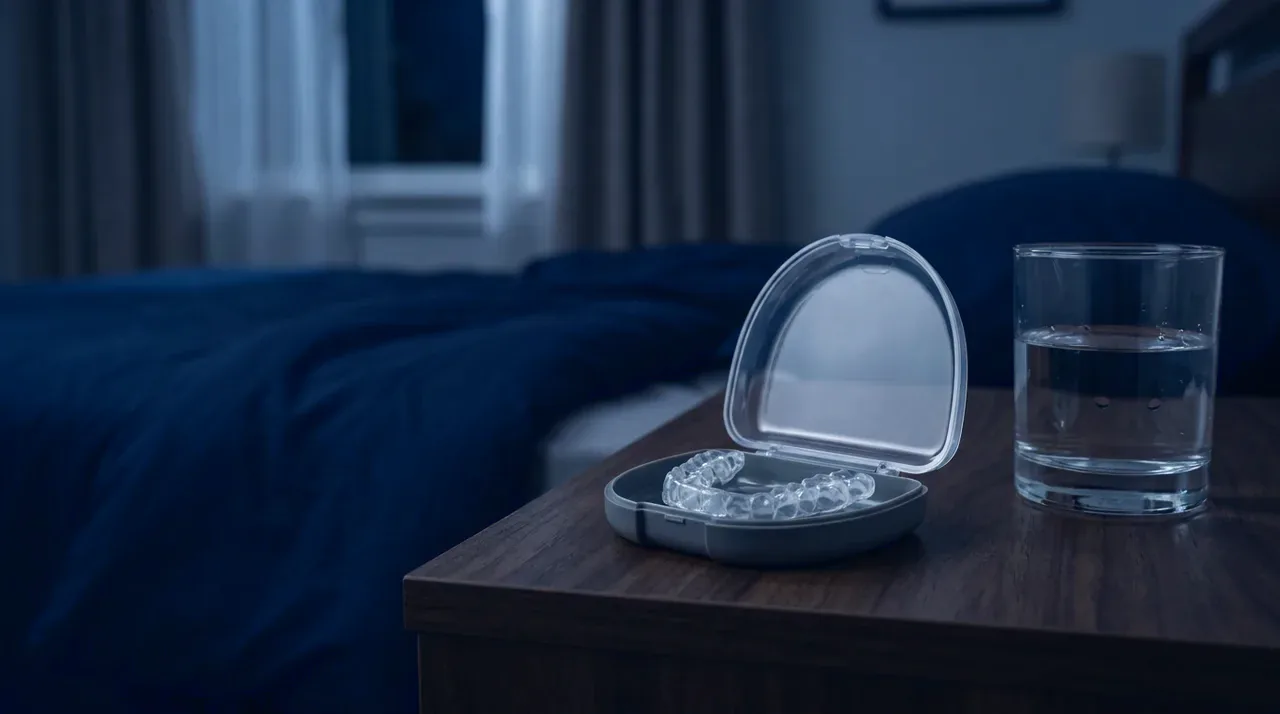
If you grind or clench your teeth at night (sleep bruxism) and someone has fitted — or wants to fit — a bite splint, there is one question worth asking first: is there sleep apnea underneath? It matters, because the wrong splint can quietly make apnea worse, while the right device can treat both problems at once.
The short answer
- ·Teeth grinding and apnea often coexist, and grinding tends to cluster around the brief awakenings (micro-arousals) after a breathing pause — though the overall evidence on the link is mixed.
- ·A classic occlusal (bruxism) splint can WORSEN apnea, because it lets the jaw fall back and narrows the airway.
- ·A mandibular advancement device does the opposite: it brings the jaw forward and can help bruxism linked to apnea AND the apnea itself.
- ·So apnea should be ruled out with a sleep study before fitting a bruxism splint without a second thought.
Why grinding and apnea travel together
Sleep bruxism is rhythmic activity of the jaw muscles during sleep — grinding or clenching. In people with obstructive sleep apnea, those bursts of muscle activity often appear right after a breathing pause, in the moment the brain briefly wakes itself up (a micro-arousal) to reopen the airway. One systematic review noted that the large majority of grinding episodes occurred within a few seconds of an arousal, suggesting the arousal opens a "window" in which grinding can happen, rather than the grinding causing the apnea (García Doblado et al., 2025).
Be honest about the evidence, though: it is genuinely mixed. A 2024 meta-analysis pooling 14 studies did not find that sleep bruxism was significantly more common in people with apnea than in those without (Błaszczyk et al.). The takeaway is not "grinding equals apnea", but rather: if you grind and you also have warning signs of apnea, the two deserve to be looked at together.
The catch: the wrong splint can make apnea worse
A standard bruxism splint protects the teeth — but it is not neutral for the airway:
A classic occlusal splint is a flat guard that covers the upper or lower teeth. By taking up space and slightly unlocking the bite, it tends to let the lower jaw — and with it the tongue — drift backward, which narrows the space at the back of the throat. In a randomized controlled trial in people with apnea, wearing an occlusal stabilization splint raised the mean apnea-hypopnea index from about 16 to 17 events per hour: a small average increase, but in the wrong direction (Nikolopoulou et al., 2013). A foundational pilot study had already warned of this, with some patients shifting into a worse apnea category and the respiratory disturbance index rising by roughly a third when the splint was in place (Gagnon et al., 2004).
For this reason, untreated obstructive sleep apnea is considered a contraindication to a standard occlusal splint: putting one on undiagnosed apnea can quieten the damage to the teeth while leaving — or even nudging up — a more serious problem underneath.
The device that can help both: mandibular advancement
A mandibular advancement device looks like a sports mouthguard but does something different: it holds the lower jaw slightly forward all night. That forward position opens the space behind the tongue and is an accepted treatment for snoring and for mild-to-moderate obstructive sleep apnea. Because it also covers and cushions the teeth, it can take care of the bruxism that goes with apnea at the same time. When grinding and apnea coexist, this single device usually makes more sense than a flat night guard — it addresses both instead of protecting the teeth while ignoring (or worsening) the breathing.
Standard guidance reflects this: patients who grind their teeth and also have sleep apnea, and who need protection for their teeth, should use a mandibular advancement device rather than a plain occlusal splint (Bruxism Management, StatPearls). You can read more about the appliance itself in our guide to the mandibular advancement device.
Before fitting a splint: who needs apnea ruled out
Check for apnea FIRST if you grind AND…
- You snore loudly or your partner has seen you stop breathing.
- You wake unrefreshed, with a dry mouth or morning headaches.
- You feel sleepy during the day, or have high blood pressure.
A plain splint may be fine if…
- A sleep study has ruled out significant apnea.
- You have no snoring or daytime sleepiness, and the grinding is mainly stress-related.
- It is reassessed if you ever develop snoring or breathing pauses.
References: Błaszczyk et al., Sleep bruxism may not be associated with obstructive sleep apnea — a systematic review and meta-analysis (Sleep Medicine Reviews, 2024); García Doblado et al., Relationship Between Bruxism and Obstructive Sleep Apnea: a systematic review (Journal of Clinical Medicine, 2025); Nikolopoulou et al., Effects of occlusal stabilization splints on obstructive sleep apnea — a randomized controlled trial (Journal of Orofacial Pain, 2013); Gagnon et al., Aggravation of respiratory disturbances by the use of an occlusal splint in apneic patients — a pilot study (International Journal of Prosthodontics, 2004, foundational); Bruxism Management (StatPearls, NCBI Bookshelf). Standard guidance: untreated OSA is a contraindication to a classic occlusal splint; a mandibular advancement device is preferred when bruxism and apnea coexist.
Grind your teeth and not sure if there is apnea underneath? The smart first step is to look at the airway, not just the bite.
Frequently asked questions
Are teeth grinding and sleep apnea related?
They often appear together, but the link is not as simple as cause and effect. Many people with obstructive sleep apnea also grind or clench their teeth at night, and grinding episodes tend to cluster around the brief awakenings (micro-arousals) that follow a breathing pause. That said, the overall evidence is mixed: a 2024 meta-analysis found no statistically significant excess of sleep bruxism in people with apnea (Błaszczyk et al.), while a 2025 systematic review reported a consistently higher prevalence (García Doblado et al.). So grinding can be a clue worth checking, not proof of apnea.
Can a teeth-grinding splint make sleep apnea worse?
Yes, a classic occlusal splint (a flat night guard for bruxism) can worsen apnea in some people. By covering the lower or upper teeth it tends to let the jaw and tongue fall slightly backward, narrowing the airway. In a randomized controlled trial the mean apnea-hypopnea index rose from about 16 to 17 events per hour with the splint in place (Nikolopoulou et al., 2013), and an earlier study saw a larger jump in some patients (Gagnon et al., 2004). For that reason, untreated obstructive sleep apnea is considered a contraindication to a standard bruxism splint.
What is the difference between a bruxism splint and a mandibular advancement device?
A bruxism splint (occlusal splint or night guard) only protects the teeth from grinding; it does not open the airway and may even narrow it. A mandibular advancement device holds the lower jaw slightly forward, which opens the airway to treat snoring and mild-to-moderate apnea — and, by protecting the teeth at the same time, it can address bruxism associated with apnea too. When both problems coexist, the advancement device is usually the better single choice.
Should I have apnea ruled out before getting a bruxism splint?
Yes. If you grind your teeth and also snore loudly, wake unrefreshed, feel sleepy by day or your partner has seen you stop breathing, apnea should be ruled out with a sleep study before fitting a standard splint. Putting a flat night guard on undiagnosed apnea can protect the teeth while leaving — or worsening — a more serious problem underneath.
Does clenching my teeth while asleep mean I have apnea?
Not on its own. Plenty of people clench or grind without having apnea, and stress, anxiety, certain medicines and alcohol can all drive bruxism. It becomes worth investigating for apnea when it goes together with loud snoring, witnessed breathing pauses, morning headaches, a dry mouth or daytime sleepiness. The only way to know is to assess your sleep, not just your teeth.
Related: is snoring dangerous? · symptoms of sleep apnea · CPAP, appliance or surgery
Take the next step in your evaluation
Dr. Méndez-Benegassi uses your data to answer your message. Email is not end-to-end encrypted: it can be read on the servers it passes through. Do not send medical reports or health data that way.
Data controller: Dr. Iván Méndez-Benegassi Silva, ENT physician.
Purpose: To read and answer your message. Tell us only what is essential; the rest is covered in the consultation.
Legal basis: The healthcare you are requesting (Art. 9.2.h GDPR).
Recipients: Your data is not shared with third parties; only the technical providers needed are involved, as data processors.
Your rights: Access, rectify or erase your data, object, restrict its processing and request its portability by writing to contacto@ronquidoyapneas.com. You may also lodge a complaint with the Spanish Data Protection Agency.
Full details in the Privacy policy.