
Genioglossus Advancement & Hyoid Suspension
Medically reviewed by Dr. Iván Méndez-Benegassi Silva · Otorhinolaryngology (ENT) Specialist with over 25 years of experience in sleep surgery and advanced rhinology · European Board Certificate (ORL-HNS) · HM Hospitales, Madrid · License No. 282855946
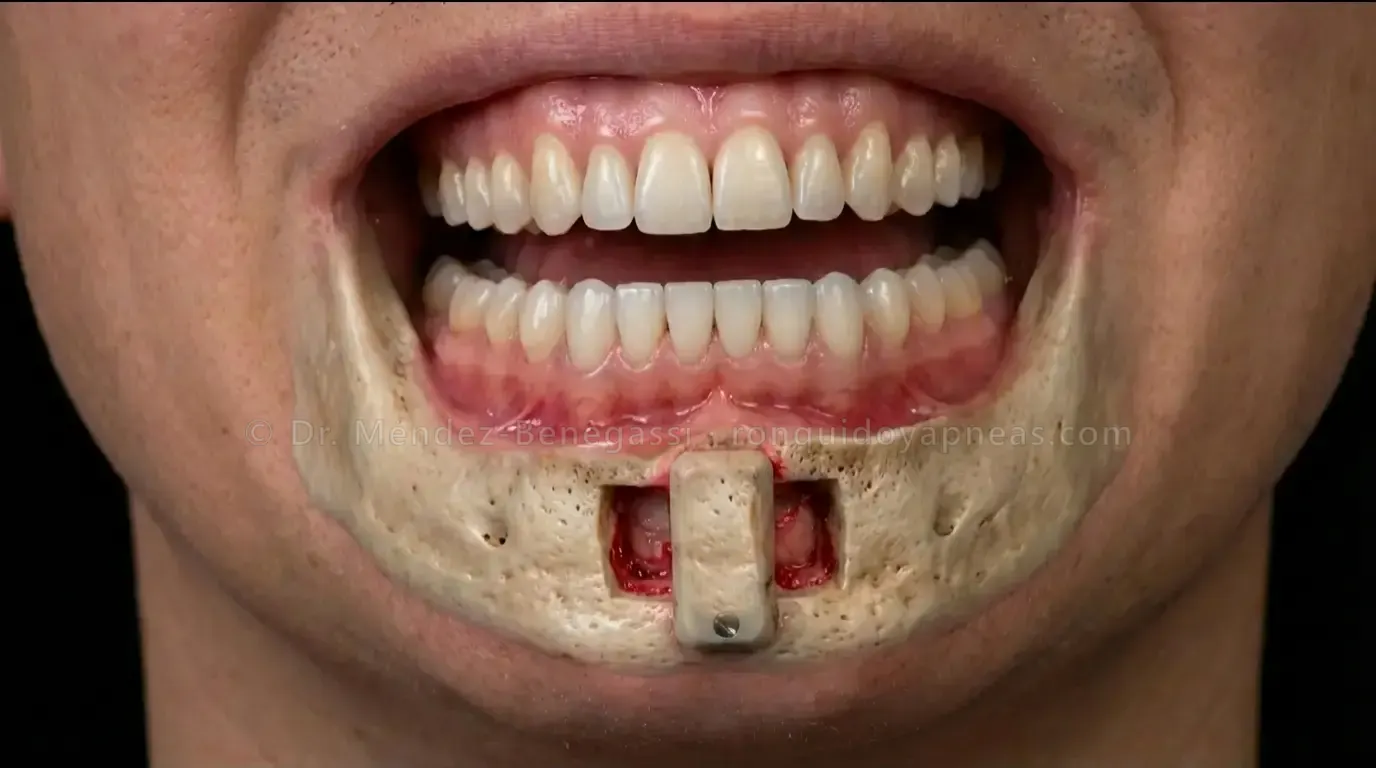
The genioglossus is the main muscle of the tongue: it starts on the inside of the chin, on small bony spines of the mandible (the genial tubercles), and when it contracts it pulls the tongue forward and keeps the throat open. Genioglossus advancement is the operation that cuts a small rectangle of bone from the front of the mandible exactly where that muscle is attached, moves it forward and fixes it with a plate and screws, so that the base of the tongue does not fall back during sleep.
When the problem is the bony support or the position of the deep muscles, we act on these anchor points to prevent the airway from collapsing because of gravity.
What does it involve?
It is done under general anaesthesia and from inside the mouth, through an incision between the lower lip and the gum. According to the SEORL-CCC consent form, the bone rectangle measures about 2 cm long and 1 cm high. The attachment of the genioglossus lies in the midline, about 10 mm below the tip of the roots of the lower front teeth and 10 mm above the lower edge of the mandible, which is why the cut is planned on the X-rays beforehand. It is often combined with hyoid bone suspension to also open the lowest part of the throat. The aim is to act on the anchor points, not to remove tissue.
Who is it for?
It is aimed at selected patients in whom the airway collapses because of the bony support or the position of the deep tongue muscles. The indication is decided individually after studying where and why the airway collapses, usually with examination and sleep endoscopy (DISE). It is not a first option for everyone. If what takes up the space is the tissue of the tongue base itself (the lingual tonsil or a large tongue base), the alternative is to reduce it, for example with transoral robotic surgery (TORS).
Recovery
In the first days it is normal to have pain in the operated area and in the tongue, and some difficulty swallowing; painkillers, antibiotics and anti-inflammatories are given for a few days. Food is liquid at first and then soft until healing is complete. The hospital stay varies with each case and is sometimes very short. A few weeks later the sleep study is repeated to check whether the apneas, the blood oxygen and the quality of sleep have improved.
Risks
These are the specific risks listed in the official consent form of the Spanish Society of Otorhinolaryngology and Head and Neck Surgery (SEORL-CCC), in plain words:
- ·The most immediate and important complication is that the airway closes because of swelling or a haematoma (a collection of blood) in the floor of the mouth or the tongue; it sometimes requires a tracheotomy and a stay in intensive care.
- ·Tingling or numbness of the lower lip and lower teeth for several weeks.
- ·In one third of patients some loss of sensation remains in the teeth closest to the operation, and it can be permanent.
- ·A small change in the face because the chin moves forward, usually very small.
- ·Infection of the mandible, or the gum incision opening up (it usually heals on its own). Less often, damage to the roots of the lower teeth or to the nerves of the chin, and fracture of the mandible: the area is somewhat weaker if there is a later blow.
- ·Late infection with loss of a small piece of bone, or one of the fixation pieces coming out.
As a reference from a published series: in 31 patients operated on with genioglossus advancement and hyoid suspension, the wound opened in 3%, swallowing was temporarily difficult in 3% and the jaw felt temporarily numb in 6%; most had mild to moderate pain for 5 to 7 days.
SEORL-CCC consent form: mandibular osteotomy and genioglossus advancement (in Spanish)Procedures
Genioglossus Advancement
A small window is made in the mandible to advance the insertion of the genioglossus muscle (the main tongue muscle). This pulls the tongue forward, freeing the throat.
Hyomandibular or Thyrohyoid Advancement
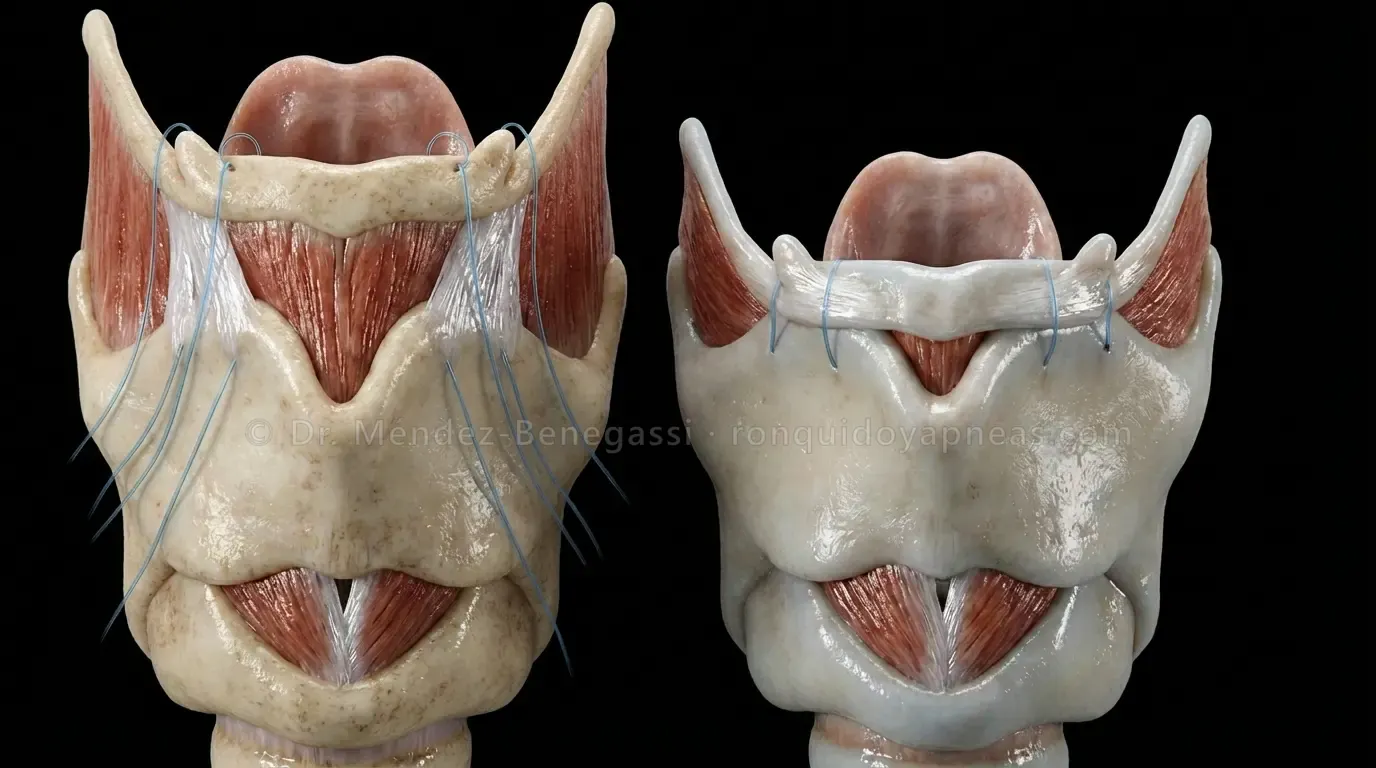
Consists of fixing the hyoid bone (located in the neck) to the mandible or thyroid cartilage. This expands the hypopharyngeal zone and prevents collapse of the lowest part of the airway.
What the evidence says (and what it does not)
Genioglossus advancement and hyoid suspension act on the tongue and the lowest part of the throat, but honestly they rarely cure sleep apnea on their own: they are usually part of a multilevel plan and are reserved for well-selected patients (confirmed with a sleep endoscopy, DISE).
- ·Genioglossus advancement alone (meta-analysis, 24 patients): the apnea-hypopnea index fell from 37.6 to 20.4 events per hour (46% less); combined with hyoid surgery (50 patients), from 34.5 to 15.3 (56% less). There are few studies.
- ·In a 2026 systematic review and meta-analysis of multilevel sleep surgery, hyomandibular suspension reached about 74% surgical success (the Sher criterion: more than 50% reduction in the apnea-hypopnea index and a final value below 20); hyothyroidopexy combined with palate surgery reached about 57%, with the apnea-hypopnea index falling by roughly 21 to 29 events per hour.
- ·Combined with uvulopalatopharyngoplasty, genioglossus advancement (with or without hyoid suspension) reached 61% success in a review of 18 studies. This family of techniques comes from the Stanford two-phase protocol (Riley and Powell), which reserved maxillomandibular advancement for those who did not improve.
- ·When the problem is mainly skeletal, the most effective surgery is maxillomandibular advancement (MMA), with the highest success rates among sleep surgeries in recent meta-analyses.
Frequently asked questions
What does genioglossus advancement involve?
It advances the insertion of the genioglossus, the main muscle of the tongue, through a small window in the mandible so the tongue is held forward and does not fall back over the airway during sleep. It is often combined with hyoid bone suspension to also open the lower part of the throat.
Is bone removed? Is it very aggressive?
No bone is removed: a small window is made in the mandible to reposition the muscle attachment, and the bone is fixed back in place. It is a planned procedure that acts on anchor points rather than removing tissue, and it is reserved for selected cases where the skeletal support is the cause of the collapse.
Is it the same as mandibular advancement or the oral appliance?
No. The mandibular advancement device (oral appliance) is a removable splint worn at night that moves the lower jaw forward; it is not surgery. Genioglossus advancement is a surgical technique that repositions the muscle and bone anchor points permanently, and is considered when other options are not enough or are not suitable.
What is recovery like?
It is performed in the operating room and usually involves a soft diet and some swelling or discomfort in the chin and neck area during the first days. Your surgeon will give you specific instructions about diet, hygiene and follow-up depending on your case.
Will it show on my face?
Usually little or not at all. The consent form of the Spanish ENT society (SEORL-CCC) warns that some patients show a small change in the face because the chin moves forward, although it is usually very small. A study that measured the facial profile on X-rays before and after genioglossus advancement with hyoid suspension (23 patients) found no significant changes. When the bone cut reaches the lower edge of the mandible, the chin can move forward more; surgeons plan this beforehand and can even compensate for it.
How long does it last?
Recovery: pain and a liquid, then soft, diet in the first days, and tingling or numbness of the lower lip and lower teeth that can last several weeks. The result: the bone is fixed with a plate and screws and does not move back, but apnea can return over the years, especially with weight gain. In a series of 46 patients followed for more than three years after genioglossus advancement with hyoid suspension, 65% kept their success, and those who relapsed had gained more weight.
What is hyoid suspension?
The hyoid is a small horseshoe-shaped bone in the neck, above the Adam’s apple, from which tongue and throat muscles hang. Hyoid suspension brings it forward and fixes it, either to the mandible (hyomandibular suspension) or to the thyroid cartilage, the Adam’s apple (hyothyroidopexy), to widen the lowest part of the throat. In a 2026 meta-analysis of 21 studies, success was 73.8% with fixation to the mandible and 57.5% with fixation to the thyroid combined with palate surgery; on its own, without other surgery, it lowered the apnea-hypopnea index by 38% on average in another meta-analysis.
Who is it indicated for?
It is aimed at selected patients whose airway collapses because of the bony support or the position of the deep tongue muscles, confirmed by examination and sleep endoscopy (DISE). It is not a first option for everyone: the indication is decided individually after studying where and why the airway collapses.
References
- SEORL-CCC. Documento de información y autorización para la realización de osteotomía mandibular y avance geniogloso (consentimiento informado aprobado por la Sociedad Española de Otorrinolaringología y Cirugía de Cabeza y Cuello). Official document
- Chang ET, Kwon YD, Jung J, et al. Genial tubercle position and genioglossus advancement in obstructive sleep apnea (OSA) treatment: a systematic review. Maxillofac Plast Reconstr Surg. 2019;41(1):34. PMID 31544097 · DOI 10.1186/s40902-019-0217-1
- Song SA, Chang ET, Certal V, et al. Genial tubercle advancement and genioplasty for obstructive sleep apnea: a systematic review and meta-analysis. Laryngoscope. 2017;127(4):984-992. PMID 27546467 · DOI 10.1002/lary.26218
- Song SA, Wei JM, Buttram J, et al. Hyoid surgery alone for obstructive sleep apnea: a systematic review and meta-analysis. Laryngoscope. 2016;126(7):1702-8. PMID 26801005 · DOI 10.1002/lary.25847
- Weatherford D, James J, Smith H, et al. Comparing hyoid suspension approaches in multilevel sleep surgery: a systematic review and meta-analysis. Otolaryngol Head Neck Surg. 2026;174(5):1157-1166. PMID 41886779 · DOI 10.1002/ohn.70216
- Handler E, Hamans E, Goldberg AN, Mickelson S. Tongue suspension: an evidence-based review and comparison to hypopharyngeal surgery for OSA. Laryngoscope. 2014;124(1):329-36. PMID 23729234 · DOI 10.1002/lary.24187
- Riley RW, Powell NB, Guilleminault C. Obstructive sleep apnea syndrome: a review of 306 consecutively treated surgical patients. Otolaryngol Head Neck Surg. 1993;108(2):117-25. PMID 8441535 · DOI 10.1177/019459989310800203
- Walker A, Kassir MF, Sama V, et al. Maxillomandibular advancement safety and effectiveness in obstructive sleep apnea: systematic review and meta-analysis. Otolaryngol Head Neck Surg. 2025;172(4):1142-1154. PMID 39764681 · DOI 10.1002/ohn.1114
- Neruntarat C. Genioglossus advancement and hyoid myotomy: short-term and long-term results. J Laryngol Otol. 2003;117(6):482-6. PMID 12818058 · DOI 10.1258/002221503321892343
- Neruntarat C. Genioglossus advancement and hyoid myotomy under local anesthesia. Otolaryngol Head Neck Surg. 2003;129(1):85-91. PMID 12869922 · DOI 10.1016/S0194-59980300094-9
- Cillo JE, Thakker P, Dattilo DJ. Cephalometric soft tissue analysis of combined elliptical-window genioglossus advancement and hyoid suspension for obstructive sleep apnea. J Oral Maxillofac Surg. 2012;70(3):690-5. PMID 21684652 · DOI 10.1016/j.joms.2011.02.028
- Emanuelli E, O'Connor MK, Garg RK. Genioglossus advancement: technique modification for improved chin contour. Plast Reconstr Surg Glob Open. 2023;11(3):e4846. PMID 36910733 · DOI 10.1097/GOX.0000000000004846
Take the next step in your evaluation
Dr. Méndez-Benegassi uses your data to answer your message. Email is not end-to-end encrypted: it can be read on the servers it passes through. Do not send medical reports or health data that way.
Data controller: Dr. Iván Méndez-Benegassi Silva, ENT physician.
Purpose: To read and answer your message. Tell us only what is essential; the rest is covered in the consultation.
Legal basis: The healthcare you are requesting (Art. 9.2.h GDPR).
Recipients: Your data is not shared with third parties; only the technical providers needed are involved, as data processors.
Your rights: Access, rectify or erase your data, object, restrict its processing and request its portability by writing to contacto@ronquidoyapneas.com. You may also lodge a complaint with the Spanish Data Protection Agency.
Full details in the Privacy policy.

Where I see patients in Madrid
I see patients in person at my HM Hospitales clinics (HM Madrid, HM Valdebebas and HM Tres Cantos), or by personalized video consultation if you prefer.
Private consultation, no waiting lists
Call the appointments line: you get your appointment during the same call, at any of my three clinics.
Call · 910 786 601- HM Madrid
Wednesdays 3:00 PM - 4:00 PM - HM Valdebebas
Tuesdays 3:00 PM - 4:00 PM - HM Tres Cantos
Tuesdays 1:30 PM - 2:30 PM
€150, paid at the reception desk of the clinic. It is not processed through insurance, except for reimbursement insurance.
Coming with your health insurance? Book with HM: 919 370 000.
HM Madrid
HM Madrid University Hospital
Pl. del Conde del Valle de Súchil, 16
28015 MadridWith insurance (book with HM): Wednesdays 4:00 PM - 7:00 PM
How to get thereHM Valdebebas
HM Valdebebas Polyclinic
Av. de Juan Antonio Samaranch, 51
28055 MadridWith insurance (book with HM): Tuesdays 4:00 PM - 7:00 PM
How to get thereHM Tres Cantos
HM Tres Cantos University Hospital
C. Santiago Ramón y Cajal, 23
28760 Tres CantosWith insurance (book with HM): Tuesdays and Wednesdays 9:30 AM - 1:30 PM
How to get there