
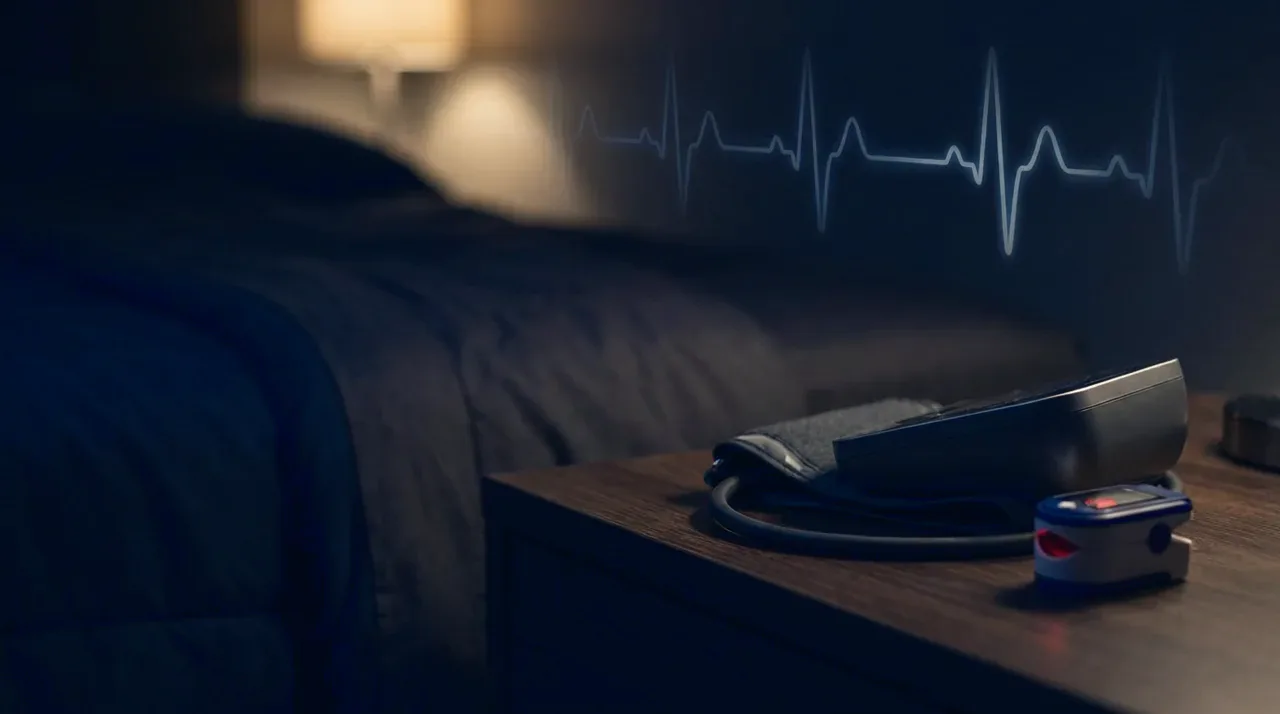
Sleep apnea is not only a problem of snoring or daytime sleepiness — it is, above all, a problem for the heart. Untreated obstructive sleep apnea is a real cardiovascular risk factor, and it is one of the most underdiagnosed conditions in heart patients. If you have atrial fibrillation, blood pressure that will not come down, or another heart condition, this guide explains why your sleep may be part of the story.
The short answer
- ·Untreated sleep apnea roughly doubles long-term cardiovascular risk, and it is present in 40% to 80% of heart patients — yet it is widely underdiagnosed.
- ·It is closely tied to atrial fibrillation: untreated apnea means more recurrences after ablation or cardioversion.
- ·It is the most common treatable cause of resistant hypertension — high blood pressure that will not come down with several drugs.
- ·Treating the apnea helps control these problems — but it works alongside your cardiologist, it does not replace them.
Why apnea strains the heart
A nightly stress test you never asked for
In obstructive sleep apnea the airway collapses repeatedly during sleep. Each pause drops the oxygen in the blood, the body responds with a surge of adrenaline, the blood pressure spikes and the heart rate swings. Repeated dozens or hundreds of times a night, this intermittent low oxygen and autonomic stress damages the blood vessels and electrically irritates the heart. Over years, untreated apnea was associated with roughly double the long-term cardiovascular risk in a 2025 meta-analysis of prospective cohort studies (pooled hazard ratio 1.82; over 25,000 people), with the risk rising as the apnea gets more severe and clearly higher for stroke.
The other half of the problem is that this goes unnoticed. The American Heart Association warned in 2021 that apnea is present in 40% to 80% of patients with hypertension, heart failure, coronary artery disease, atrial fibrillation or stroke — and yet it remains underrecognised and undertreated in cardiology. In other words: a lot of heart patients have an untreated sleep apnea that nobody has looked for.
Apnea and atrial fibrillation
The strongest link — and why it matters for ablation
Atrial fibrillation is the most common heart-rhythm disorder, and its link with sleep apnea is one of the best documented. The apnea acts as a trigger that keeps the fibrillation coming back. This shows up most clearly after an ablation (the procedure that treats the fibrillation): in patients with apnea, those who use CPAP have markedly fewer recurrences than those who do not. A 2023 meta-analysis of 8 studies and 1,231 patients found a risk ratio of 0.58 for recurrence with CPAP — about 42% fewer recurrences (Li et al., Frontiers in Neurology).
That is why it increasingly makes sense to look for apnea before treating the rhythm: if the apnea is left untreated, the fibrillation is more likely to return whatever the cardiologist does. Treating the apnea does not replace the ablation, the cardioversion or the anticoagulant — it improves the chances that the rhythm treatment lasts.
Apnea and resistant hypertension
If your blood pressure stays high despite three or more medicines (what doctors call resistant hypertension), an untreated sleep apnea is one of the first things to rule out — it is the most common treatable cause behind it. A 2023 systematic review found that people with obstructive sleep apnea had about three times the odds of resistant hypertension (adjusted odds ratio 3.34; Ahmed et al., Frontiers in Medicine). The repeated night-time surges in blood pressure and the constant sympathetic overdrive make the daytime pressure stubborn.
Honest note: treating the apnea (usually with CPAP) helps lower blood pressure, but the effect is modest on average and varies from person to person. It is a complement to your medication and your cardiologist or GP, not a replacement for them.
We explain it step by step, for patients, in sleep apnea and resistant hypertension.
Arrhythmias, heart failure and stroke
Beyond atrial fibrillation, untreated apnea is associated with other arrhythmias (pauses and irregular beats during the night), with heart failure — where it is both common and tends to worsen the outlook — and with a higher risk of stroke. In the 2025 meta-analysis above, the increase in risk was particularly marked for stroke. None of this means apnea is the only cause of these conditions, and treating the apnea alone will not fix them; but in a heart patient, an untreated apnea is a removable extra burden that is too often missed.
In heart failure another type of apnea is also common, central apnea, in which the brain stops sending the signal to breathe: we explain it in central sleep apnea.
A joint job: apnea team and cardiologist together
Treating the apnea does not replace your cardiologist — it is a job done together. The ENT and sleep team (Dr. Méndez-Benegassi) assesses and treats the airway: confirming the diagnosis with a sleep study and choosing the right treatment (most often CPAP, sometimes an oral appliance or surgery). Your cardiologist manages the heart itself: the rhythm, the blood pressure, the anticoagulation. The point is simple — clearing the apnea improves the ground the cardiologist is working on, so the two together give a better, safer result than either alone.
Worth getting checked if…
- You have atrial fibrillation, especially recurrent or before an ablation.
- Your blood pressure stays high on three or more drugs.
- You have heart failure, coronary disease or have had a stroke, and you snore or feel sleepy by day.
What this does NOT mean
- Treating apnea does not replace your heart medication or your cardiologist.
- Apnea is not the only cause of these conditions — it is one removable factor.
- Do not stop any cardiac treatment on your own; changes are decided with your doctors.
References: Yeghiazarians et al., Obstructive Sleep Apnea and Cardiovascular Disease — AHA Scientific Statement (Circulation, 2021); Craciun et al., Association Between Obstructive Sleep Apnea and Cardiovascular Risk: a systematic review and meta-analysis of prospective cohort studies (Medicina, 2025); Li et al., CPAP therapy and reduction of atrial fibrillation recurrence after ablation in patients with obstructive sleep apnea (Frontiers in Neurology, 2023); Ahmed et al., Association between obstructive sleep apnea and resistant hypertension: systematic review and meta-analysis (Frontiers in Medicine, 2023).
Have a heart condition and wonder if an undiagnosed sleep apnea is part of it? The starting point is to find out.
Frequently asked questions
How are sleep apnea and the heart related?
Obstructive sleep apnea makes the heart work harder night after night: every pause in breathing drops the oxygen, spikes the blood pressure and stresses the autonomic nervous system. Over years, untreated apnea is associated with about double the long-term cardiovascular risk (pooled hazard ratio 1.82 in a 2025 meta-analysis of prospective studies). And it is common in heart patients: apnea is present in 40% to 80% of people with hypertension, heart failure, coronary artery disease, atrial fibrillation or stroke, yet it stays underdiagnosed (AHA, 2021).
Is there a link between sleep apnea and atrial fibrillation?
Yes, and it is one of the strongest links in cardiology. Untreated apnea favours atrial fibrillation and makes it come back: in patients who undergo an ablation, those treated with CPAP have markedly fewer recurrences than those who are not (risk ratio 0.58 — about 42% fewer recurrences — in a 2023 meta-analysis of 8 studies and 1,231 patients). That is why guidelines increasingly recommend screening for apnea before rhythm-control treatment. Treating the apnea does not replace the cardiologist; it improves the ground the cardiologist is working on.
Can sleep apnea cause high blood pressure that is hard to control?
Yes. Obstructive sleep apnea is the most common treatable cause behind resistant hypertension — blood pressure that stays high despite three or more drugs. People with apnea have roughly three times the odds of resistant hypertension (adjusted odds ratio 3.34 in a 2023 systematic review). If your blood pressure will not come down with treatment, an untreated sleep apnea is one of the first things worth ruling out.
Does treating apnea help my heart problem?
It helps control it, but it is not a substitute for cardiac treatment. Treating the apnea (most often with CPAP, sometimes with an oral appliance or surgery) can lower blood pressure, reduce atrial fibrillation recurrence after ablation and ease the night-time strain on the heart. It does not replace your blood-pressure pills, your anticoagulant or your cardiologist — it works alongside them. The best results come from treating both: the apnea and the heart, together.
I have a heart condition — should I get checked for sleep apnea?
If you have atrial fibrillation, resistant or poorly controlled hypertension, heart failure, coronary disease or you have had a stroke — and you snore loudly, stop breathing in your sleep, or feel sleepy and unrefreshed by day — it is well worth getting assessed, because apnea is both common and underdiagnosed in these patients. Screening questionnaires (such as STOP-BANG) flag the risk; the diagnosis is confirmed with a sleep study. Then the ENT and sleep team and your cardiologist work together.
Related: is snoring dangerous? · symptoms of sleep apnea
Take the next step in your evaluation
Dr. Méndez-Benegassi uses your data to answer your message. Email is not end-to-end encrypted: it can be read on the servers it passes through. Do not send medical reports or health data that way.
Data controller: Dr. Iván Méndez-Benegassi Silva, ENT physician.
Purpose: To read and answer your message. Tell us only what is essential; the rest is covered in the consultation.
Legal basis: The healthcare you are requesting (Art. 9.2.h GDPR).
Recipients: Your data is not shared with third parties; only the technical providers needed are involved, as data processors.
Your rights: Access, rectify or erase your data, object, restrict its processing and request its portability by writing to contacto@ronquidoyapneas.com. You may also lodge a complaint with the Spanish Data Protection Agency.
Full details in the Privacy policy.