
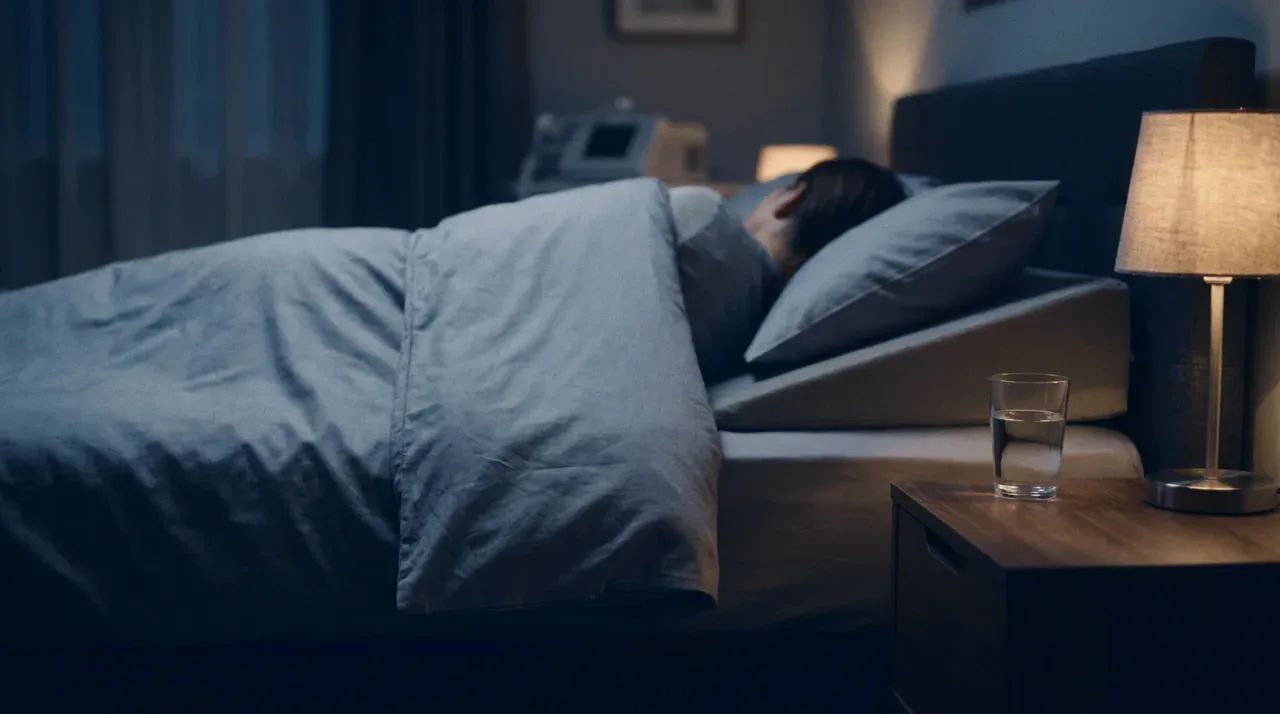
If you wake at night with heartburn or a sour taste, and you also snore or have been told you stop breathing in your sleep, you are not imagining a connection. Acid reflux (GERD) and obstructive sleep apnea often travel together, and at night they can feed each other. The good news: the same study that diagnoses the apnea, and the same simple habits, help with both.
The short answer
- ·Reflux and sleep apnea coexist more than chance would predict: having one raises the odds of the other (about 1.5-fold).
- ·Apnea can drive night-time reflux (pressure swings and arousals); reflux can fragment your sleep. It works both ways.
- ·CPAP often reduces nocturnal reflux as a side benefit. Weight loss, head-of-bed elevation and sleeping on the left also help.
- ·Honest limit: treating one does not cure the other. Both deserve to be assessed and managed.
How they connect at night
Apnea → reflux, and reflux → poor sleep
During an obstructive apnea you keep trying to breathe against a blocked airway. That effort makes the pressure inside the chest swing sharply, which can pull stomach contents up past the valve at the top of the stomach — and each apnea ends in a brief arousal that can trigger reflux too. Lying flat removes gravity's help, so acid that comes up stays up longer. This is why the reflux linked to apnea is typically nocturnal — acid rising while you sleep — the kind most likely to irritate the gullet and wake you.
It runs the other way too. A 2024 systematic review and meta-analysis found a mutual relationship between reflux and sleep problems: poor sleep and short sleep were linked to more reflux, and reflux was linked to worse sleep quality — a loop that keeps both going. In a 2025 meta-analysis, people with reflux disease had measurably lower sleep efficiency. In plain terms: reflux and disturbed sleep keep handing the problem back to each other.
What the evidence shows
That the two coexist is well documented. A 2023 systematic review and meta-analysis (El Hage Chehade et al., 6 studies, 2,950 patients) found a significant association between obstructive sleep apnea and GERD, with an odds ratio of about 1.53. Importantly, in that same analysis the presence of reflux did not make the apnea itself more severe — so reflux is a frequent companion, not a cause of worse apnea. A larger 2025 meta-analysis (49 studies) pointed in the same direction but its overall estimate (relative risk 1.23) just missed statistical significance, which is a fair reminder that the association is real but modest.
And treating the apnea can quieten the reflux. A 2021 meta-analysis (Li et al., 10 studies) found that CPAP significantly reduced nocturnal reflux: less time with the oesophageal pH below 4, fewer reflux events, shorter reflux episodes and lower acid-exposure (DeMeester) scores, with greater improvement the longer CPAP was used. The pressure both holds the airway open and seems to brace against acid rising. Useful to know — but it is a bonus, not the reason to start CPAP.
What helps both — practical measures
Good evidence, easy to do
- Lose weight if you are overweight — it eases both the airway and the reflux.
- Leave about 3 hours between dinner and lying down.
- Raise the head of the bed (a wedge or blocks, not just extra pillows).
- Sleep on your left side rather than your right or flat on your back.
Be realistic about…
- These habits and acid-suppressing medication control reflux — they do not treat the apnea.
- CPAP and an oral appliance treat the apnea — they are not a reflux cure.
- Persistent reflux despite measures, or alarm symptoms (trouble swallowing, weight loss), need a digestive specialist.
Those lifestyle measures are not folklore: weight loss, head-of-bed elevation, the 3-hour meal-to-bed gap and the left-side sleeping position are all recommended in a 2023 international evidence-based consensus on reflux-like symptoms (Hungin et al.), and the left-side advantage is backed by a 2023 systematic review and meta-analysis.
The honest bottom line: assess both
Reflux and apnea are two separate problems that often share a bed. Treating your reflux can make your nights more comfortable and protect your oesophagus, but it will not cure obstructive sleep apnea; and treating the apnea will not, by itself, cure reflux. So the right move is not to pick one — it is to check both. The apnea is confirmed with a sleep study and treated at the airway (CPAP, an oral appliance or, in selected cases, surgery), while the reflux is managed with the habits above and, if needed, medication or a digestive-specialist review.
A note on certainty: the coexistence and the benefit of CPAP on nocturnal reflux are supported by meta-analyses, but most of this evidence is observational and the effect sizes are modest. That is exactly why both conditions are assessed on their own merits rather than assuming one explains the other.
References: El Hage Chehade et al., Association between obstructive sleep apnea and gastroesophageal reflux disease — a systematic review and meta-analysis (Journal of Gastroenterology and Hepatology, 2023); Li et al., Effect of continuous positive airway pressure on gastroesophageal reflux in patients with obstructive sleep apnea — a meta-analysis (Sleep and Breathing, 2021); Tan et al., Bidirectional correlation between gastroesophageal reflux disease and sleep problems — a systematic review and meta-analysis (PeerJ, 2024); Zeng et al., Association between obstructive sleep apnea and reflux disease — a systematic review and meta-analysis (Nature and Science of Sleep, 2025); Hungin et al., Management advice for patients with reflux-like symptoms — an evidence-based consensus (European Journal of Gastroenterology & Hepatology, 2023); Simadibrata et al., Left lateral decubitus sleeping position is associated with improved gastroesophageal reflux disease symptoms — a systematic review and meta-analysis (World Journal of Clinical Cases, 2023).
Heartburn at night and snoring or pauses in your sleep? The starting point is a proper assessment of your airway, so you can treat each problem for what it is.
Frequently asked questions
Are reflux and sleep apnea related?
Yes. Gastroesophageal reflux disease (GERD) and obstructive sleep apnea often coexist. A 2023 systematic review and meta-analysis (6 studies, 2,950 patients) found people with one condition were significantly more likely to have the other (odds ratio about 1.53). The link goes in both directions in the sense that each can disturb the other at night, although in that analysis the presence of reflux did not make the apnea itself more severe.
Can sleep apnea cause acid reflux at night?
It can contribute. During an obstructive event you fight to breathe against a closed airway; that effort lowers the pressure inside the chest and can suck stomach acid up into the gullet, while the arousals that end each apnea may also trigger reflux. The result is more night-time (nocturnal) reflux: acid coming up while you are lying down, which is the type most likely to harm the oesophagus and wreck your sleep.
Does CPAP help with acid reflux?
Often, yes. A 2021 meta-analysis (10 studies) found that CPAP treatment significantly reduced nocturnal reflux in people with apnea — less time with a low oesophageal pH, fewer reflux events and lower acid-exposure scores — with more improvement the longer CPAP was used. The positive airway pressure both keeps the airway open and seems to act as a barrier against acid coming up. It is a welcome side benefit, not the reason CPAP is prescribed.
How can I reduce reflux while I sleep?
The measures with the best evidence are simple: lose weight if you are overweight, leave about 3 hours between your evening meal and lying down, raise the head of the bed (a wedge or blocks, not just more pillows) and sleep on your left side rather than your right or flat on your back. These are recommended in a 2023 international consensus on reflux-like symptoms. Your doctor may also add acid-suppressing medication.
If I treat my reflux, will my sleep apnea go away?
No. This is the honest part: controlling reflux can improve how you sleep and protect your oesophagus, but it does not cure obstructive sleep apnea, and treating the apnea does not by itself cure reflux. They are two different problems that happen to travel together. The sensible approach is to assess and treat both — confirm the apnea with a sleep study and treat the airway (CPAP, oral appliance or surgery), while managing the reflux in parallel.
Related: is snoring dangerous? · symptoms of sleep apnea
Take the next step in your evaluation
Dr. Méndez-Benegassi uses your data to answer your message. Email is not end-to-end encrypted: it can be read on the servers it passes through. Do not send medical reports or health data that way.
Data controller: Dr. Iván Méndez-Benegassi Silva, ENT physician.
Purpose: To read and answer your message. Tell us only what is essential; the rest is covered in the consultation.
Legal basis: The healthcare you are requesting (Art. 9.2.h GDPR).
Recipients: Your data is not shared with third parties; only the technical providers needed are involved, as data processors.
Your rights: Access, rectify or erase your data, object, restrict its processing and request its portability by writing to contacto@ronquidoyapneas.com. You may also lodge a complaint with the Spanish Data Protection Agency.
Full details in the Privacy policy.