
Maxillomandibular advancement: what it is and who it is for
Revisado por Dr. Iván Méndez-Benegassi Silva · Especialista en Otorrinolaringología y Medicina del Sueño · HM Hospitales, Madrid · Nº Colegiado 282855946
Maxillomandibular advancement (MMA) brings both the upper jaw (maxilla) and the lower jaw (mandible) forward, permanently enlarging the airway. It is the surgical procedure with the highest success rates in obstructive sleep apnea, but it is not a first-line treatment: it is considered mainly for patients who cannot tolerate CPAP. This guide is informative and does not replace a medical consultation.
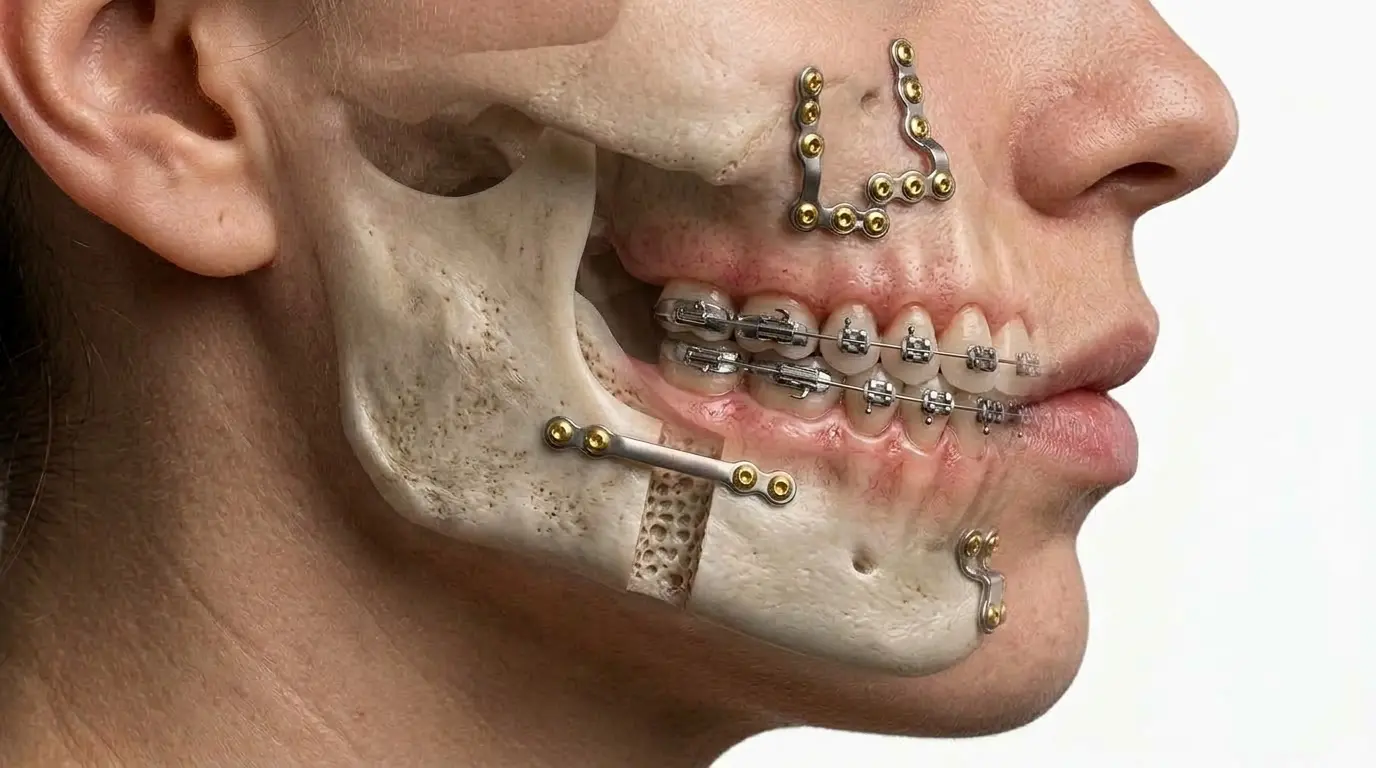
What exactly is maxillomandibular advancement?
It is a surgical procedure that repositions the upper jaw (maxilla) and the lower jaw (mandible) several millimeters forward. As the bones move, the tongue, the soft palate and the throat walls are pulled forward with them. The airway expands simultaneously at all levels.
It is performed in the operating room under general anesthesia, through incisions inside the mouth, leaving no visible scars on the face. The bone segments are stabilized with titanium miniplates and screws. A hospital stay of a few days is typical, followed by several weeks on a soft or pureed diet.
Orthodontics is an integral part of treatment
Orthodontics is not an afterthought: teeth are aligned before surgery so that the arches interlock stably in their new forward position; final bite adjustments are made afterwards. This orthodontic journey spans months.
Who makes the diagnosis and who performs the surgery?
These are two distinct, complementary roles. The sleep study and the comprehensive airway evaluation belong to the sleep ENT specialist. The facial skeletal surgery is performed by oral and maxillofacial surgeons, working closely with an orthodontist.
In clinical practice, the sequence is methodical: first, sleep apnea severity is measured and the anatomical collapse sites are identified; then, if the patient is a suitable candidate, the case is evaluated jointly with maxillofacial surgery and orthodontics. The decision is never made on a single consultation or test.
What clinical results does maxillomandibular advancement achieve?
It achieves the highest response rates of all surgical treatments for obstructive sleep apnea. In a meta-analysis of individual patient data from 518 patients, the apnea-hypopnea index (AHI) dropped by an average of 47.8 events per hour, representing an average reduction of 80.1% [1].
Success is not identical to a cure: most patients improve dramatically, but achieving an AHI of zero is not guaranteed.
Daytime sleepiness also improves significantly: mean Epworth scores decreased from 13.5 to 3.2, and lowest oxygen saturation increased from 70.1% to 87.0% [1]. A broader review of 1,597 patients confirmed mean AHI reductions of 41.9 events/h and daytime sleepiness improvements of 8.7 points [2].
Compared to soft tissue multilevel surgery (palate and tongue base), MMA achieved greater AHI reductions (46.2 vs 24.7 events/h) and higher cure rates (46.3% vs 28.1%), though major complications were slightly higher (3.2% vs 1.1%) [4].
Quality of evidence note: Most of these clinical data stem from patient cohorts rather than sham-controlled trials. Evidence grading systems (GRADE) qualify the global evidence certainty as low/very low despite large, consistent effect sizes [8]. These statistics serve as clinical orientation, not an unconditional promise.
Who is considered for maxillomandibular advancement?
It is indicated in moderate-to-severe sleep apnea when CPAP has failed or cannot be tolerated, and airway imaging/endoscopy confirms obstruction behind the tongue or at multiple levels. Skeletal retrognathia reinforces the indication. It is never a casual first-line choice.
When MMA is NOT indicated:
- Patients who tolerate and use CPAP comfortably without issues.
- Mild, asymptomatic snoring or apnea without physiological impact.
- Severe uncontrolled comorbidities, heavy active smoking, or reluctance to undergo orthodontics.
What are the risks and how does the face change?
Advancing the upper jaw (maxilla) and the lower jaw (mandible) also brings the chin and lower lip forward. Sensory changes to the lower lip and chin are very frequent and must be known in advance.
Nerve sensation (mental nerve):
In a review of 1,597 patients, numbness of the lower face occurred in 83.4% immediately postoperatively, persisted in 66.5% before 12 months, and remained in 32.7% past one year [2]. Serious vascular or life-threatening events were negligible [2].
Hardware removal:
Around 21.9% of patients required a minor procedure later on to remove symptomatic miniplates or screws [2].
Long-term recurrence:
While bone stability is high, sleep apnea can gradually worsen over years if body weight increases: follow-ups past 8 years found mean AHI returning into moderate ranges (from 53.2 to 23.1 events/h) [3]. Ongoing weight management is crucial.
More details on postoperative timelines can be found in the guide on recovery after sleep apnea surgery.
What if my problem is a narrow palate and blocked nose?
Then MMA is probably not the initial answer. Young adults with a high, vaulted palate (ogival palate) and chronic nasal obstruction have an anatomical profile centered on maxillary transverse deficiency. For them, palatal expansion procedures (such as DOME, MARPE, or SARME) widen the floor of the nose.
For full information on maxillary expansion, consult the guide on adult palatal expansion: MARPE, SARME and DOME.
How to choose between CPAP, oral appliance, surgery, implant and MMA?
Treatment selection is based on two pillars: a sleep study confirming apnea severity, and drug-induced sleep endoscopy (DISE) showing precisely how and where the airway collapses.
- Sleep study: Measures AHI and hypoxic burden (explained in AHI and hypoxia guide).
- CPAP trial: Reference initial therapy for all severities.
- If CPAP is not tolerated: Review alternatives (see real CPAP alternatives).
- DISE evaluation: Palate collapse points to pharyngoplasty; tongue collapse to an oral appliance (MAD) or hypoglossal implant; multilevel skeletal collapse with CPAP failure points to MMA.
Frequently Asked Questions
Does maxillomandibular advancement hurt?
It hurts less than most people imagine, partly because the area is numb. The main discomforts are facial swelling, difficulty opening the mouth and being on a liquid or pureed diet for several weeks. Postoperative pain is managed with routine painkillers.
How long is the recovery?
Hospital stay is measured in days and returning to light activities in a few weeks, but the soft diet and residual swelling last longer. Factoring in orthodontics before and after surgery, the full treatment takes months.
Will my face change?
Yes, though the aesthetic change is usually balanced: the chin and lower lip move forward. Most patients report satisfaction with their appearance, though studies note this outcome has not been measured in a standardized way. Simulations and in-depth discussions are essential beforehand.
Will I be able to stop CPAP?
Sometimes yes, sometimes no. In the largest meta-analysis, 85.5% achieved surgical success and 38.5% reached an AHI under 5. Many patients improve substantially without reaching zero; realistic goals are defined before surgery.
Will my lip and chin remain numb permanently?
Most patients recover sensation. Numbness occurs in 83.4% immediately after surgery, drops to 66.5% before one year and remains in 32.7% past one year. This means roughly one in three retains some altered sensation in the long term.
At what age can MMA be performed?
It is considered in adults once facial bone growth has finished. There is no strict upper age limit; general health, dental and periodontal condition matter far more than chronological age.
What if I have reduced bone or thin gums?
Periodontal bone levels and root anatomy must be evaluated carefully with dental 3D imaging (CBCT) before planning orthodontic tooth movement and surgery.
What if I am overweight?
Excess weight does not automatically rule out MMA: patients with BMI of 30 or higher achieve substantial AHI reductions. However, clinical guidelines set the referral threshold for sleep surgery below BMI 40, and recommend evaluating bariatric surgery if BMI is 35 or above.
Does health insurance cover MMA?
Coverage depends on your specific policy and medical indications. When performed for clinically documented obstructive sleep apnea with prior CPAP failure, coverage rules differ from purely cosmetic procedures. You must verify terms with your insurer.
Can sleep apnea return after MMA surgery?
Yes, it can. Long-term follow-up at eight years or more shows that mean AHI can gradually rise back into moderate apnea ranges, especially if weight is gained. Ongoing sleep reviews and weight control remain necessary.
Where is this evaluated?
A comprehensive evaluation begins with an overnight sleep study and upper airway endoscopy. From there, medical and surgical indications are defined, including whether a joint assessment with maxillofacial surgery and orthodontics is warranted. When dynamic airway closure must be visualized, the first step is drug-induced sleep endoscopy (DISE).
Learn about sleep endoscopy (DISE) →Scientific References
- Zaghi S, Holty JE, Certal V, et al. Maxillomandibular Advancement for Treatment of Obstructive Sleep Apnea: A Meta-analysis. JAMA Otolaryngol Head Neck Surg. 2016;142(1):58-66. PMID 26606321
- Walker A, Kassir MF, Sama V, Nguyen SA, Abdelwahab M. Maxillomandibular Advancement Safety and Effectiveness in Obstructive Sleep Apnea: Systematic Review and Meta-Analysis. Otolaryngol Head Neck Surg. 2025;172(4):1142-1154. PMID 39764681
- Camacho M, Noller MW, Del Do M, et al. Long-term Results for Maxillomandibular Advancement to Treat Obstructive Sleep Apnea: A Meta-analysis. Otolaryngol Head Neck Surg. 2019;160(4):580-593. PMID 30598047
- Zhou N, Ho JTF, Huang Z, et al. Maxillomandibular advancement versus multilevel surgery for treatment of obstructive sleep apnea: A systematic review and meta-analysis. Sleep Med Rev. 2021;57:101471. PMID 33831676
- Diemer TJ, Nanu DP, Nguyen SA, Ibrahim B, Meyer TA, Abdelwahab M. Maxillomandibular Advancement for Obstructive Sleep Apnea in Patients With Obesity: A Meta-Analysis. Laryngoscope. 2025;135(2):507-516. PMID 39264209
- Al-Bayyati HHR, Hassing GJ, van der Hoeve EP, Koppendraaier L, de Ruiter MHT. Patient-Reported Outcomes With Focus on Health-Related Quality of Life in Patients With Obstructive Sleep Apnea Treated With Maxillomandibular Advancement Surgery: A Systematic Review and Meta-Analysis. J Oral Maxillofac Surg. 2025;83(5):543-557. PMID 39952285
- Yang J, Tan ML, Ho JTF, et al. Non-sleep related outcomes of maxillomandibular advancement, a systematic review. Sleep Med Rev. 2024;75:101917. PMID 38503113
- Trindade PAK, Nogueira VSN, Weber SAT. Is maxillomandibular advancement an effective treatment for obstructive sleep apnea? Systematic literature review and meta-analysis. Braz J Otorhinolaryngol. 2023;89(3):503-510. PMID 37167845
- Kent D, Stanley J, Aurora RN, et al. Referral of adults with obstructive sleep apnea for surgical consultation: an American Academy of Sleep Medicine clinical practice guideline. J Clin Sleep Med. 2021;17(12):2499-2505. PMID 34351848
- Kent D, Stanley J, Aurora RN, et al. Referral of adults with obstructive sleep apnea for surgical consultation: an American Academy of Sleep Medicine systematic review, meta-analysis, and GRADE assessment. J Clin Sleep Med. 2021;17(12):2507-2531. PMID 34351849
- De Vito A, Carrasco Llatas M, Ravesloot MJ, et al. European position paper on drug-induced sleep endoscopy: 2017 Update. Clin Otolaryngol. 2018;43(6):1541-1552. PMID 30133943