
Adult palatal expansion: MARPE, SARME and DOME in sleep apnea
Revisado por Dr. Iván Méndez-Benegassi Silva · Especialista en Otorrinolaringología y Medicina del Sueño · HM Hospitales, Madrid · Nº Colegiado 282855946
Widening an adult palate is a direct way to expand the nasal floor. There are three ways to do it: with micro-implants without osteotomy (MARPE/MSE), with operating room surgical assistance (SARME/SARPE), or with an intermediate protocol designed specifically for sleep apnea (DOME). They have different scientific evidence and suit different anatomical profiles.
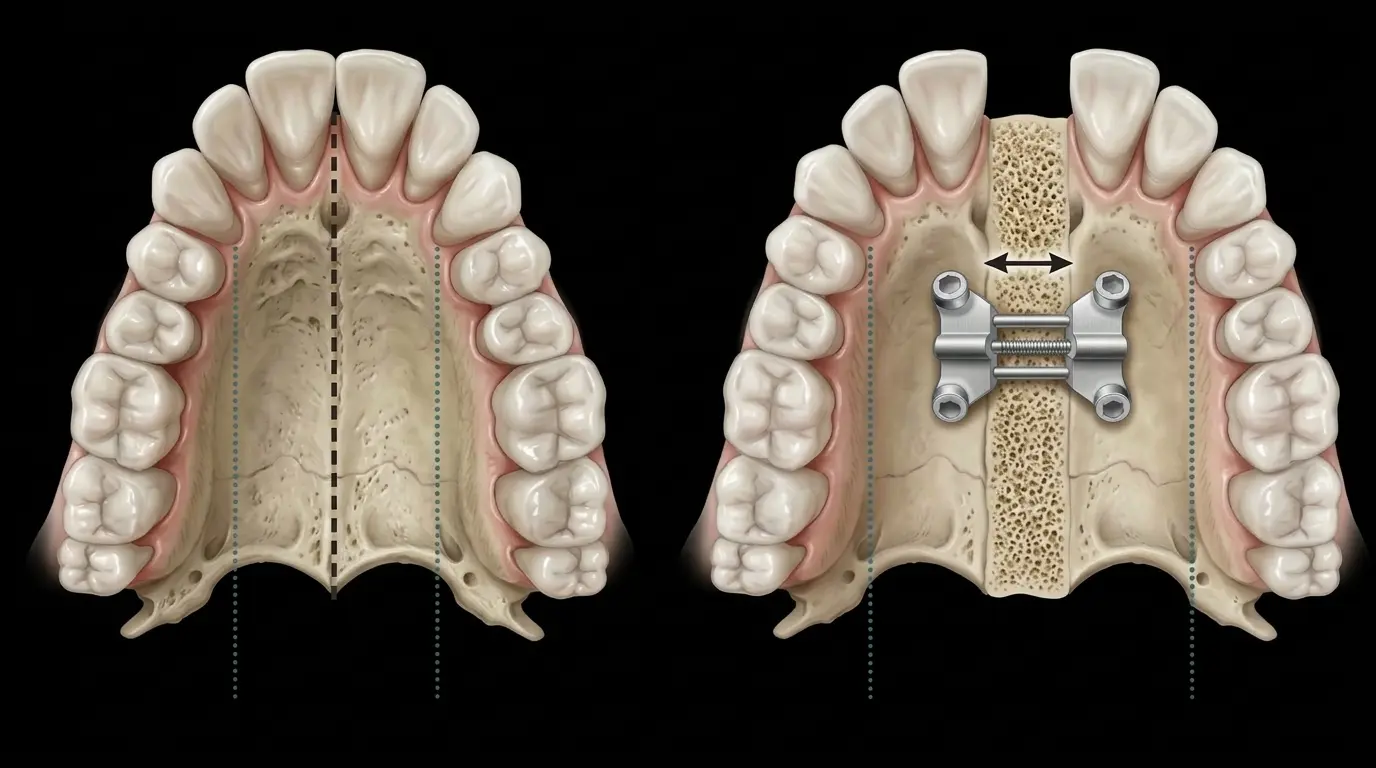
Why is the palate directly connected to the nose?
Because the roof of the mouth is the floor of the nose. It is the exact same bone viewed from two sides: the hard palate. If that bony arch is narrow and high (ogival palate), the nasal airway resting on top of it is structurally constricted.
Nasal airflow restriction:
A narrow nasal floor forces inhaled air through a constricted tube, increasing nasal resistance during sleep.
Tongue space restriction:
A high, vaulted palate prevents the tongue from resting firmly against the oral roof, predisposing it to fall back into the throat.
Why child expanders fail in adults
In children, the midpalatal suture has not fused and yields easily under light dental forces. In adults, the suture progressively interlocks and calcifies with age [1].
When an adult is fitted with a conventional tooth-borne expander, the bone resists and the teeth simply tip outwards. In long-term studies, tooth movement accounted for 43.6% of the expansion measured with conventional appliances [9]. Nearly half of what moves are tipped teeth, not expanded nasal floors.
The three techniques compared
1. MARPE / MSE (Microtornillos sin osteotomía)
An expander anchored into the palatal bone using 4 bicortical miniscrews. Performed in the orthodontic office under local anesthesia without operating room surgery [5].
- Target profile: Late adolescents and young adults with open sutures.
- Limitations: Suture split success drops over age 25-30; high risk of dental tipping if suture fails to separate [10].
2. SARME / SARPE (Expansión asistida quirúrgicamente)
Traditional maxillofacial surgery involving a subtotal Le Fort I osteotomy with or without pterygomaxillary dysjunction under general anesthesia in the OR [12][33].
- Target profile: Severe transverse deficiency (>5 mm) with fully fused suture.
- Evidence note: Developed to fix bites, not primarily for sleep apnea. Systematic reviews note its respiratory benefits are inconsistent [16].
3. DOME (Distracción osteogénica específica para apnea)
Designed at Stanford specifically for sleep apnea patients with high vaulted palates. Combines a mini-implant expander with minimal targeted corticotomies under local/sedation or outpatient anesthesia [4][7].
- Clinical outcomes: In 75 patients, mean AHI dropped from 21.3 to 9.2 (57% reduction), and NOSE nasal obstruction fell from 57.3 to 14.7 [15].
- Context: Series come from specialized academic centers; no published multi-center trials in Spain to date.
What palatal expansion does NOT solve
Widening the palate opens the nose and gains space for the anterior tongue. However, it does not prevent collapse of the retrobasal tongue or epiglottis during sleep.
That is why drug-induced sleep endoscopy (DISE) is mandatory: if dynamic collapse is identified behind the tongue or at the pharyngeal walls, other therapies such as mandibular advancement or targeted surgery may be needed.sleep endoscopy (DISE) is essential to observe where and how collapse occurs.
Frequently Asked Questions
Can an adult palate be widened without surgery?
Only if the midpalatal suture has not yet fully fused, as evaluated with a dental CBCT scan. In late adolescents and selected young adults, miniscrew-assisted expansion (MARPE) can separate the suture without osteotomies. When the suture is fully interlocked, skeletal expansion requires surgical assistance (SARME or DOME); otherwise, the appliance merely tips teeth.
Does widening the palate improve nasal breathing?
Yes. The roof of the mouth is the floor of the nose. Skeletal expansion widens the nasal cavity and internal nasal valve, documented by significant drops in nasal obstruction scores (NOSE questionnaire) across multiple series.
Will expanding the palate cure my sleep apnea?
It rarely acts as a standalone cure in unselected patients. In Yoon’s DOME series of 75 patients with narrow palates, AHI decreased from 21.3 to 9.2 events/h (mean 57% reduction). If dynamic collapse occurs behind the tongue base or at the epiglottis, additional treatments are required.
What is the main difference between SARME and DOME?
SARME was developed in oral and maxillofacial surgery primarily to correct crossbites and dental crowding, utilizing full Le Fort I osteotomies. DOME was designed specifically for sleep apnea patients with high vaulted palates, combining mini-implants with targeted minimal corticotomies and an outpatient protocol.
Is there an age limit for adult palatal expansion?
Chronological age alone does not decide eligibility; suture maturation staging on 3D imaging does. While MARPE success drops past age 25-30, surgically assisted methods (SARME and DOME) can be successfully performed in mature adults.
How long does the entire expansion process take?
Active appliance expansion takes between 3 to 8 weeks. However, complete treatment requires leaving the expander in place for several months for bone consolidation, followed by conventional orthodontics to align the bite.
Clinical evaluation and coordination
The sleep study and upper airway dynamic evaluation are performed by the sleep ENT surgeon. If skeletal transverse deficiency is confirmed, treatment is planned in close coordination with oral and maxillofacial surgery and specialized orthodontics.
Scientific References
- Melsen B. Palatal growth studied on human autopsy material. A histologic microradiographic study. Am J Orthod. 1975;68(1):42-54. PMID 1056077
- Angelieri F, Cevidanes LH, Franchi L, et al. Midpalatal suture maturation: classification method for individual assessment before rapid maxillary expansion. Am J Orthod Dentofacial Orthop. 2013;144(5):759-769. PMID 24182591
- Vinha PP, de Mello-Filho FV. Morphometric palate features and its relationship with OSAS. Braz J Otorhinolaryngol. 2017;83(3):329-335. PMID 27344154
- Yoon A, Guilleminault C, Zaghi S, Liu SY. Distraction Osteogenesis Maxillary Expansion (DOME) for adult obstructive sleep apnea patients with high arched palate. Otolaryngol Head Neck Surg. 2017;157(2):345-348. PMID 28605987
- Cantarella D, Dominguez-Mompell R, Mallya SM, et al. Changes in the midpalatal and pterygopalatine sutures induced by micro-implant-supported skeletal expander. Prog Orthod. 2017;18(1):34. PMID 29052026
- Camacho M, Chang ET, Song SA, et al. Rapid maxillary expansion for pediatric obstructive sleep apnea: A systematic review and meta-analysis. Laryngoscope. 2017;127(7):1712-1719. PMID 27796040
- Liu SY, Guilleminault C, Yoon A. Distraction Osteogenesis Maxillary Expansion (DOME) for Adult Obstructive Sleep Apnea. J Oral Maxillofac Surg. 2020;78(6):877-880. PMID 32194042
- Kapur P, Chourasia S, Sahu S, et al. Efficacy of miniscrew-assisted rapid palatal expansion in late adolescents and adults: A systematic review and meta-analysis. Int Orthod. 2023;21(3):100779. PMID 37257321
- Mehta S, Wang D, Kuo CL, et al. Long-term skeletal and dental effects of miniscrew-assisted rapid palatal expansion in young adults. Angle Orthod. 2021;91(2):195-205. PMID 33301548
- Bhandari R, Lale P, Shetty K, et al. Does age influence skeletal and dentoalveolar effects of MARPE? A systematic review and meta-analysis. Int Orthod. 2024;22(2):100862. PMID 38520849
- Brunetto DP, Moschik CE, Dominguez-Mompell R, et al. Mini-implant assisted rapid palatal expansion (MARPE) in adults: A randomized controlled trial. Angle Orthod. 2022;92(4):441-450. PMID 35421235
- Gisbert-Garzando E, Garcia-Sanz V, Bellot-Arcis C, et al. Maxillary changes in surgically assisted rapid palatal expansion: A CBCT systematic review. J Clin Exp Dent. 2020;12(11):e1084-e1095. PMID 33178430
- Zandi M, Miresmaeili A, Heidari A. Comparison of skeletal and dental stability and complications of three SARPE techniques. J Craniomaxillofac Surg. 2014;42(8):1889-1897. PMID 25017849
- Storti A, Agnoletti G, De Santis R, et al. Piezosurgery versus conventional rotatory instruments in SARPE: A randomized trial. Clin Oral Investig. 2021;25(10):5885-5893. PMID 33721111
- Abdelwahab M, Yoon A, Okland T, et al. Impact of DOME on nasal airflow and sleep architecture. Laryngoscope. 2020;130(9):2280-2286. PMID 31742689
- Pereira MD, Prado GP, Santos HF, et al. Surgical and orthodontic expansion of the maxilla in adults. J Oral Maxillofac Surg. 2018;76(1):150-160. PMID 29077680
- De Vito A, Carrasco Llatas M, Ravesloot MJ, et al. European position paper on drug-induced sleep endoscopy: 2017 Update. Clin Otolaryngol. 2018;43(6):1541-1552. PMID 30133943