
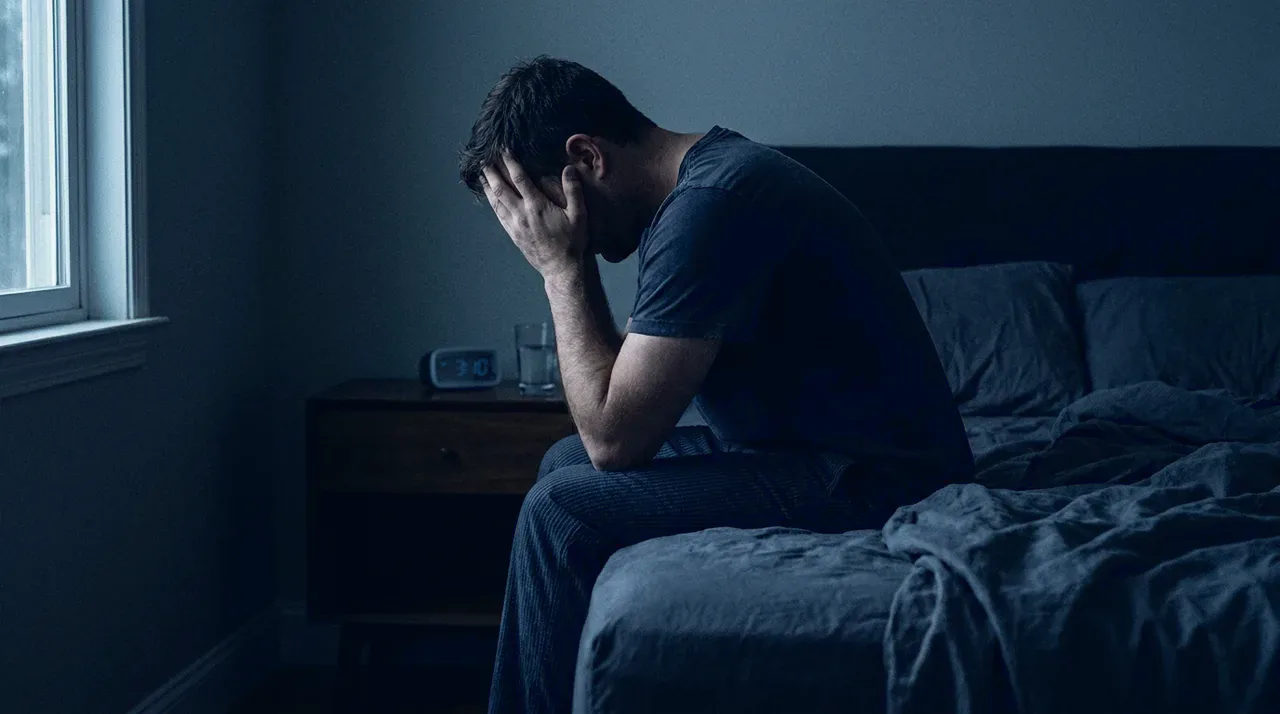
"I cannot sleep, and on top of that they tell me I have apnea." If that sounds like you, you are not facing two separate problems by chance — you very likely have COMISA: comorbid insomnia and obstructive sleep apnea, the two living together. It is far more common than people think, and the two conditions feed each other. The trap is treating only one of them.
The short answer
- ·COMISA = insomnia + obstructive sleep apnea coexisting. It is very common: insomnia is present in roughly 40 to 60% of people with apnea.
- ·They feed each other, so treating only one usually fails. Both have to be treated.
- ·Do not reach for sleeping pills on your own: benzodiazepines can worsen untreated apnea and do not reduce its severity.
- ·For the insomnia, CBT-I (a drug-free behavioural therapy) is the first-line treatment.
Why they feed each other
Obstructive sleep apnea repeatedly narrows or blocks your airway during the night. Each event ends with a tiny awakening to recover your breath, so your sleep gets broken into pieces. After enough nights of that, your brain learns to associate the bed with poor, restless sleep — and that learned tension is the engine of chronic insomnia. Now the two reinforce each other: the apnea wakes you, and the insomnia keeps you awake and frustrated once you are up.
This is not a rare overlap. Insomnia is present in roughly 40 to 60% of people with obstructive sleep apnea, and sleep apnea is found in a large share of people whose main complaint is insomnia. That is why this combination has its own name — COMISA — and its own management approach (Ragnoli et al., 2021).
Two situations deserve special attention. In women, especially from the menopause onwards, apnea often shows up as insomnia or tiredness rather than loud snoring (sleep apnea in women and sleep apnea and menopause). And when mood suffers too, read sleep apnea, depression and mental health. You will find more practical detail in COMISA: when insomnia and sleep apnea go hand in hand.
The honest warning: sleeping pills are not a free pass
The instinct, when you cannot sleep, is to take something. But if you have apnea, the wrong sleeping pill can backfire. Benzodiazepines and similar sedatives relax the throat muscles and raise the threshold you need to wake up and breathe — so the apnea events can last longer and your oxygen can drop more before your body reacts. A 2024 systematic review and meta-analysis (Messineo, Sands and colleagues) confirmed the nuance: hypnotics do raise the arousal threshold (by about 2.7 cm H₂O), but they did NOT meaningfully reduce apnea severity (apnea-hypopnea index change −1.4 events/hour, not significant). The authors concluded that hypnotics should not be used as a treatment for apnea.
The practical message is simple: do not start a sleeping pill on your own if you snore heavily or might have apnea. If a medicine is genuinely needed, it has to be chosen by a doctor who already knows the state of your breathing.
What actually works: treat both, the right way
For the insomnia: CBT-I first
- CBT-I (cognitive behavioural therapy for insomnia) is a structured, drug-free programme — it retrains your sleep instead of sedating it.
- It works even when apnea is present, whether the apnea is treated or not (Sweetman et al., 2023).
- Bonus: by calming the insomnia first, it can make CPAP easier to accept and use.
For the apnea: treat the airway
- CPAP, an oral appliance, or surgery — chosen for your anatomy and severity.
- The apnea has to be treated on its own merits; the insomnia therapy does not fix the breathing.
- The two run in parallel — that is the COMISA approach, not "one then maybe the other".
And if a sleep medicine really is needed?
Sometimes a medicine is still warranted alongside the behavioural work. In that case the newer dual orexin receptor antagonists — daridorexant is the best-known — seem to be a gentler choice for the breathing than classic sleeping pills. A 2025 systematic review and meta-analysis (Yeh et al.) found these drugs did not increase the apnea-hypopnea index or worsen night-time oxygen levels in people with apnea, while still improving sleep. Important caveats: this evidence is mainly in mild-to-moderate apnea, and a medicine never replaces treating the apnea itself. It is always a decision for your doctor, not a self-prescription.
The honest bottom line
If you cannot sleep and you also have apnea, the answer is not "a stronger pill". It is to recognise that you have two problems that feed each other and to treat both — usually CBT-I for the insomnia alongside CPAP, an oral appliance or surgery for the apnea. Treating only the apnea can leave the insomnia (and a poorly tolerated CPAP); treating only the insomnia leaves the apnea and its cardiovascular risk untouched. The starting point is a proper assessment that looks at both your sleep and your breathing.
References: Ragnoli et al., Comorbid Insomnia and Obstructive Sleep Apnea (COMISA): Current Concepts of Patient Management (International Journal of Environmental Research and Public Health, 2021); Messineo, Sands, Labarca et al., Hypnotics on Obstructive Sleep Apnea Severity and Endotypes: A Systematic Review and Meta-Analysis (American Journal of Respiratory and Critical Care Medicine, 2024); Sweetman et al., The effect of cognitive behavioural therapy for insomnia in people with comorbid insomnia and sleep apnoea: a systematic review and meta-analysis (Journal of Sleep Research, 2023); Yeh et al., The efficacy and safety of dual orexin receptor antagonists in obstructive sleep apnea: a systematic review and meta-analysis of randomised controlled trials (Journal of Sleep Research, 2025).
Cannot sleep and suspect apnea too? The first step is to assess both your sleep and your breathing — not to add another pill.
Frequently asked questions
I cannot sleep and I have sleep apnea — what is going on?
You probably have COMISA: comorbid insomnia and obstructive sleep apnea, the two coexisting at the same time. It is very common — insomnia is present in roughly 40 to 60% of people with sleep apnea — and the two feed each other: the apnea fragments your sleep and wakes you, while the insomnia keeps you lying awake and on edge. The key point is that treating only one of them usually fails; both have to be addressed.
Are sleeping pills safe if I have sleep apnea?
Not automatically, and this matters. Benzodiazepines and some sleeping pills can relax the throat muscles and blunt the reflex that wakes you to breathe, which can make untreated apnea worse. A 2024 meta-analysis (Messineo, Sands and colleagues) found that hypnotics did raise the arousal threshold but did NOT meaningfully reduce apnea severity, so they should not be used as a treatment for apnea. Never start a sleeping pill on your own if you snore heavily or may have apnea — it has to be a medical decision after the apnea is assessed.
What is the first-line treatment for the insomnia in COMISA?
For the insomnia, the first-line treatment is CBT-I (cognitive behavioural therapy for insomnia) — a structured, drug-free programme that retrains your sleep, not a pill. A 2023 systematic review and meta-analysis (Sweetman and colleagues) showed CBT-I improves insomnia even when sleep apnea is present, whether the apnea is treated or not. It is preferred precisely because it does not depress breathing and can also make CPAP easier to accept.
Do I have to treat both the insomnia and the apnea?
Yes. That is the whole point of recognising COMISA. If you only treat the apnea (for example with CPAP) and leave the insomnia, the insomnia often makes the CPAP harder to tolerate; if you only treat the insomnia and leave the apnea, the apnea keeps breaking your sleep and carries its own cardiovascular risk. The modern approach is to treat both in parallel, usually CBT-I for the insomnia alongside CPAP, an oral appliance or surgery for the apnea.
Is there a sleep medicine that is safer for the breathing? (daridorexant)
When a medicine for insomnia is genuinely needed, the newer dual orexin receptor antagonists (such as daridorexant) appear to have less effect on breathing than classic sleeping pills. A 2025 systematic review and meta-analysis (Yeh and colleagues) found these drugs did not increase the apnea-hypopnea index or worsen night-time oxygen levels in people with apnea, while improving sleep. They are an option, but still a medical decision and not a substitute for treating the apnea itself.
Related: is snoring dangerous? · CPAP alternatives
Take the next step in your evaluation
Dr. Méndez-Benegassi uses your data to answer your message. Email is not end-to-end encrypted: it can be read on the servers it passes through. Do not send medical reports or health data that way.
Data controller: Dr. Iván Méndez-Benegassi Silva, ENT physician.
Purpose: To read and answer your message. Tell us only what is essential; the rest is covered in the consultation.
Legal basis: The healthcare you are requesting (Art. 9.2.h GDPR).
Recipients: Your data is not shared with third parties; only the technical providers needed are involved, as data processors.
Your rights: Access, rectify or erase your data, object, restrict its processing and request its portability by writing to contacto@ronquidoyapneas.com. You may also lodge a complaint with the Spanish Data Protection Agency.
Full details in the Privacy policy.