
Home Sleep Test vs. In-Lab Polysomnography: Which is Best for You?
Reviewed by Dr. Iván Méndez-Benegassi Silva
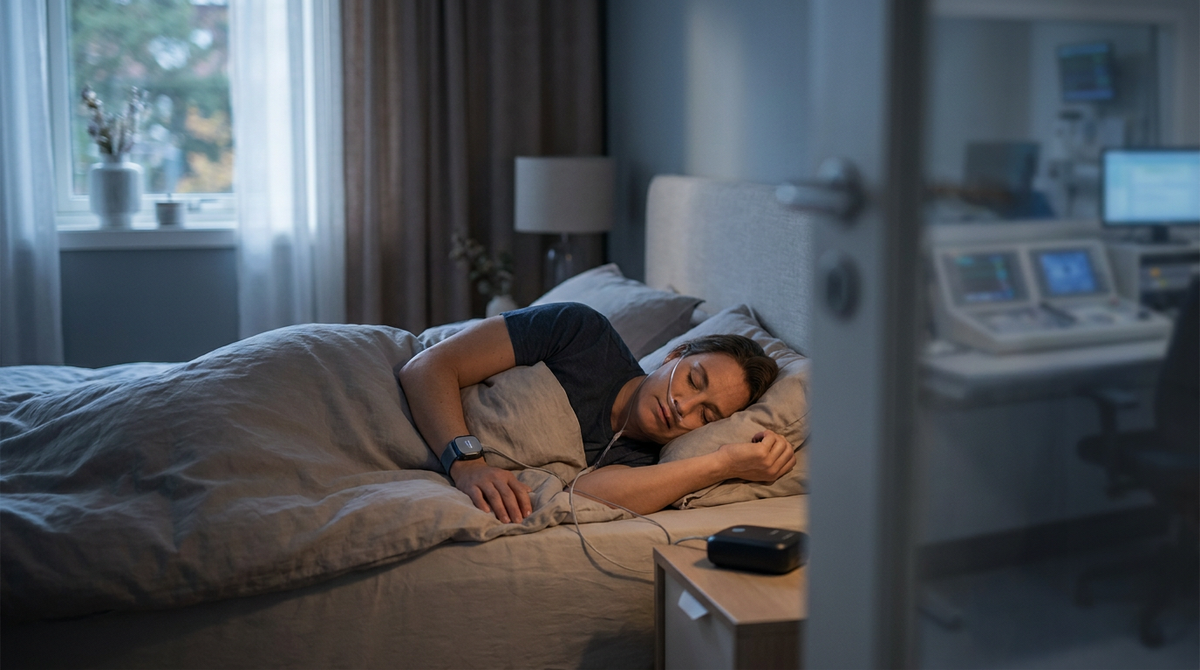
We explore the differences between home sleep tests and in-lab polysomnography for diagnosing sleep apnea, highlighting their advantages and when each is most appropriate. This guide will help you understand the available options, but it does not replace a personalized medical evaluation.
Obstructive sleep apnea (OSA) is a common disorder affecting millions of people, and accurate diagnosis is crucial for effective treatment. Different methods exist to evaluate sleep quality and detect OSA, the most well-known being in-lab polysomnography and home sleep apnea tests.
In-Lab Polysomnography (PSG): The Gold Standard
Polysomnography (PSG) performed in a sleep laboratory is considered the gold standard for diagnosing sleep disorders. During this test, multiple physiological variables are monitored while the patient sleeps in a controlled environment. This includes brain activity (electroencephalogram), eye movements, muscle tone, heart rate, respiratory effort, airflow, blood oxygen levels, and leg movements.
PSG offers a very comprehensive picture of what happens during sleep, allowing for the identification of not only the presence of apneas and hypopneas but also other sleep disorders such as insomnia, restless legs syndrome, or narcolepsy. Its main advantage is supervision by specialized personnel and the ability to record a wide range of data with high precision. However, it can be less comfortable and more expensive than other options.
Home Sleep Apnea Tests (HSAT): Convenience and Accessibility
Home Sleep Apnea Tests (HSAT) or home respiratory polygraphy have gained popularity due to their convenience and accessibility. The patient takes the equipment home and sleeps in their own bed, which can result in more natural sleep. These devices typically record fewer parameters than in-lab PSG, focusing mainly on breathing, thoracoabdominal effort, and oxygenation (4-7 channels).
HSATs are a valid and effective option for diagnosing OSA in adults, especially in those with high clinical suspicion. A 2014 study found that HSAT showed excellent reliability and good agreement with in-lab PSG for the apnea-hypopnea index (AHI) [3]. Furthermore, 74.4% of patients preferred the home test [3].
When to Choose Each Option?
The choice between a home test and an in-lab PSG should be determined by an expert sleep medicine professional, based on the patient's clinical picture, characteristics, comorbidities, and the results of preliminary questionnaires.
In-lab PSG is generally preferred in cases such as:
- Suspicion of other sleep disorders in addition to OSA.
- Complex medical conditions or significant comorbidities.
- When home test results are inconclusive.
- In children, where PSG remains the gold standard [1].
Home tests are suitable for:
- Adults with high clinical suspicion of OSA without other complex comorbidities.
- Patients seeking greater comfort and a more familiar sleep environment.
- Situations where access to a sleep laboratory is limited.
Advances in Pediatric Evaluation
Traditionally, in-lab PSG has been the standard for diagnosing OSA in children, affecting 1-5% of the pediatric population [1]. However, logistical and emotional barriers associated with these tests have driven the search for alternatives. An ongoing randomized clinical trial, expected to conclude in 2025, is comparing HSAT with in-lab PSG for the diagnosis of OSA in children aged 5-12 years, including those with Down syndrome [1]. This study aims to evaluate the diagnostic accuracy of HSAT and its acceptability, which could expand diagnostic options for families in the future.
The Future: Beyond a Single Night
Current research also explores OSA evaluation beyond a single night of sleep. A randomized controlled trial in 2026 is evaluating the diagnostic accuracy and cost-effectiveness of multi-night in-home devices versus conventional single-night PSG in adults [2]. This study aims to determine if simplified and accessible multi-night testing can improve the accuracy and cost-effectiveness of OSA diagnosis in routine care [2].
The Importance of Drug-Induced Sleep Endoscopy (DISE)
Once OSA is diagnosed, especially if surgical intervention is considered, Drug-Induced Sleep Endoscopy (DISE) is an essential complementary tool. While PSG or polygraphy measure the severity of apnea, DISE allows the surgeon to see exactly where and how the upper airway collapses during sedation-induced sleep. This test is painless and minimally invasive, performed in a hospital setting under anesthetic supervision. DISE is crucial for planning personalized treatments, as it locates the exact point of closure and the pattern of collapse. It does not always lead to surgery; it can also confirm that other therapies like a mandibular advancement splint or CPAP are sufficient, or even that simply sleeping on one's side is enough.
Frequently asked questions
What is the main difference between in-lab polysomnography and a home sleep test?
In-lab polysomnography (PSG) monitors a wider range of physiological variables under specialized supervision, being the gold standard. Home sleep tests (HSAT) are more convenient and record fewer parameters, focusing on breathing and oxygenation, suitable for cases with high suspicion of OSA without other complications.
Is the home sleep test suitable for children?
Currently, in-lab polysomnography remains the gold standard for diagnosing sleep apnea in children. However, studies are underway to validate the effectiveness of home sleep tests in the pediatric population, which could expand options in the future.
What is Drug-Induced Sleep Endoscopy (DISE) and when is it used?
Drug-Induced Sleep Endoscopy (DISE) is a complementary test that allows the surgeon to directly visualize where and how the upper airway collapses during sedation-induced sleep. It is used to plan personalized treatments, especially before considering surgical intervention for sleep apnea.
References
- Randomised trial of home sleep apnoea testing compared to in-lab polysomnography for the evaluation of obstructive sleep apnoea in children: rationale and study protocol. (2025)
- ACCESS-OSA: a randomized controlled trial for accurate, accessible, and cost-effective screening solutions for obstructive sleep apnoea: study protocol. (2026)
- Home-based diagnosis of obstructive sleep apnea by polysomnography type 2: accuracy, reliability, and feasibility. (2014)
Informational content reviewed by Dr. Méndez-Benegassi. It does not replace a medical consultation.